
When I began studying the rapid convergence of artificial intelligence, robotics, and decentralized infrastructure, I noticed something interesting. Most discussions about AI today revolve around software—chatbots, generative models, automation tools, and digital assistants. But the real transformation that seems to be approaching is not just digital. It is physical.
Artificial intelligence is slowly moving out of data centers and into the real world through machines. Robots are starting to perform tasks that once required human intelligence, from warehouse logistics to infrastructure inspection and even healthcare assistance. As I explored this shift more deeply, I came across the work of Fabric Foundation, a project that appears to be thinking about this transformation at a completely different level.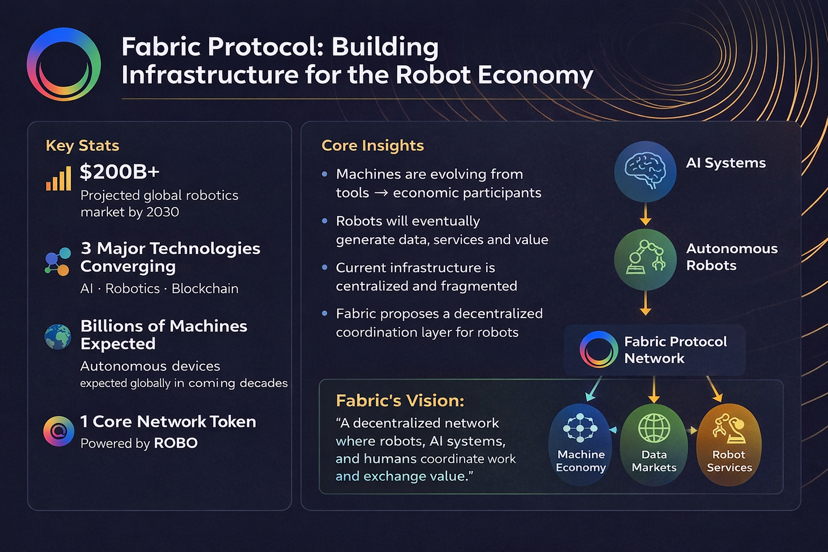
What fascinated me most about Fabric was not simply the presence of a token or a blockchain network. Instead, what stood out was the broader question the project is trying to answer: how will intelligent machines participate in the global economy?
Today, robots exist almost entirely within closed environments. A warehouse robot works within a single company’s infrastructure. A delivery robot operates inside a tightly controlled software ecosystem. Even the most advanced robotic systems rely heavily on centralized management and human oversight. Machines may be performing tasks autonomously, but economically they remain invisible.
The deeper I looked into Fabric’s vision, the more I realized that the project is attempting to build something far more fundamental than an application or platform. It is trying to create an economic infrastructure layer for machines themselves.
In many ways, this idea mirrors the early days of the internet. Before social networks, streaming platforms, or digital marketplaces existed, engineers first had to build communication protocols that allowed computers to connect and exchange information reliably. Those early protocols eventually enabled entire digital economies.
Fabric seems to be exploring a similar idea for robotics and machine intelligence.
Instead of asking how robots can be controlled more efficiently, the project asks a more radical question: what if robots could coordinate and transact autonomously through decentralized networks?
To understand why this matters, it helps to look at the scale of change happening in robotics today. Industry research suggests that the global robotics market could exceed $200 billion within the next decade, driven by automation across manufacturing, logistics, agriculture, and healthcare. Companies such as Tesla, Amazon, and Boston Dynamics are investing heavily in autonomous systems capable of operating with increasing levels of independence.
Despite these technological advances, the economic systems surrounding robots remain surprisingly primitive. Machines cannot hold digital identities in a universal sense. They cannot easily exchange value with other machines. They cannot participate in open marketplaces where services are discovered and traded.
Fabric proposes to solve this structural gap by creating a decentralized coordination layer where machines can interact economically. In the ecosystem envisioned by the project, robots could potentially have persistent digital identities, cryptographic wallets, and access to decentralized marketplaces where they exchange services and data.
This concept introduces a fascinating shift in how we think about machines. Instead of viewing robots purely as tools owned by corporations, we begin to see them as operational agents within a broader economic network.
Within this ecosystem, the network is powered by the ROBO token, which functions as the economic unit of the system. The token is intended to facilitate payments, incentives, and governance across the network. Developers who contribute algorithms, infrastructure providers who supply computational resources, and robotic systems that generate useful data could all interact within the same economic framework.
What I find particularly interesting about this model is the idea that physical activity performed by machines could eventually be verified and rewarded within a decentralized network. Fabric has explored concepts such as rewarding real-world robotic work, where machines performing valuable tasks contribute to the network and receive incentives in return.
This raises a fascinating possibility. Imagine environmental monitoring robots collecting climate data across multiple continents. Instead of a single organization controlling that network, machines could contribute their data to an open system where researchers, governments, and companies access the information. The robots providing that data could be rewarded automatically through token-based incentives.
Such systems could dramatically expand the scale of machine collaboration.
From my perspective, the biggest implication of this idea is that it shifts the conversation about robotics from hardware alone to infrastructure and coordination. Robots are becoming increasingly capable, but their ability to collaborate across networks remains limited. A decentralized infrastructure layer could potentially unlock entirely new types of interactions between machines.
However, while the vision is compelling, it also comes with enormous challenges.
The first challenge is technical complexity. Coordinating digital transactions between computers is relatively straightforward. Coordinating real-world robotic activity is significantly more difficult. Physical environments introduce unpredictability, sensor errors, and safety concerns that software systems rarely encounter.
Another challenge lies in industry adoption. For a decentralized robotics network to succeed, it must attract developers, hardware manufacturers, and data providers who are willing to build on top of open infrastructure. Convincing companies that currently operate within closed ecosystems to adopt shared protocols will require strong incentives and clear advantages.
Security also becomes a critical factor. Machines interacting within economic networks must operate safely and reliably. Ensuring that decentralized systems can maintain strict safety standards will be essential, especially when robots perform tasks in public environments.
Despite these obstacles, the broader direction of technological progress suggests that the ideas Fabric is exploring may become increasingly relevant. Artificial intelligence continues to advance rapidly. Robotics hardware is becoming more affordable and capable. Decentralized networks are improving in scalability and efficiency.
When multiple technological revolutions intersect, entirely new industries often emerge.
The smartphone ecosystem appeared when mobile hardware, software platforms, and wireless connectivity matured simultaneously. Cloud computing became dominant once distributed infrastructure and internet bandwidth reached critical scale.
Today, we may be witnessing a similar convergence between artificial intelligence, robotics, and decentralized infrastructure.
Projects like Fabric represent early attempts to design the systems that could support this new era.
What fascinates me most about studying Fabric is not simply the technology or the tokenomics, but the broader question it encourages us to consider. If intelligent machines become widespread participants in economic activity, we will need entirely new models for identity, trust, and value exchange.
The infrastructure supporting those systems will shape how humans and machines interact for decades to come.
Whether Fabric ultimately becomes the dominant platform for such coordination or simply one of the early experiments pushing the idea forward, its vision highlights something profound.
We are approaching a moment where machines may no longer be passive tools within economic systems. Instead, they could become active participants within them.
And if that transition truly begins, the networks that enable machine economies may become just as important as the networks that once connected the internet.
@Fabric Foundation #ROBO $ROBO