
Artificial intelligence has advanced rapidly in recent years, but one major challenge still remains: reliability. AI can generate insights, perform complex tasks, and even assist in decision-making. However, it can also produce errors, hallucinations, or biased outputs. This raises an important question — how much can we really trust AI, especially in situations where accuracy is critical?
This is the problem that Mira Network and its token MIRA aim to solve.
The core idea behind Mira Network is simple: AI outputs should not just be accepted — they should be verified. Instead of relying on a single AI model to generate answers, the network brings together multiple AI models. When a claim or result is produced, these different models evaluate it independently. Their assessments are then combined to form a consensus on whether the information is reliable or not.
Blockchain also plays an important role in this system. Verification results are recorded on-chain, creating a transparent and traceable record of how each conclusion was reached. In addition, economic incentives encourage participants to validate claims honestly, while the decentralized structure removes the need for a single controlling authority.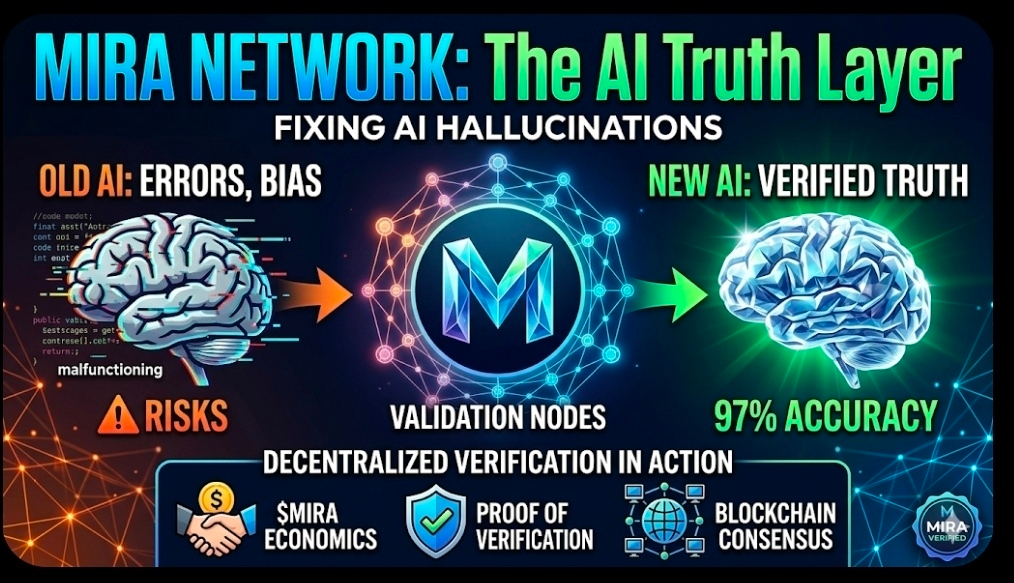
Another key feature of Mira Network is interoperability. Verified results can potentially be used across different platforms, allowing developers to build applications that rely on trusted and validated AI outputs.
In the bigger picture, Mira Network is trying to shift the focus of AI from simply being powerful to being trustworthy. As AI continues to expand into critical areas, systems that verify and validate its outputs could become an essential layer of the future AI ecosystem.