
Lately, I’ve developed a little routine whenever a new AI token starts creating buzz. I don’t immediately hop onto Twitter to see what everyone’s excited about. Instead, I start with the basics: I check the price page, the unlock schedule, and the number of holders. After that, I ask myself a question that’s a bit uncomfortable, but honestly, far more important: once the initial hype dies down, will people actually keep using this project?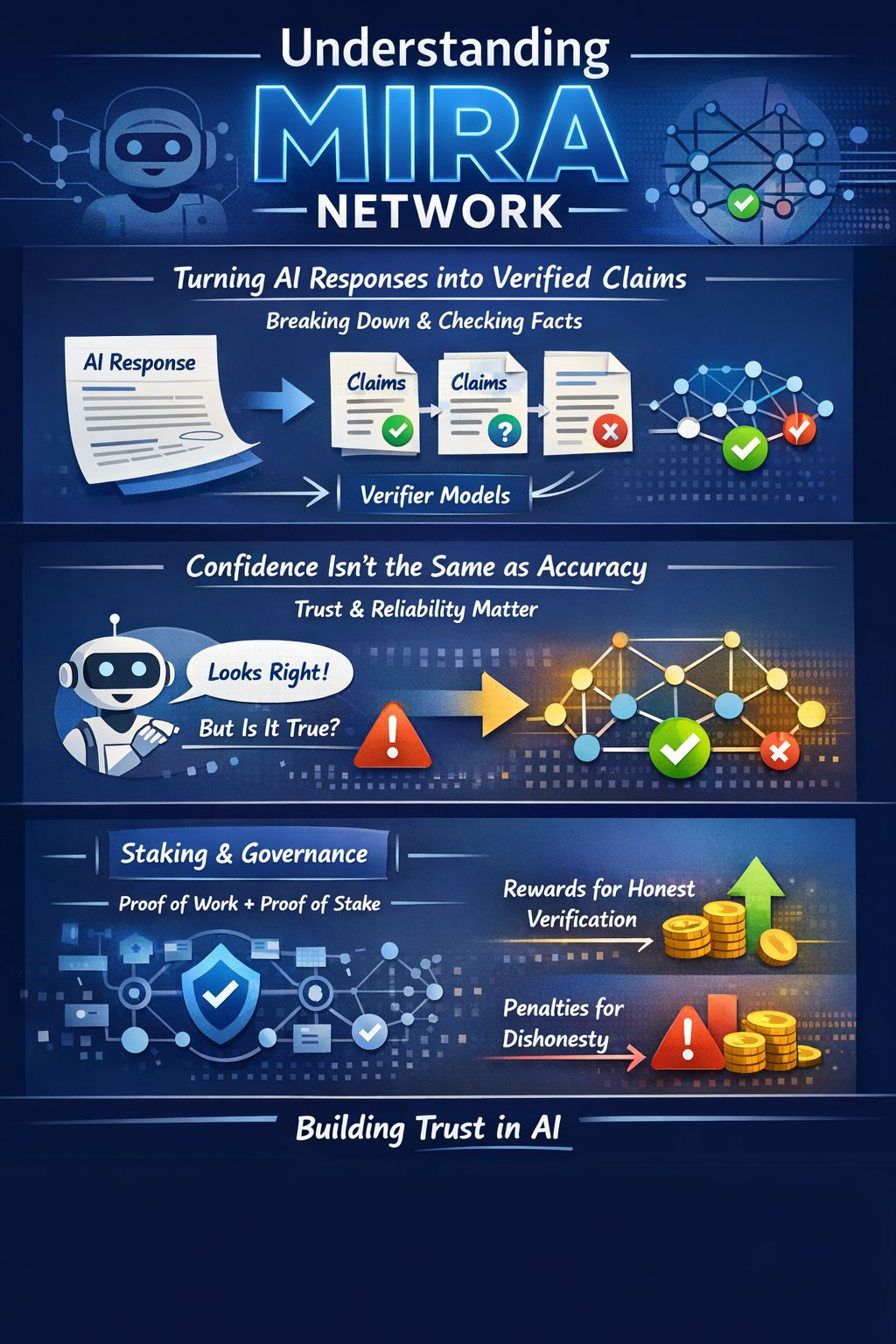
That question hit me hard when I started looking at Mira Network. It’s not just that AI is trendy or fun to play with. The bigger picture Mira is focusing on is trust. AI still has a big problem here—its outputs can look convincing, but can you really verify them? Mira is trying to make AI responses something that can actually be checked, not just something that “sounds right.”
Reading the whitepaper, the idea became pretty clear to me. Mira takes an AI’s response and breaks it down into individual claims. Each claim can then be checked independently, and a set of verifier models run a decentralized consensus to decide if those claims hold up. Compared to most AI projects, which often feel more like hype than anything else, this approach is focused and precise. From an investor or trader’s perspective, that focus is exactly where the opportunity and the risk lie—the concept is strong, but its success really depends on whether users care about trust in AI outputs.
And this matters because so much of the AI space treats confidence and correctness as the same thing. They’re not. I’ve spent hours using language models for trading research, coding, or operational work, and I’ve seen it firsthand: the answer can look perfect and convincing, and then suddenly you realize there’s a hidden mistake that could create real problems.
That gap—between sounding right and actually being right—is exactly what Mira is tackling. The whitepaper doesn’t overcomplicate it: the real barrier to AI handling serious, high-impact tasks isn’t capability alone, it’s reliability. Mira doesn’t try to solve this with a single “better” model. Instead, it uses multiple models to review and verify the same claims, making it harder for mistakes to slip through.
I like to think of it like checking a trade idea with multiple desks. Each desk has its own perspective and might catch things the others miss. It’s not perfect, but it increases the odds of spotting weak assumptions or outright errors before anything goes live.
From a market perspective, I’ve started looking at MIRA differently than most people look at AI tokens. It doesn’t feel like just another AI coin. It feels like an attempt to create an actual economic layer around verification itself. And it’s not just marketing fluff—the MiCA filing talks about staking, governance, and paying for API usage. The whitepaper explains a hybrid Proof of Work and Proof of Stake system where node operators earn rewards for honest verification and face penalties if they cheat. That’s the heart of the whole thing: verification only has value if dishonesty is costly and honest participation pays off.
One thing I found particularly interesting is @Mira - Trust Layer of AI that verification isn’t free—it has friction and cost. Mira’s early whitepaper even points out that in the first stages of decentralization, duplicating verification increases costs. It’s a necessary trade-off to catch lazy or malicious nodes, but it’s also a sign that they’re serious about building something that actually works.$MIRA #Mira