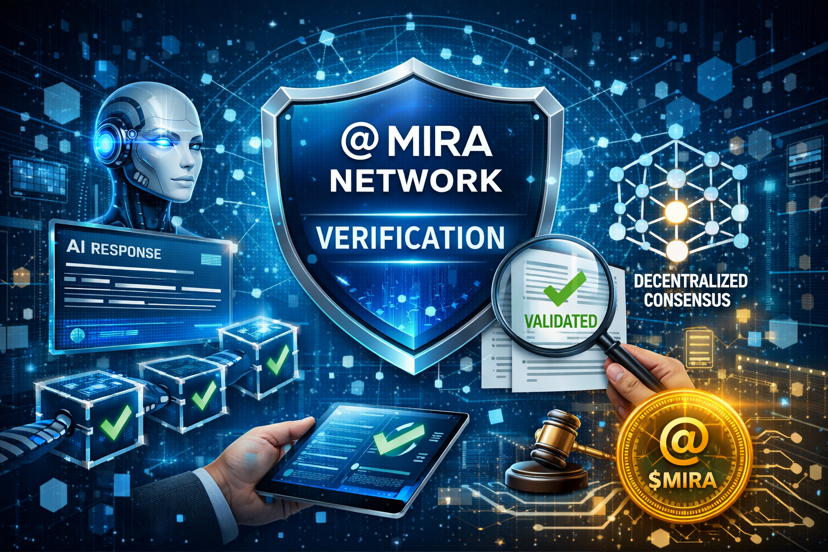
We are living in a moment where AI can write, summarize, recommend, predict, and explain at a speed that still feels unreal. Every week there is a new model, a new benchmark, a new promise that machines are getting closer to thinking well enough to support serious decisions. On the surface, it looks like progress. And in many ways, it is. But the deeper I think about it, the more I feel that intelligence alone is not the real finish line.
Trust is.
That is why @Mira stands out to me in a way that many other AI projects do not.
Not because it simply adds blockchain to AI. That would be too shallow a reading. What interests me is the deeper idea underneath it. Mira seems to be built around a question that I think will define the next stage of artificial intelligence: how do we stop treating AI output like something we either blindly accept or constantly doubt, and start turning it into something that can actually be checked?
That shift feels important.
Most people already understand that AI can hallucinate. The word has become common enough that it no longer surprises anyone. A model says something false, but says it in a polished and convincing way. Bias is another issue people mention often, and rightly so. But I think the larger problem is not any single error. The larger problem is the structure around the error.
Right now, when AI gives an answer, we usually deal with it in one of two ways. We trust it because it sounds good, or we verify it ourselves through extra effort. In other words, the burden still falls on the human. The machine may be fast, but the responsibility for truth remains manual. That is not a stable model for the future.
If AI is going to move into places where mistakes carry real consequences, then “probably correct” is not enough. Healthcare cannot run on polished guessing. Finance cannot rely on elegant uncertainty. Legal systems, research workflows, public infrastructure, autonomous agents, none of these areas can afford a foundation built on output that sounds right but may not be right.
This is where my view of Mira becomes more than technical.
do not see it as just a verification protocol. I see it as an attempt to redesign the social contract around machine intelligence.
Instead of asking users to trust a single system because it is advanced, Mira appears to push toward a process where claims are separated, examined, and validated across a broader network. That idea feels much healthier to me than the model the AI world has drifted toward, where bigger systems are treated as more trustworthy simply because they are more powerful.
Power is not proof. Scale is not proof. Confidence is not proof. Verification is proof.
And what I find compelling is that Mira seems to understand this at the architectural level. The concept of breaking complex AI output into smaller verifiable claims makes a lot of sense to me because truth is often easier to test in pieces than as one polished whole. A long answer can feel persuasive while still hiding weak assumptions inside it. But once that answer is divided into checkable parts, the conversation changes. It becomes less about presentation and more about evidence.
That is a meaningful change in philosophy.
I also think there is something powerful in the ideaof distributing validation across independent models rather than concentrating authority in one central system. Whether we are talking about institutions, algorithms, or networks, centralized trust always creates fragility. When one source becomes the sole judge of correctness, everyone downstream inherits its blind spots. A distributed model does not magically remove error, but it changes the way error is handled. It becomes contestable. It becomes visible. It becomes part of a process rather than a hidden flaw inside a sealed box.
That matters more than hype cycles usually allow us to say.
Too much of the AI conversation still revolves around capability. What can the model do? How fast can it do it? How cheap can it become? Those are useful questions, but they are incomplete. The harder and more necessary question is this: when the model gives us an answer, what makes that answer dependable?
For me, Mira speaks directly to that gap.
And maybe that is why it feels more relevant than a lot of projects that only focus on output generation. We already have enough systems that can produce language. We already have enough tools that can impress people in demos. What we do not yet have enough of are systems designed to make machine-generated information hold up under pressure.
That is the layer I think the industry has been missing.
I can imagine a future where AI is everywhere, but I can also imagine two very different versions of that future. In one version, people become increasingly overwhelmed, constantly second-guessing the systems they depend on. In the other, AI becomes more usable because reliability is built into the process rather than treated as an afterthought. The difference between those futures may not come from who builds the smartest model. It may come from who builds the best framework for checking whether smart output deserves trust in the first place.
That is why I think Mira’s direction is worth paying attention to.
Not because it promises perfection. I do not think any serious person should expect perfection from AI or from the systems built around it. But I do think there is enormous value in moving from unverifiable intelligence toward accountable intelligence. That move feels mature. It feels necessary. And honestly, it feels overdue.
What I like most is that this idea respects the seriousness of the problem. It does not pretend that hallucinations and bias are just minor bugs that will disappear with better marketing or larger datasets. It treats reliability as infrastructure. That is the right instinct.
To me, that is the real significance of $MIRA.
It is not just attached to a narrative about AI growth. It is tied to a much more important conversation about whether intelligence can become trustworthy enough to support real-world autonomy. That is a stronger foundation than simple excitement. Hype fades quickly. Infrastructure stays relevant longer.
So when I think about Mira, I do not think first about token speculation or branding. I think about a missing discipline in the AI world. I think about the difference between an answer and a verified claim. I think about how many systems today still ask for faith when they should be offering proof.
And I think that the projects worth watching are the ones trying to close that gap.
Mira, at least from the way I see it, is not chasing the loudest part of the AI story.
It is working on the part that may matter most. @Mira - Trust Layer of AI $MIRA #Mira