
I have a habit that probably annoys people who want clean buy signals. When a token is quietly sitting below all its moving averages with RSI near 42 and nobody is talking about it, I do not close the tab. I start reading the whitepaper again. Not because suppressed price is automatically interesting — most suppressed tokens deserve exactly the price they have — but because infrastructure projects have a specific window where the chart and the actual construction work are completely disconnected from each other, and that window is where the useful analysis lives. MIRA is sitting in that window right now. The price is $0.0827. Binance Square just launched a 250,000 MIRA token campaign. Volume on the 4H is thin. None of that tells you anything meaningful about whether what Mira Network is building has a real future. For that you have to go somewhere else entirely.
The project's central claim is that AI has a trust problem and that the trust problem is structural, not temporary. Not fixable by training a better model. Not solved by adding more parameters. The problem is that AI systems produce confident outputs without any standardized, independent, verifiable mechanism for proving those outputs are accurate. That gap matters more the further AI moves into consequential decisions — medical assessments, legal analysis, financial modeling, autonomous agents executing on-chain. In those contexts, a fluent wrong answer is not just unhelpful. It carries liability. And right now the industry has no receipt for any of it.
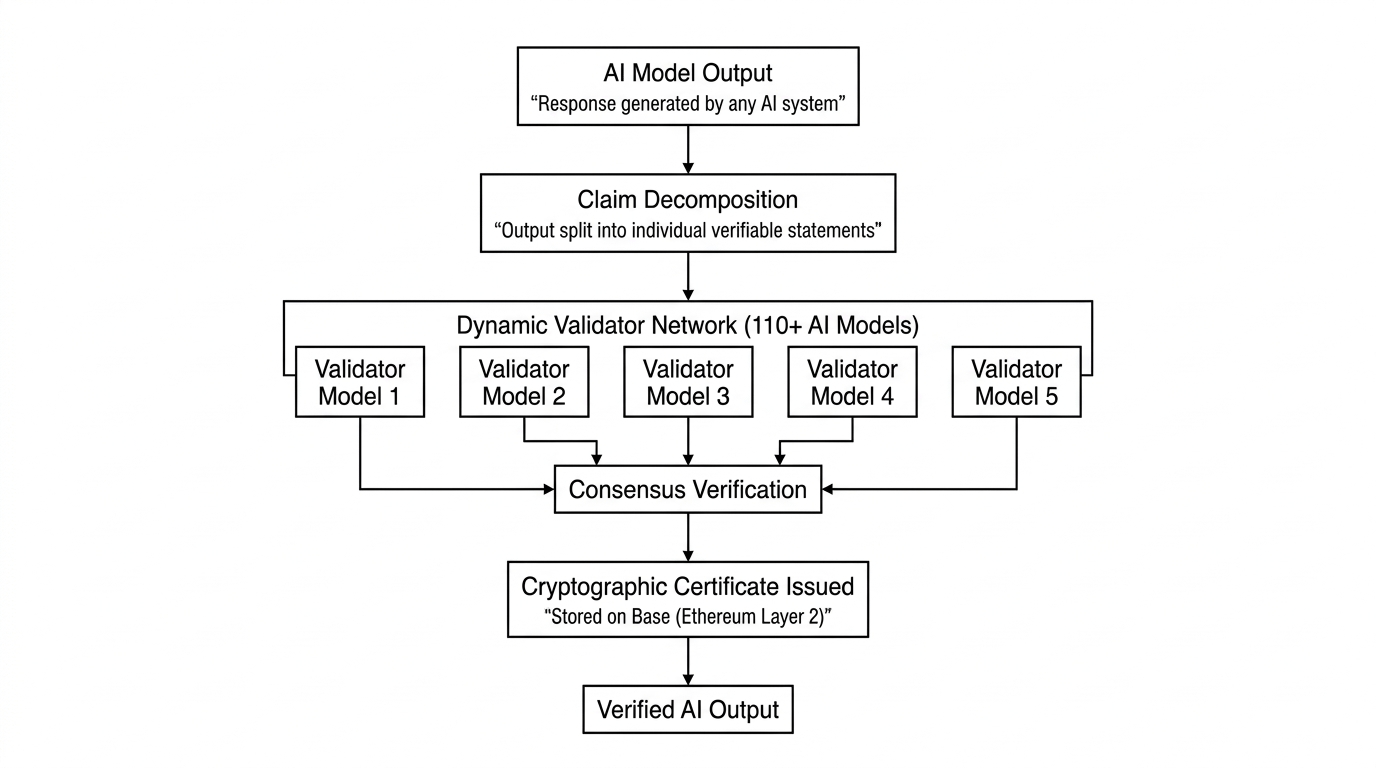
Mira's answer is a decentralized verification layer that sits above AI models entirely — source-agnostic, meaning it does not care whether the output came from GPT, Llama, or anything else. The protocol decomposes AI outputs into individual verifiable claims, routes those fragments across its Dynamic Validator Network where over 110 independent AI models assess them separately, reaches consensus, and issues a cryptographic certificate stored permanently on Base, Ethereum's Layer 2. The fragmentation design is the part worth understanding carefully. No single validator node ever sees the complete original output. That is not a minor technical detail. It means coordinated manipulation requires compromising enough independent nodes simultaneously to change the consensus — expensive to attempt, statistically visible when it happens. The design is trying to make dishonesty structurally impractical, not just contractually prohibited.
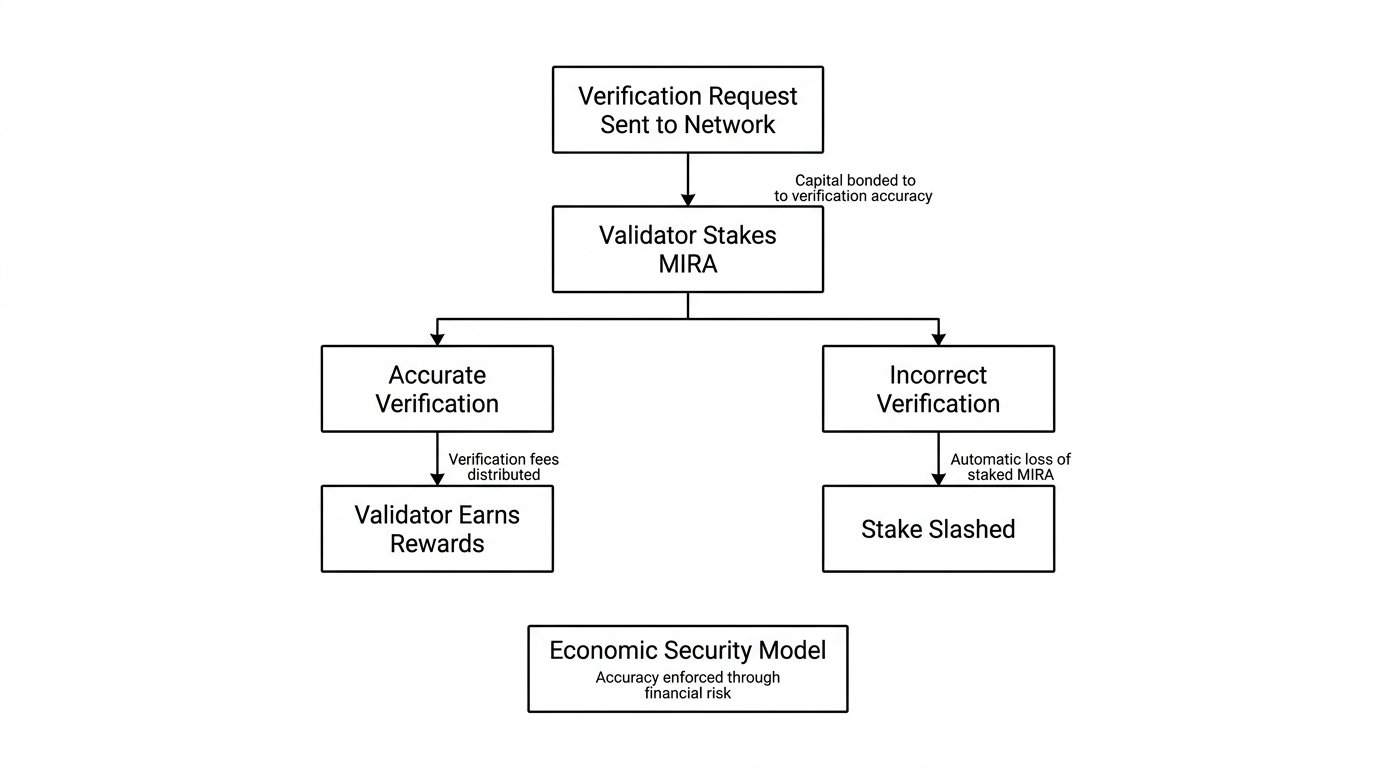
What changed my view on whether this is serious infrastructure or another AI narrative token was reading the incentive design carefully. Node operators stake MIRA to participate. Honest verification earns rewards. Incorrect or lazy assessments trigger slashing — automatic, protocol-enforced loss of staked capital, not a warning or a governance vote. Delegators who back misbehaving validators also face slashing exposure. That design choice matters because it creates a selection effect over time. A system that only pays for participation attracts capital that leaves when yields fall. A system that also destroys capital for poor verification is trying to filter for operators who believe they can perform accurately and are willing to put real money behind that belief. Whether that filter holds in practice depends on whether slashing actually fires against real failures rather than sitting dormant as theoretical deterrence. That is something I cannot verify from the outside, and it remains the most important operational question about the network.
Now let us talk about the part most coverage skips. Verification is not free. Mira's own whitepaper acknowledges that decentralized verification adds latency and cost compared to a single model query. That is a genuine commercial friction, not a footnote. The buyers who will pay that premium are not uniformly distributed across AI use cases. They are concentrated in regulated industries where the cost of an unverified wrong answer already exceeds the cost of verification — healthcare, compliance, legal services, financial audit trails. Outside those verticals, the value proposition is harder to sell. Developers building consumer apps do not lie awake worrying about cryptographic proof of output accuracy. Enterprise compliance officers increasingly do. That asymmetry means Mira's real addressable market is narrower than the total AI market, but also that the buyers in that narrower market have real budget and real urgency. The question is whether Mira can reach them before the slower enterprise sales cycle exhausts the project's runway and community patience.
The market data is straightforward and I will not dress it up. MIRA is currently trading at $0.0827 on the 4H chart, sitting below EMA20 at $0.0841, EMA50 at $0.0866, and EMA200 at $0.0939 — a bearish stack that reflects the broader post-TGE repricing rather than anything project-specific. RSI14 is 42.15, not yet oversold but showing weak momentum. The MACD histogram is near zero with a marginal positive reading of 0.0001, which means compression rather than directional conviction. BaseScan shows approximately 13,000 holders on Base. The next scheduled token unlock is March 26, releasing 10.48 million MIRA across ecosystem reserve, foundation, and node reward allocations. Circulating supply is roughly 22.5% of the 1 billion hard cap. These numbers say: real market presence, early distribution, supply overhang still ahead. They do not say whether the product is working. For that you need different data points entirely.
The metric I keep returning to is not price or holder count. It is whether verification is becoming sticky inside real workflows. Mira's published figures show 4.5 million users and billions of tokens processed daily — numbers that suggest genuine activity if they reflect current usage rather than the pre-TGE incentive period. But user count and sticky infrastructure usage are different things. Sticky means developers are renewing API access because verified outputs are improving production systems, not because the token is trending. It means node operators are running verification infrastructure during quiet markets because the economics still work. It means request volume is deepening inside existing integrations, not just spreading across new ones. The Irys partnership for permanent on-chain storage of certificates is the 2026 development I am watching most carefully — not because permanent storage is novel, but because it is the piece that makes Mira's certificates useful in legal and regulatory contexts where auditability must extend a decade forward. If that integration ships and gets used by one serious enterprise client in a compliance context, the narrative changes considerably.
The infrastructure Mira is building will matter more the further AI moves into decisions where being wrong has real consequences. That is not a price prediction. It is an observation about the direction regulation, liability exposure, and enterprise risk management are all moving simultaneously. The projects that survive long enough to catch that wave rarely look compelling at this stage of their chart. They look like exactly this — real technology, real design thinking, suppressed price, thin volume, and a thesis that requires patience to prove. Whether Mira is one of those projects or a well-designed idea that runs out of time before adoption arrives is genuinely unclear. But the gap it is attempting to fill is not closing on its own. And the closer AI gets to autonomy in high-stakes environments, the more expensive it becomes to keep ignoring it.