
My Deep Research Into the Vision and Infrastructure of the Fabric Foundation
Over the past few months, I’ve been spending a lot of time exploring the intersection of artificial intelligence, robotics, and decentralized infrastructure. One idea that keeps appearing in discussions across both the AI and crypto communities is something often described as the “robot economy.” At first, the phrase sounds futuristic, almost speculative. But the deeper I looked into the current state of robotics and automation, the more I realized that this shift is already beginning. Robots are no longer confined to research labs or experimental factories—they are increasingly present in logistics warehouses, hospitals, agricultural fields, and even service industries. What struck me during my research, however, is that while machines are becoming capable of performing economic work, our global infrastructure still treats them as tools rather than participants in the economy. This is exactly where the vision of the Fabric Foundation becomes fascinating.
The central idea behind Fabric is surprisingly simple but incredibly ambitious: build the economic and coordination layer that allows intelligent machines to interact with humans and with each other in an open, decentralized system. In other words, Fabric is attempting to create a digital infrastructure where robots and AI agents can have identities, perform tasks, verify work, and receive payments. When I first encountered this concept, it reminded me of the early days of blockchain networks like Ethereum, which introduced programmable infrastructure for decentralized applications. Fabric is essentially applying a similar logic, but instead of focusing purely on software applications, it is looking at physical machines operating in the real world.
One of the most important insights that came out of my research is that robotics is approaching a massive inflection point. Advances in AI—especially machine learning models capable of interpreting physical environments—are dramatically increasing what robots can do. At the same time, hardware costs are steadily declining, making robotic deployment economically viable for many industries. Global demographics also play a role here. Many developed economies are experiencing labor shortages in sectors such as manufacturing, logistics, and healthcare. As a result, companies are increasingly turning toward automation to maintain productivity. Analysts estimate that the global robotics industry could reach hundreds of billions of dollars in market value over the coming decade, as automation spreads into more sectors of the economy. Yet despite this rapid growth, there is still no universal system that allows machines to coordinate economically on a global scale.
When I think about this challenge, I often compare it to the early internet. Before standardized protocols existed, computers struggled to communicate with each other. Once shared infrastructure like TCP/IP emerged, the internet became scalable and open. Fabric is attempting something similar for robotics. The project envisions a world where robots have verifiable digital identities, allowing them to prove who they are and what they are capable of doing. This identity layer is important because machines performing tasks in the real world must be accountable. If a robot performs a delivery, inspects infrastructure, or gathers environmental data, there needs to be a reliable method for verifying that the work actually happened. Fabric’s architecture aims to provide that verification layer.
Another aspect that I find particularly interesting is the concept of machine-to-machine coordination. In traditional systems, robots are usually controlled by centralized platforms operated by individual companies. This limits interoperability and often traps machines inside isolated networks. Fabric proposes an alternative model where robots can interact across open networks, share data, and coordinate tasks without relying on a single centralized authority. Imagine a scenario where a fleet of delivery robots, warehouse robots, and autonomous vehicles can communicate with each other, negotiate tasks, and optimize routes dynamically. Instead of being locked inside one corporate platform, they could operate within a shared economic environment. This idea of an open robot network could fundamentally change how automation systems scale globally.
Of course, none of this would work without a payment system that machines can use autonomously. One of the key pieces of the Fabric ecosystem is its native token, known as ROBO. The token acts as the economic fuel of the network, allowing machines and operators to transact within the system. Robots performing tasks could receive payments automatically, validators could confirm completed work, and contributors could be rewarded for providing data, infrastructure, or computational resources. In this sense, Fabric is not just building communication infrastructure—it is also constructing an economic framework where machines can generate and exchange value.
During my research, I found it particularly notable that Fabric initially plans to build its network infrastructure on top of the Base ecosystem, which itself is built on the broader Ethereum stack. This approach allows Fabric to leverage existing blockchain security and scalability while focusing on its specialized robotics infrastructure. Over time, however, the project’s long-term vision may involve evolving toward a more specialized blockchain architecture optimized for machine coordination and robotic activity.
Another reason Fabric has attracted attention within the crypto ecosystem is its backing from major investors and venture groups. Organizations such as Pantera Capital, Coinbase Ventures, and Digital Currency Group have historically supported infrastructure projects that aim to shape the next generation of decentralized technology. Their involvement suggests that Fabric’s vision is being taken seriously by experienced investors who understand the long-term potential of combining robotics with blockchain networks.
What I find most compelling about Fabric, however, is not just the technology itself but the broader implications. As AI becomes increasingly capable, machines will start performing more economic activities independently. If these systems are controlled entirely by centralized corporations, we could end up with a world where a handful of entities control massive automated workforces. On the other hand, if the infrastructure is open and decentralized, it becomes possible for communities, developers, and entrepreneurs to participate in the robot economy in more equitable ways. Fabric appears to be positioning itself on the latter side of this debate, advocating for a future where robotic infrastructure is governed transparently and accessible globally.
Another scenario that illustrates Fabric’s potential involves autonomous logistics networks. Imagine a global shipping system where autonomous drones, delivery robots, and warehouse machines interact through a shared protocol. A merchant could request a delivery task, a robot could accept the job, sensors could verify completion, and payment could be automatically processed through the network. The entire system would operate with minimal human intervention while still maintaining accountability and transparency. While this may sound ambitious today, the technological pieces required to build such systems are rapidly coming together.
Reflecting on everything I have studied about Fabric, I increasingly see it as an attempt to answer a question that most people have not yet asked: What economic infrastructure will support a world filled with intelligent machines? The internet gave us the infrastructure for digital communication, and blockchain introduced decentralized systems for digital value. Fabric is exploring whether those principles can extend into the physical world of robots and autonomous agents.
From my perspective, the significance of this idea cannot be overstated. Over the next decade, the number of intelligent machines operating in the world could increase dramatically. If those machines are able to coordinate through open economic systems, we may witness the birth of an entirely new layer of the global economy—one where humans and robots collaborate in ways that were previously impossible.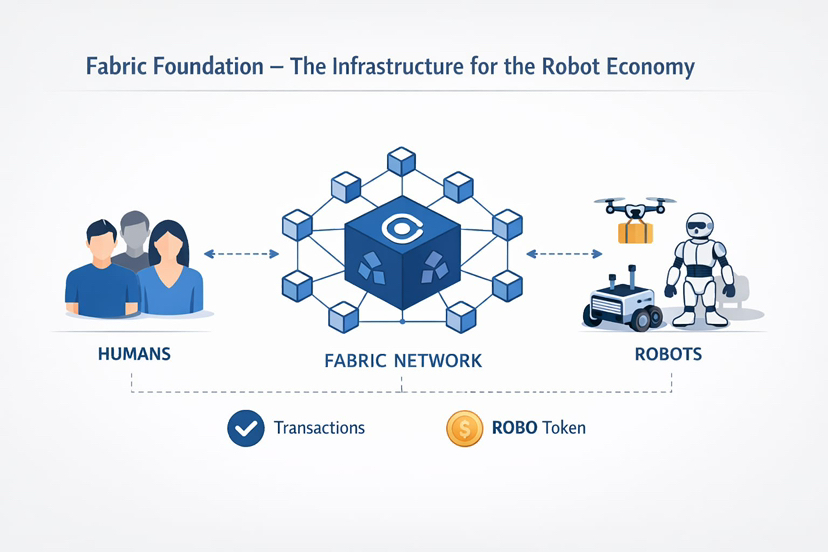
The future that Fabric is envisioning is not just about robotics or cryptocurrency. It is about creating the foundational infrastructure for a new type of economic participant: the intelligent machine. Whether or not Fabric ultimately becomes the dominant platform in this space remains to be seen, but the questions it raises are already incredibly important.
And as I continue researching this emerging sector, one thought keeps returning to my mind: if decentralized networks transformed how humans exchange information and value, it might only be a matter of time before similar systems begin to coordinate the work of machines across the world.