
When I first came across Fabric Foundation and the idea behind Fabric Protocol, my initial reaction was skepticism. After spending years around the crypto industry, I have learned that the market has a habit of discovering a new narrative every few months, attaching a token to it, and then watching the timeline fill with confident predictions before the technology has proven it can actually work. AI narratives, agent narratives, robotics narratives — all of them have appeared in waves. So when I saw a protocol that claimed it wanted to build infrastructure for robots and machine agents to participate in open economic systems, my instinct was to pause rather than immediately buy into the excitement.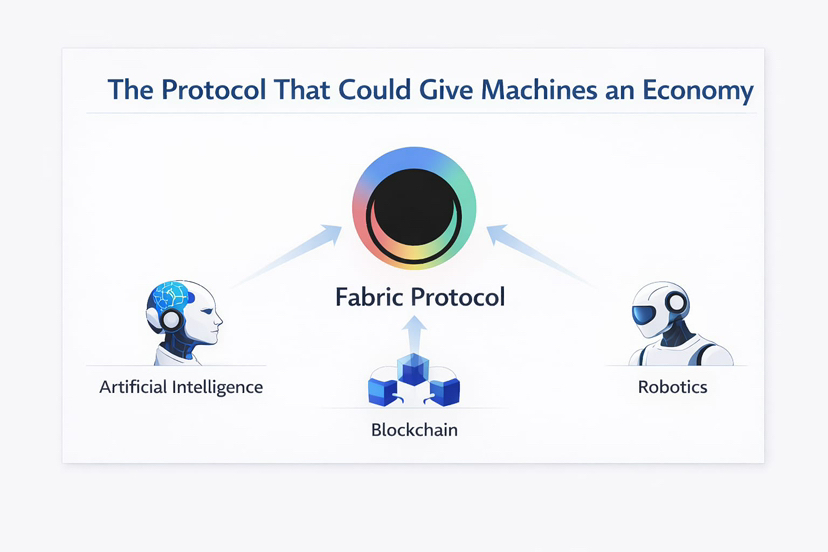
But the more time I spent studying the ecosystem around Fabric, the more the idea started to make sense. Not because the narrative was flashy, but because the problem it is trying to address feels very real. Technology is moving toward a future where machines are not just passive tools but active participants in production, logistics, data collection, and decision-making. Autonomous vehicles, warehouse robots, delivery drones, and intelligent manufacturing systems are already appearing across industries. When these machines start performing meaningful work at scale, a basic question emerges: how do they coordinate activity, verify performance, and exchange value in a system that involves multiple participants? The current model mostly relies on closed systems controlled by a single organization, but that approach creates limitations around transparency, interoperability, and access. Fabric attempts to imagine a different path.
At its heart, Fabric is trying to create open infrastructure that allows machines and humans to collaborate in a decentralized environment. Instead of robotic systems existing inside isolated corporate networks, the protocol introduces the idea that robots and machine agents could operate within a shared coordination layer. This layer would handle identity, payments, task allocation, and verification. In practical terms, it is an attempt to build economic rails for machines — something comparable to how blockchain networks created economic rails for digital transactions.
One of the reasons this idea becomes more compelling the longer I think about it is because it touches on a structural gap in the technology landscape. As artificial intelligence becomes more capable and robotics hardware becomes more accessible, the number of machines interacting with the real world will grow dramatically. These machines will gather data, perform tasks, deliver goods, inspect infrastructure, and interact with people. Yet the systems that coordinate this activity are still largely centralized and fragmented. Fabric is essentially asking whether there should be an open network that enables machine activity to be coordinated in a transparent way rather than hidden behind proprietary infrastructure.
The non-profit Fabric Foundation plays a key role in guiding this vision. Instead of operating purely as a commercial project, the foundation focuses on developing standards, governance structures, and research that keep the ecosystem open. This model is somewhat similar to how certain open internet technologies evolved under independent organizations rather than private companies. By structuring the development process around a foundation, the ecosystem attempts to avoid becoming just another closed platform controlled by a single entity.
Another concept that becomes increasingly important when examining the protocol is verifiable computing. When machines perform tasks in the physical world, trust becomes complicated. A robot might claim it inspected a pipeline, delivered a package, or collected environmental data, but verifying that work actually happened is not always straightforward. Fabric addresses this challenge by integrating cryptographic verification systems that can prove computations and machine activity occurred as expected. This concept, often referred to as verifiable computing, allows the network to confirm that tasks are completed according to predefined rules. In other words, the system does not rely solely on trust — it relies on mathematical verification.
Transparency also plays a central role in the architecture. The protocol uses public ledger systems to record significant events within the network. This includes interactions between machine agents, task completion records, and data exchanges. By storing this information on an immutable ledger, Fabric creates an auditable history of machine activity. The advantage of this approach is that it allows multiple parties to participate in the ecosystem without needing to trust a single centralized authority. Anyone can verify what happened within the network.
Of course, coordination is only part of the challenge. Economic incentives also matter. Machines performing tasks must operate within systems that reward useful behavior and discourage manipulation or inefficiency. Fabric integrates a tokenized economic model to facilitate these incentives through ROBO. The token functions as a mechanism for payments, operational bonding, and governance participation. In theory, when machines complete work or provide useful resources to the network, they can receive rewards through this economic layer. Meanwhile, actors who want to participate in the ecosystem may need to stake tokens or provide collateral to ensure they behave honestly.
This economic design is important because real-world systems are rarely clean or predictable. Machines fail, sensors break, networks disconnect, and human operators sometimes make mistakes. Fabric attempts to account for this messy reality by introducing incentive structures that encourage reliability. Participants have reasons to maintain quality because their economic position in the system depends on it. In many ways, this is one of the most interesting aspects of the protocol because it acknowledges that theoretical designs are not enough. The system must operate under real-world conditions where imperfections are unavoidable.
When I step back and look at the bigger picture, Fabric sits at the intersection of several powerful technological trends. Artificial intelligence is advancing rapidly, robotics hardware is becoming more capable, and decentralized technologies have introduced new ways of coordinating economic activity without centralized intermediaries. Fabric tries to combine these developments into a single framework where machines can collaborate with humans through open infrastructure. This is a challenging ambition, but it is also what makes the project intellectually interesting.
Another reason the concept resonates with me is that it highlights a potential future conflict between open systems and closed corporate ecosystems. If robotic networks become essential to logistics, infrastructure, and service industries, the entities controlling those networks will wield significant power. Data ownership, access to robotic infrastructure, and coordination standards could all become concentrated in a small number of companies. Fabric’s philosophy suggests that an open alternative might be possible, where developers, researchers, and organizations from around the world can contribute to a shared ecosystem rather than being locked into proprietary platforms.
Of course, none of this guarantees success. The distance between a compelling concept and a functioning global infrastructure is enormous. Robotics integration alone presents significant technical challenges, and combining it with blockchain coordination adds additional complexity. Execution will determine whether Fabric evolves into a meaningful network or remains a promising idea that struggled to translate theory into practice. The project exists within a particularly demanding intersection of technologies: crypto systems, robotics hardware, AI agents, and decentralized governance. Each of these fields is complex on its own, and bringing them together requires extraordinary coordination.
Still, I find the thesis difficult to ignore. If machines increasingly perform useful work in society, someone will eventually need to build the economic and coordination infrastructure around that activity. That infrastructure could be proprietary and closed, or it could be open and collaborative. Fabric is essentially betting on the second option. Instead of focusing solely on short-term market narratives, the project is attempting to design the rails that could support machine-driven economic activity in the future.
What I appreciate most about the approach is that it does not pretend the world will become simple once the technology is deployed. Real-world systems involve failure, uncertainty, and conflicting incentives. Fabric seems aware of this reality, which is why the architecture leans heavily on verification mechanisms and incentive structures rather than idealistic assumptions about how participants will behave. In many ways, that realism is what makes the project stand out to me.
As the ecosystem evolves, the real test will not be whether the narrative attracts attention but whether the network begins to demonstrate tangible usage. Real robotic integrations, real task coordination, and real economic interactions between machines and humans will be the indicators that matter. The market often gets distracted by speculation, but infrastructure projects ultimately prove themselves through sustained adoption rather than temporary excitement.
For now, Fabric remains an early experiment exploring a difficult but fascinating question: what happens when machines stop being passive tools and begin operating as participants in economic systems? The answer will shape how automation integrates with society in the coming decades. Whether Fabric becomes the foundation of that infrastructure or simply contributes ideas that influence future systems is still uncertain. But the question it is asking feels increasingly relevant, and that alone makes the project worth paying attention to.
In a technology landscape crowded with superficial narratives, I find it refreshing to encounter a project that is at least attempting to wrestle with a genuine structural problem. Fabric may still be early, and the road ahead is undoubtedly complicated, but the vision behind it forces us to think about the future of machines, economics, and open collaboration in a deeper way. And sometimes, the projects that initially feel strange are the ones that eventually reveal why the question they asked was more important than the answers anyone expected.