
There was a moment when I submitted a simple onchain transaction and watched it sit in a pending state far longer than I expected. Nothing was technically broken, yet nothing was moving either. The network was active, blocks were being produced, but my action felt like it had been placed in a queue that I could not see or understand. That experience stayed with me more than the transaction itself.
After seeing this happen a few times across different networks and applications, I started to realize that what we often call “decentralized speed” is still deeply constrained by invisible coordination limits. It is not just about throughput. It is about how systems decide what gets processed first, what waits, and what gets delayed when demand spikes.
From a system perspective, this feels less like a digital highway and more like a shared public facility with limited staff. Everyone arrives with tasks, but only a certain number can be verified, sorted, and executed at the same time. The rest wait in silent queues, sometimes unpredictably.
A useful analogy I often return to is a global shipping warehouse during peak season. Packages arrive continuously from different regions, but they cannot all be processed simultaneously. Some require verification, some need sorting by destination, and others depend on missing information before they can move forward. The real bottleneck is not movement itself, but coordination under pressure.
When I think about crypto systems through this lens, what matters is not just execution speed, but how intelligently the system manages incoming work when it exceeds capacity. In logistics, the best warehouses are not the ones that move everything instantly, but the ones that degrade gracefully under overload without collapsing the entire flow.
When I look at how @Pixels approaches this, I do not see it purely as a game economy in the traditional sense. What caught my attention is how it tries to structure participation, actions, and progression in a way that resembles a system managing time as a resource rather than just tokens or rewards.
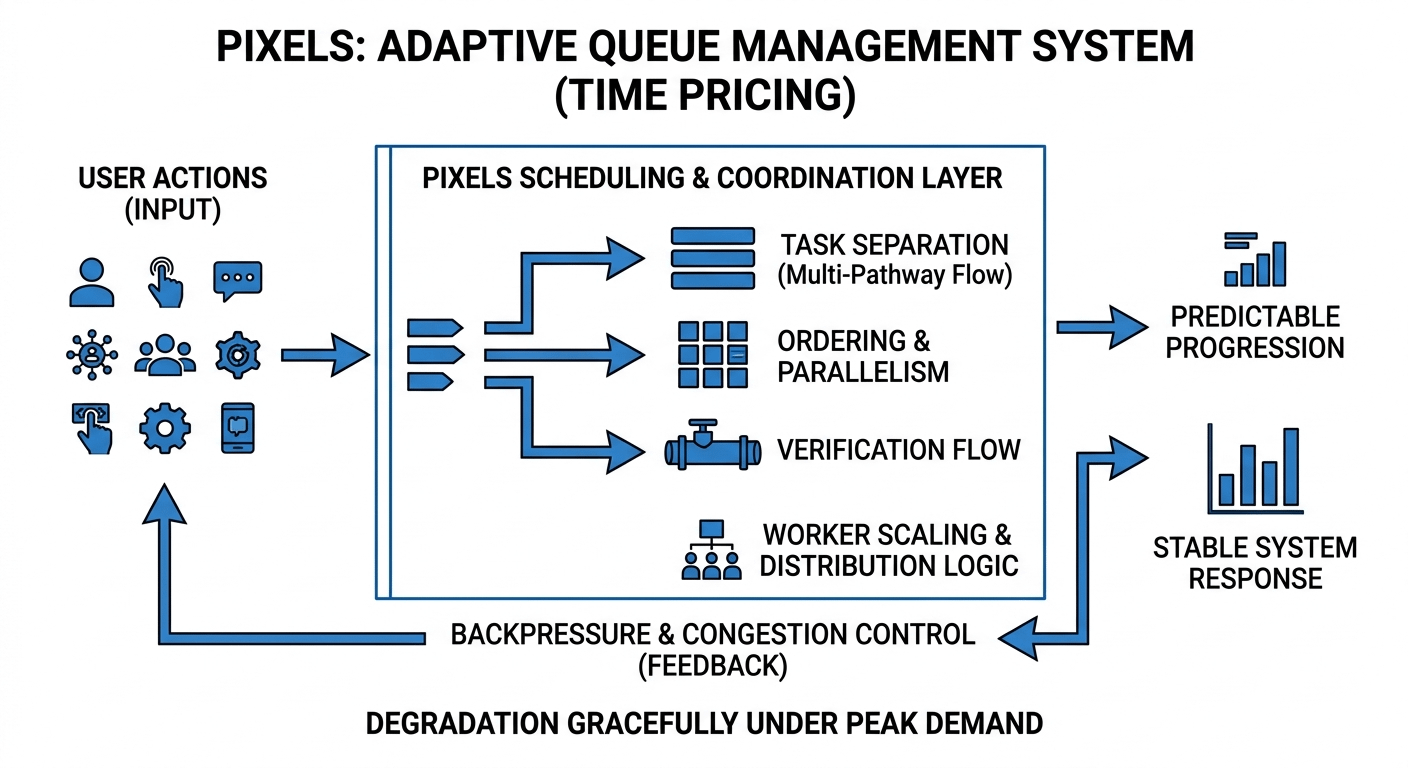
From a system perspective, this shifts the conversation. Instead of treating user activity as uniform input, it introduces layers of scheduling and prioritization. What interests me more is how tasks are distributed, how actions are sequenced, and how the system responds when participation increases beyond expected levels.
In practical terms, I look at a few things when evaluating such architecture.
Scheduling becomes important because it determines how user actions are ordered when demand rises. Task separation matters because it prevents a single overloaded pathway from slowing down the entire system. Verification flow is another critical layer, especially when multiple actions require validation before completion. If that pipeline is not designed carefully, congestion spreads quickly.
Then there is congestion control itself. In resilient systems, backpressure is not a failure; it is a signal. It tells upstream components to slow down rather than pushing instability downstream. Worker scaling also plays a role, but scaling alone is never enough without proper workload distribution logic. Finally, ordering versus parallelism defines whether the system behaves predictably under stress or becomes chaotic when activity spikes.
What I find interesting in this framing is that pixels can be interpreted as experimenting with these ideas in a more visible, user facing environment. Instead of hiding infrastructure complexity, it makes timing, progression, and participation feel like part of the system’s structure itself.
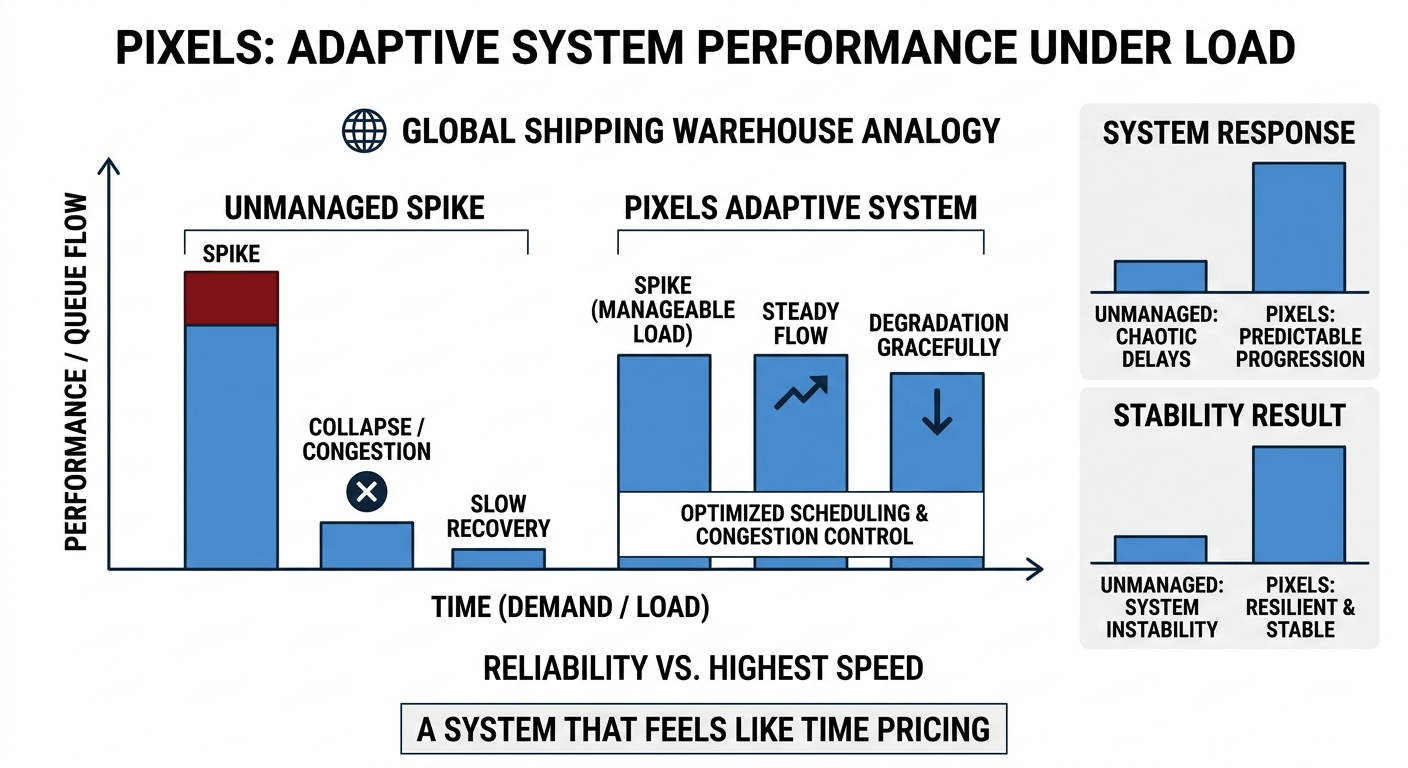
From my experience watching networks evolve, systems that last are not the ones that eliminate constraints, but the ones that design around them intelligently. They accept that congestion will happen, that demand will spike, and that coordination will always have limits.
A reliable system is not the one that boasts the highest speed, but the one that stays stable when demand surges. Good infrastructure rarely draws attention to itself. It simply keeps working when everything around it becomes chaotic.