I usually get cautious when a web3 game says “fun first.”That line is everywhere now. Easy to say. Cheap to market. Hard to prove.The practical problem is simple: if players only stay because rewards are flowing, the game is not retaining users. It is renting them. The moment emissions drop, token price weakens, or better incentives appear somewhere else, attention moves. I think Pixels understands that problem better than many projects in the sector, and that may be one of the most credible parts of its thesis.#pixel @Pixels $PIXEL
What stood out to me in the Pixels material is not that it talks about token design. Most web3 games do. What stands out is the idea that rewards should not be the core reason people play. They should strengthen behavior that is already meaningful inside the game. That is a much stronger starting point than the old play-to-earn logic.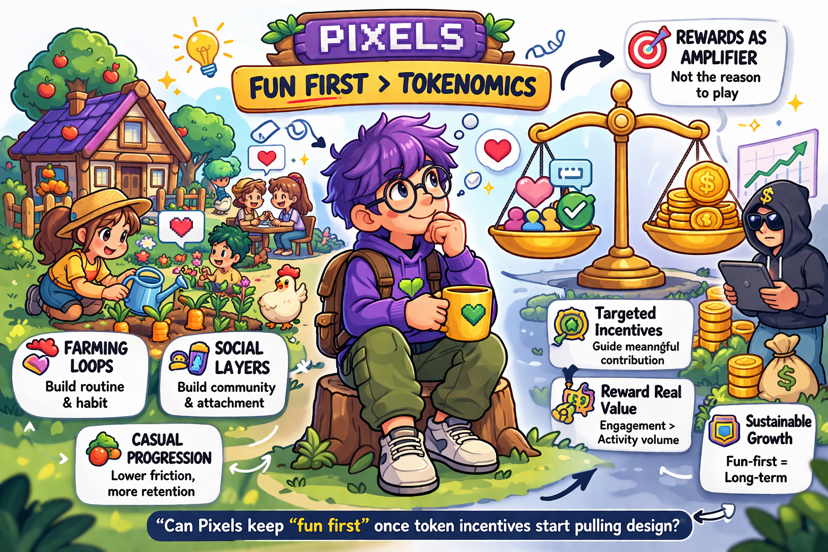
This matters because web3 gaming has already run the failed experiment. A lot of earlier games tried to use incentives as a substitute for game design. The result was familiar: fast user growth, shallow engagement, poor retention quality, and economies dominated by extractive behavior. Players showed up for yield, not for the world, the loop, or the identity of the game itself. That model can produce numbers for a while, but it usually cannot produce loyalty.
Pixels seems to be pushing in a different direction. The serious claim is not “we have rewards.” The serious claim is “people need a reason to care before rewards scale.” That sounds obvious, but in practice it is difficult because fun-first design is much harder to measure than token activity. Wallet actions are easy to count. Daily reward claims are easy to optimize. Genuine enjoyment is messy. It lives in repetition, habit, social attachment, progression pacing, and whether small moments inside the game feel satisfying even when no one is calculating ROI.
That is why the farming, social, and casual parts of Pixels matter more than they may look at first glance. On the surface, those mechanics can appear simple. But simple is often the point. Farming loops give players routine. Social layers give them reasons to return beyond profit. Casual progression lowers cognitive friction and broadens the audience beyond pure crypto natives. In business terms, this is not just game design. It is an attempt to build retention through comfort, rhythm, and community instead of pure financial extraction.
A small real-world comparison helps. Think about the difference between a neighborhood café loyalty card and a café people genuinely like visiting. The loyalty card may increase repeat visits, but only after the place already offers a decent experience. If the coffee is bad and the atmosphere is forgettable, the stamp card does not save the business. It only delays the churn. I think Pixels is trying to apply the same logic to web3 gaming. Rewards can amplify engagement, but they work best when they sit on top of a loop players would already choose.
That shift changes the role of token incentives in an important way. Under the older model, rewards are the engine. Under the Pixels-style framing, rewards become a tuning layer. They can guide behavior, reinforce contribution, and deepen attachment, but they are not supposed to carry the entire product. That is a healthier design philosophy because it creates more room for targeted incentives rather than blanket emissions.
And targeted incentives are where long-term sustainability starts to look more realistic. If a game can identify which actions actually strengthen the ecosystem, then rewards can become more selective. Not every repeated action deserves equal economic weight.A player who helps the game feel more alive, keeps others engaged, supports the in-game economy, or adds something real to the community is probably more valuable than someone who is only there to farm rewards as efficiently as possible. That difference matters, because strong game economies are usually built by rewarding real contribution, not just counting who clicked the most.
Imagine a player who logs into Pixels every day to finish quests, upgrade land, chat with friends, and help new users understand the game loop. Compare that with another player who appears only when reward conditions are attractive, optimizes a narrow routine, sells everything possible, and disappears when returns compress. Both may look “active” in raw metrics. But they are not equally useful to the ecosystem. A fun-first design gives the team permission to care about that difference.
Still, this is where the risk starts.A lot of teams say fun-first while secretly optimizing for token-led growth. They keep the language of sustainability, but the product decisions still revolve around incentive pressure. That usually shows up in subtle ways: too much focus on grinding, progression warped around emissions, user behavior trained to chase payouts, and game loops that feel thinner once rewards are removed. So the real test for Pixels is not whether it says the right thing in the paper. The real test is whether the game still feels socially sticky and habit-forming when the token is no longer the headline reason to show up.#pixel @Pixels $PIXEL
That is why I think the Pixels thesis is credible, but not automatically proven. The direction makes sense. Maybe more sense than the older web3 gaming playbook. But fun-first is a discipline, not a slogan. It requires teams to protect gameplay quality even when token metrics are louder, more visible, and easier to optimize around.If Pixels can keep rewards in the role of amplifier rather than replacement, it may have a stronger foundation than many earlier crypto games ever did.
But can Pixels keep “fun first” intact once token incentives start pulling design decisions in the other direction?

Artykuł
Pixels Thinks Retention Starts With Fun Not Tokens

--
Zastrzeżenie: zawiera opinie stron trzecich. To nie jest porada finansowa. Może zawierać treści sponsorowane. Zobacz Regulamin