
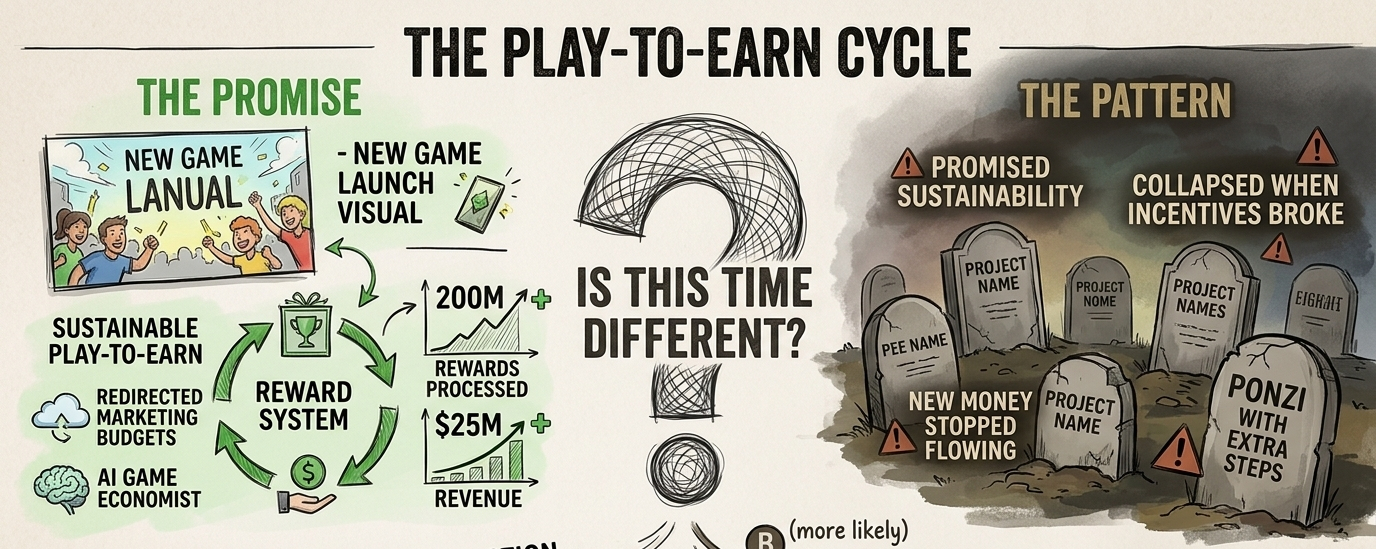
I keep watching @undefined and trying to figure out if Stacked is actually different from every other play-to-earn system that promised sustainability then collapsed when the incentives broke.
What I'm watching isn't whether the technology works. It probably does. What I'm watching is whether they've solved the fundamental problem where rewarding players for playing attracts people who don't care about the game and just want the rewards.
Play-to-earn sustainability in gaming.
Not the ecosystem narrative. The reality where games launch with reward systems that look sustainable, then discover players optimize for rewards instead of fun and the economy collapses when new money stops flowing.
That's where most play-to-earn dies.
The Pixels team says they lived through this. They say Stacked is battle-tested infrastructure that already powers their ecosystem and has processed 200 million rewards.
What I can't tell is whether "battle-tested" means they solved the core problem or whether they survived long enough to build something that still has the same fundamental issues.
The problem with play-to-earn isn't technical. It's incentive design. When you pay people to play games, you attract people there for the payment. They farm. They bot. They extract value until there's nothing left.
Every play-to-earn system deals with this. Most don't survive it.
@Pixels claims Stacked is different because it gives the right reward to the right user at the right moment. AI analyzing player behavior. Fraud prevention. Anti-bot systems built over years.
Technically impressive. What I don't know is whether it solves the incentive problem or just delays it.
The challenge is sustainable play-to-earn requires rewards that don't exceed value creation. Players need to generate more value than they extract.
In play-to-earn developers pay players. That only works if players create value exceeding what they're paid. Where does that value come from.
Most play-to-earn answers this with "new players paying in." That's not sustainable. That's a Ponzi with extra steps.
Stacked says the value comes from redirecting marketing budgets. Instead of paying ad platforms, studios pay players directly for genuine engagement.
That's a better answer. What I can't tell is whether it actually works at scale or whether it's still dependent on new money flowing in.
The AI game economist layer is interesting. Studios can ask why cohorts are churning, where reward budget is leaking. That's genuinely useful if it works. It's also exactly what helps optimize a system right up until the fundamental economics break.
What keeps me coming back is that Pixels claims $25 million in revenue with this system. That's real money. That suggests something's working beyond just reward extraction.
But revenue and sustainability are different things. You can have revenue while burning reserves. Revenue proves people are engaged. It doesn't prove the economics work long-term.
The question isn't whether Stacked works today. It apparently does. The question's whether it works in two years when the initial reward pool has been distributed.
Maybe they solved play-to-earn sustainability. Maybe the AI economist and fraud prevention are enough to keep value creation exceeding value extraction.
Maybe this is another play-to-earn system that looks sustainable until it's not.
I'm watching to see which one.
What I'm particularly watching is $PIXEL's role. It's shifting from single-game token to cross-ecosystem rewards currency. More games using it should create more demand.
The reality's more complicated. More games means more reward distribution. More rewards means more selling pressure unless utility keeps pace.
Most cross-game tokens don't survive this transition. Utility growth doesn't match token distribution growth. Price collapses.
Maybe Pixels is different. Maybe they planned for this. Maybe the AI economist helps them manage token velocity in ways that keep economics stable.
I'd prefer they actually solved it. I'm just not convinced anyone's solved sustainable play-to-earn yet.
The play-to-earn problem's fundamental. You can build better fraud prevention. You can target rewards precisely. You can analyze behavior with AI. None of that changes the core dynamic where paying people to play attracts people who optimize for payment instead of engagement.
And honestly, I trust teams that acknowledge how hard this problem is more than teams that claim they solved it completely.
