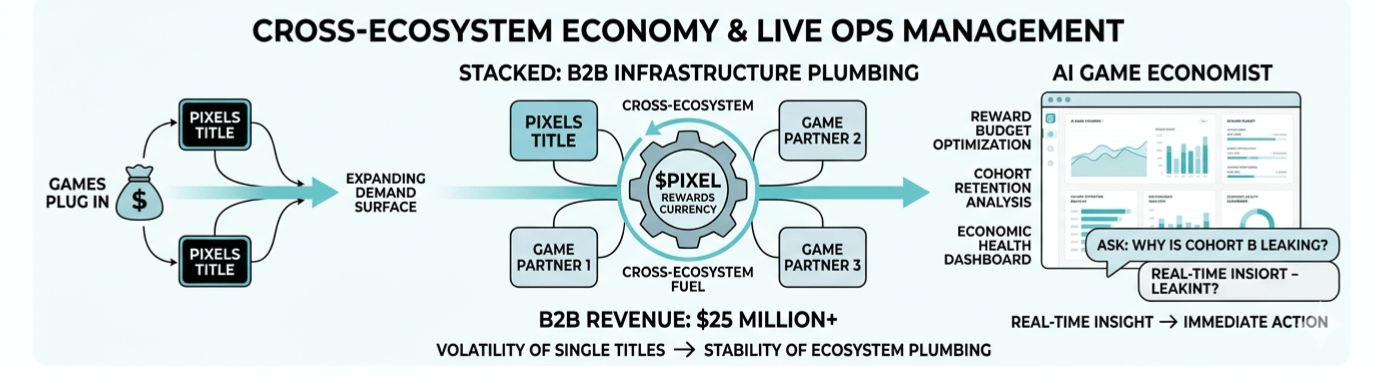
I spent my morning staring at yet another pitch deck promising to revolutionize gaming with some convoluted circular economy that requires a PhD to understand and a miracle to scale. We are all exhausted by the vaporware and the endless roadmaps that lead to nowhere, which is why seeing something actually functioning in the wild feels like finding an oasis in a desert of broken promises. The reality of Web3 gaming has been a lot of noise and very little signal, but the team behind Pixels is currently proving that you do not need a grand vision if you have a working engine. They did not just build a game, they built an infrastructure layer called Stacked that is already responsible for over twenty five million dollars in revenue. This is not some theoretical value proposition or a series of "what if" scenarios designed to bait a seed round. This is tech built in production, not in a deck, and that distinction is everything in a market that has been burned by empty promises too many times to count.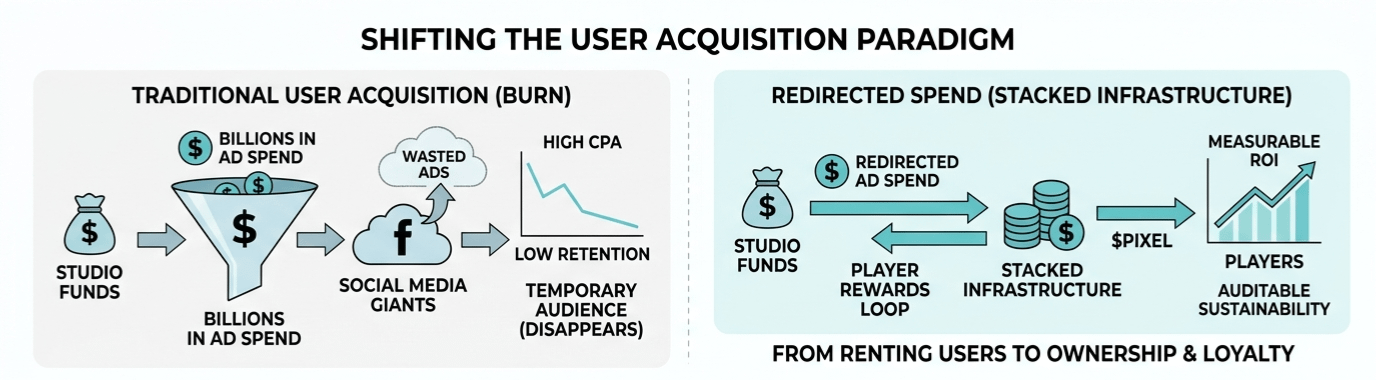
The old way of doing things is essentially lighting money on fire and hoping the smoke signals attract players who actually stick around. Studios spend billions on traditional user acquisition, throwing cash at social media giants just to rent an audience that disappears the moment the subsidy ends. Stacked is leaning into a thesis that redirects that wasted ad spend directly into the pockets of the players themselves. It turns the reward loop into something measurable and the ROI into something auditable, which is a massive shift for any fund looking at sustainable economics instead of a pump and dump scheme. By moving $PIXEL from a single game token to a cross ecosystem rewards currency, they are expanding the demand surface across every new title that plugs into the system. It is a pivot from being a speculative asset for one world to becoming the literal fuel for a growing network of digital economies.
What really catches my eye is how they are using AI as a legitimate layer for live game management rather than just a buzzword to pad out a whitepaper. Most studios are flying blind, waiting weeks for data scientists to tell them why a specific cohort of players stopped logging in or where their reward budget is leaking. With this system, an AI game economist sits on top of the data and allows studios to ask those questions in real time. You get the insight and you act on it immediately inside the same interface, closing the gap between seeing a problem and fixing it. Because Stacked is positioned as B2B infrastructure, its survival is not tied to the volatility or the lifespan of any single title. It is the plumbing of the ecosystem, and in a gold rush, I would much rather own the shovels than the hole in the ground. We are moving away from the era of digital lottery tickets and toward a world of industrial grade loyalty. It is the difference between a child playing with a toy and an engineer managing a massive container terminal where every move is tracked, optimized, and settled in real time.