
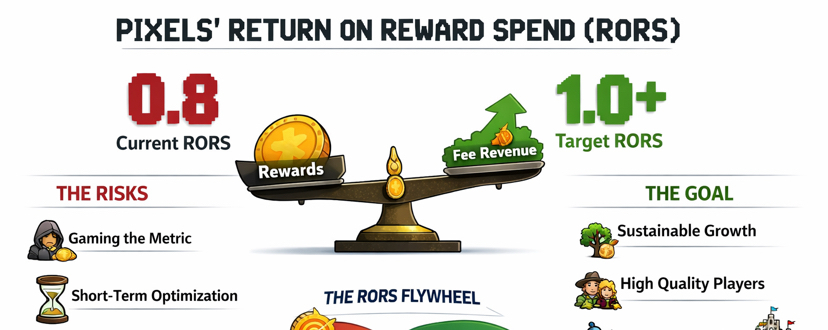

What if the most important part of Pixels is not the game loop, not the token, and not even the publishing vision, but one blunt operating metric? The part I’m not fully convinced about is also the part I take most seriously: can Pixels actually prove that reward spend creates more value than it destroys?#pixel @Pixels $PIXEL
That question matters because web3 gaming has a habit of hiding weak economics behind soft language. “Ecosystem growth” can mean almost anything. “Community expansion” sounds good even when retention is shallow. “Engagement” can be inflated by mercenary users. Pixels, to its credit, is trying to replace that fog with something more measurable. In its whitepaper, it frames Return on Reward Spend, or RORS, as a core success metric: rewards paid out versus revenue returned in protocol fees. It explicitly compares that logic to ROAS, the familiar marketing benchmark of return on ad spend. It also says the current RORS is around 0.8 and that getting above 1.0 is the target.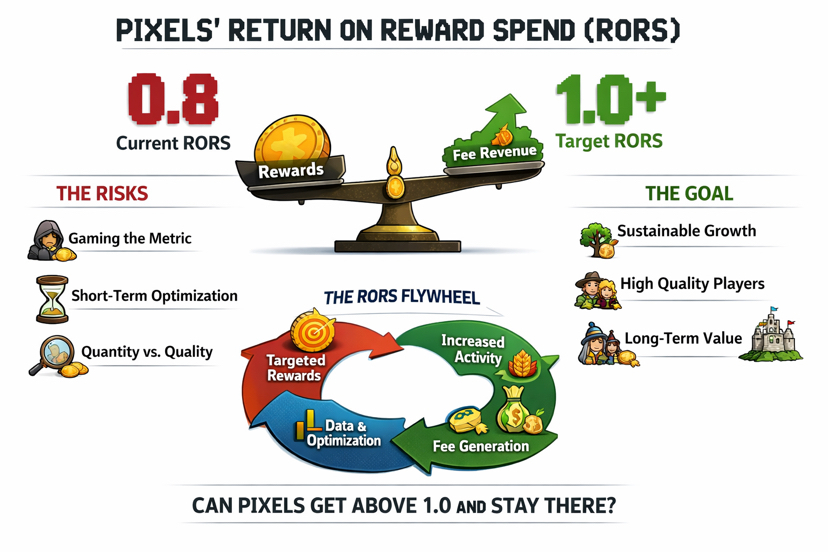
If a game spends one dollar equivalent in rewards and gets back only eighty cents of durable economic value, the system is still subsidizing itself. Maybe that is acceptable early. Plenty of platforms tolerate negative unit economics while scaling. But if the model is supposed to become a long-term coordination layer for user acquisition, loyalty, and publishing, then “almost works” is not enough. A reward engine that never crosses breakeven is not a flywheel. It is a burn schedule with better branding.
RORS is probably the strongest concept in the Pixels paper because it forces the project to speak in operational terms instead of narrative terms. That is a higher standard than most crypto gaming projects set for themselves. But the same metric can also become dangerous if management starts optimizing the number instead of the underlying player economy.
The mechanism is easy to understand.Pixels says it wants rewards to behave less like blanket emissions and more like targeted growth spend. The whitepaper describes a data-driven rewards system that identifies actions associated with long-term value, and a publishing flywheel where better data improves reward targeting, lowers user-acquisition costs, and attracts more games into the ecosystem. In that model, RORS becomes the scoreboard. If reward dollars produce fee revenue efficiently, the loop tightens. If not, the loop weakens.
This is why the analogy to ROAS is useful.In web2, nobody serious wants to hear that ad spend “created vibes.” They want to know whether it brought in users who stayed, spent, and justified the cost. Pixels is applying that same discipline to token incentives. That is a more mature frame than the old play-to-earn habit of treating emissions as growth by default. Rewards are not valuable because they are generous. They are valuable only if they produce behavior that compounds the health of the network.And that is exactly why the current ~0.8 matters.A ratio below 1.0 does not automatically mean failure. It may simply mean the system is still in calibration mode. Early-stage ecosystems often spend ahead of realized returns. But 0.8 is close enough to make the idea credible and far enough from 1.0 to keep the pressure on. It says Pixels may be approaching a real economic threshold, but has not yet proven it can cross and hold it. That is an important distinction. The gap between 0.8 and 1.0 is not cosmetic. It is the difference between “subsidized but improving” and “self-reinforcing.”
Suppose Pixels spends rewards to bring in a wave of users during a new content cycle. On paper, activity jumps. Quests are completed. marketplace fees rise. Daily data looks healthier. RORS improves. But what if those users are highly optimized extractors who learned exactly which actions the model rewards most? What if they generate near-term fees while weakening the social and economic texture of the game over time? Then the metric can look better even as the ecosystem gets worse.
That is the first real risk: gaming the metric.The moment a reward system becomes legible, users will try to arbitrage it. That is not immoral. It is normal. In fact, good system design should assume it. If Pixels becomes highly effective at rewarding measurable value, sophisticated players will aim their behavior at whatever the model recognizes. Some of that will be productive. Some will be synthetic. If the optimization target is too narrow, the system may end up selecting for people who are good at farming the dashboard rather than strengthening the world.
The second risk is short-term optimization.ROAS-style thinking is powerful, but it can become myopic.When a team is pushed to make RORS look better, the easiest move is usually to favor whatever makes money fast instead of what builds real loyalty over time. In practice, that can mean rewarding spenders more than creators, chasing fee-generating activity over genuine community depth, or optimizing for quick conversion instead of giving players reasons to actually stay.In a game ecosystem, not every valuable player shows up first as direct revenue. Some create social glue. Some make worlds feel alive. Some are early adopters of features that matter later. If RORS becomes too dominant, Pixels may start undervaluing users whose contribution is real but delayed.
The third risk is confusing quantity with quality.Better metrics do not automatically mean better judgment. A lower acquisition cost and a higher short-term payback can still produce a brittle audience. The whitepaper’s broader framing around fun first, smart reward targeting, and a publishing flywheel suggests Pixels understands this problem conceptually. But the operating challenge is harder: can it distinguish between a user who is merely profitable and a user who makes the ecosystem more resilient?
This is why I think RORS is stronger than vague ecosystem language, but not sufficient on its own.
It is stronger because it forces accountability. It asks a very hard question: are rewards creating value back into the system, or are they just being sprayed outward and rationalized later? That alone is a meaningful step up from most GameFi rhetoric. But it is not sufficient because fee revenue is not the whole economy. Goodhart’s law lurks here: once a metric becomes the target, it can stop being a reliable measure.
What I’m watching next is not whether Pixels can say “RORS > 1.0” once. It is whether that number can stay above 1.0 without hollowing out player quality, pushing the design toward shallow monetization, or turning rewards into an overly controlled behavioral funnel. A one-quarter improvement would be interesting. A durable feedback loop would be much more important.
That is the real test for Pixels.The architecture is interesting, but the operating details will matter more. If RORS becomes the new coordination layer, can Pixels keep it honest enough to measure real ecosystem strength rather than just efficient extraction?#pixel @Pixels $PIXEL