
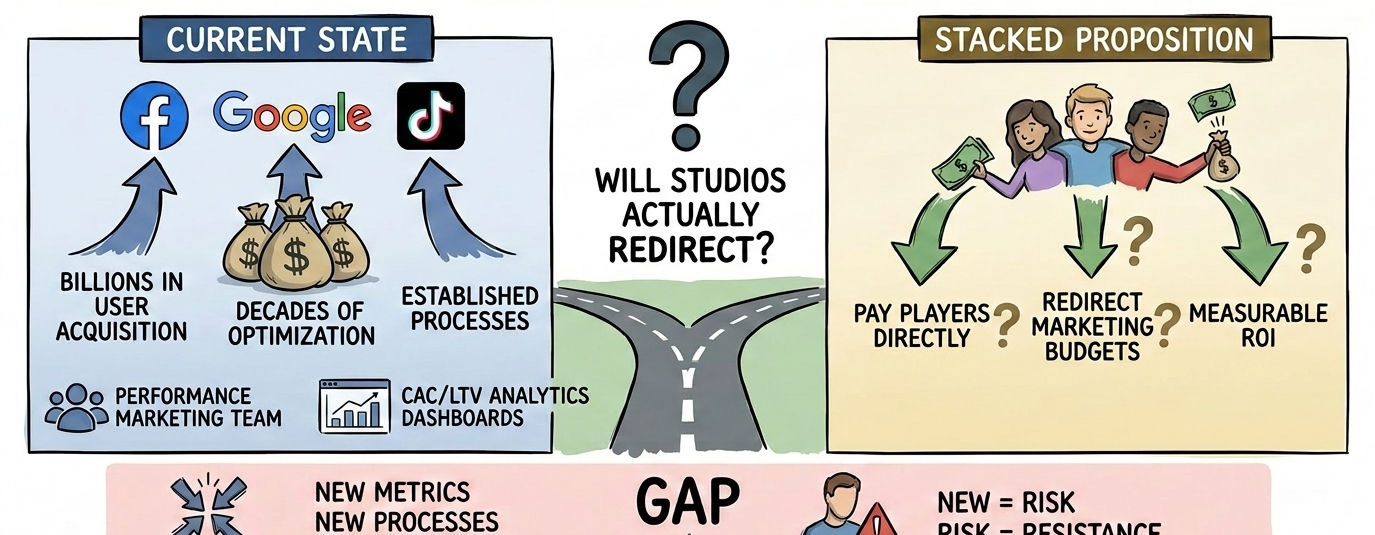
I keep watching @Pixels and trying to figure out if game studios will actually redirect marketing budgets to pay players directly or if that's just a pitch that sounds good but doesn't match how studios allocate spend.
What I'm watching isn't whether redirecting ad spend makes theoretical sense. It does. What I'm watching is whether studios change behavior when given the option to do something different from what they've always done.
The redirect ad spend thesis in gaming.
Not the efficiency narrative. The reality where studios spent decades optimizing user acquisition through ad platforms and aren't going to fundamentally change that approach just because new infrastructure suggests they could.
That behavioral inertia's where most B2B infrastructure fails.
Stacked's pitch is straightforward. Studios spend billions on user acquisition through Facebook, Google, TikTok. Most goes to platforms, not users. Stacked lets studios pay players directly for genuine engagement instead of paying platforms for impressions.
Better value proposition on paper. What I can't tell is whether it's better in practice when studios evaluate it against what they're already doing.
The challenge isn't technical. It's organizational. Marketing teams have entire departments built around paid acquisition. Performance marketers optimizing campaigns. Analytics teams measuring CAC and LTV. Vendor relationships that took years to build.
Redirecting spend means changing all of that. New metrics. New processes. Different expertise needed.
Most organizations don't change that fundamentally unless forced to.
@Pixels says Stacked makes the redirect measurable. Studios can see exactly what they're getting. Retention lift. Revenue impact. LTV improvement. All the metrics performance marketers care about.
Right approach if it works. What I don't know is whether better measurement overcomes organizational resistance to changing established processes.
The ad spend redirect thesis assumes studios optimize for efficiency. But studios optimize for predictability, risk management, organizational simplicity. Paying Facebook is predictable. Paying players directly is new.
New means risk. Risk means resistance.
Most B2B infrastructure promising to redirect existing spend hits this wall. Value proposition is clear. ROI is better. But organizational friction of changing budget allocation is higher than the pitch accounts for.
What keeps me coming back is that Pixels isn't selling from zero. They're demonstrating it internally first. Stacked already powers their ecosystem. They've got $25 million revenue showing it works. They're asking studios to copy what Pixels already did.
Stronger position than most B2B infrastructure starts from.
But internal adoption and external adoption are different. What works inside Pixels might not translate to other studios with different organizational structures, different player bases, different economics.
The question isn't whether Stacked can redirect ad spend efficiently. It probably can. The question's whether studios actually redirect when given the option or stick with established platforms despite lower efficiency.
Maybe they do. Maybe the measurement layer is compelling enough that performance marketers push for adoption.
Maybe they don't and Stacked stays as infrastructure that works theoretically but doesn't get adopted widely.
I'm watching to see which one.
What I'm particularly watching is early external studio adoption. If other studios deploy Stacked and redirect meaningful budget, that validates the thesis. If adoption stays limited to Pixels, that suggests organizational friction is higher than expected.
$PIXEL's value depends on how many studios adopt. More studios means more games distributing $PIXEL rewards. That creates more utility, more circulation, more demand.
If adoption doesn't scale, $PIXEL stays as single-ecosystem token with theoretical cross-game utility that doesn't materialize.
Most B2B infrastructure tokens don't survive the gap between "this could power many games" and "this actually powers many games." The first is a pitch. The second requires overcoming organizational friction at dozens of studios.
I'd prefer the redirect ad spend thesis works. I'm just not convinced studios change budget allocation as easily as assumed.
The redirect problem's not unique to gaming. Every industry has entrenched vendor relationships and processes that resist change even when better alternatives exist.
And honestly, I trust teams that understand organizational friction more than teams that assume efficiency advantages automatically translate to behavior change.
