
To be honest, I did not think of it that way when I first came across it. My first reaction was much more dismissive. A social casual game on Ronin, built around farming, exploration, and creation. I have seen enough descriptions like that to know how easily they can slide into mood without substance. A lot of projects know how to describe a pleasant world. That does not mean they know how to make one. So I looked at Pixels and thought, alright, I understand the category. Soft colors. gentle routines. familiar mechanics. probably another project that sounds warmer than it feels.
That was the easy reading of it.
But sometimes the easy reading misses the part that actually matters. And with Pixels, the part that stayed in my mind was not any single mechanic. It was the kind of social feeling a world like this is trying to create. Not a big dramatic community. Not constant teamwork. Something smaller than that. More ordinary. More like being around people regularly enough that the place starts to feel shared.
That is harder to build than it sounds.
Online spaces often confuse connection with activity. They think if enough people are present, chatting, trading, competing, or reacting, then the space must feel alive. But a lot of very active spaces still feel empty in a human sense. They feel crowded, not shared. They feel noisy, not social. You can usually tell when a platform has mistaken traffic for community. Everything moves, but nothing settles. Nobody feels familiar. Nothing feels local. The whole thing becomes a stream instead of a place.
@Pixels seems more interesting when I look at it as an attempt to resist that.
A farming and exploration game naturally creates repeated patterns. People return to the same tasks. They move through the same spaces. They keep small routines. That matters because neighborhoods are built out of repeated low-level contact. Not grand events. Not perfect cooperation. Just seeing the same names, the same habits, the same little pieces of effort happening around you. A person harvesting nearby. Someone changing their area over time. Another player who always seems to be around the same part of the map when you log in. These are tiny things. But tiny things are often what make a place feel real.
That is where things get interesting.
Because the modern internet is not very good at that kind of feeling anymore. Most platforms are optimized for reach, speed, visibility, and interruption. They are built to pull you outward into larger and larger surfaces. More content. More reaction. More people. More movement. What gets lost in that model is the value of bounded spaces. The value of seeing enough of the same environment, and enough of the same people, that your mind starts treating it less like a feed and more like somewhere.
I think Pixels makes sense inside that gap.
It offers an open world, yes, but the emotional logic of it feels smaller than that in a good way. Farming, creation, and exploration are not just game systems. They are ways of making space feel inhabited. Farming gives people a reason to return to specific locations. Creation gives them a way to shape those locations. Exploration connects one pocket of activity to another. The result, ideally, is not just a map full of features. It is a world where human routine leaves visible traces.
That changes how time works inside the game.
In a lot of online experiences, time feels consumed. You spend it and it disappears. You scroll, click, react, maybe enjoy a few moments, and then the next thing arrives and wipes the surface clean. Games like Pixels try to do something else. They try to let time accumulate into familiarity. Not just progress in the narrow sense. Familiarity. The feeling that because you have been here before, the world sits differently in your mind now. You know where things are. You recognize patterns. You notice change. You start to belong a little, even if only lightly.
That kind of belonging is easy to underestimate because it looks so modest from the outside.
But I think people are hungrier for it than they admit. A lot of digital life is strangely placeless. You can move through it for hours without feeling attached to anything in particular. Everything is designed to be frictionless and scalable, which often means nothing develops texture. Pixels, by contrast, seems to lean into texture. Small effort. repeated return. visible change. low-pressure presence. Those things do not sound impressive when listed plainly, but they can produce a stronger bond than louder systems do.
And I think that is why the casual part matters.
Casual does not always mean shallow. Sometimes it means the world is designed to fit alongside life instead of trying to dominate it. That is a real difference. A casual social world has to be easy to re-enter. It has to let people show up imperfectly. It has to make room for short visits, partial attention, and inconsistent commitment without collapsing. That is not easy design. In some ways it is harder than building intensity, because intensity can hide weakness for a while. Soft worlds have nowhere to hide. If the atmosphere is thin, you feel it immediately.
#pixel seems to be making a bet that softness itself can be structure.
Not softness as decoration. Softness as design. A world where farming slows things down, exploration keeps curiosity alive, and creation lets players leave enough of a mark that the place starts to matter personally. That is a different ambition from trying to amaze people. It is trying to make them settle.
Of course, this is also where I get cautious.
Because once a world like this is tied to Web3 infrastructure, another interpretation enters the picture whether the game wants it or not. The neighborhood can also become a marketplace. Routine can become optimization. Presence can become extraction. A farm can stop feeling like part of a lived-in world and start feeling like a production unit. That shift can happen quietly. Nothing on the surface has to change very much. The same actions remain. The same world remains. But the player starts relating to them differently.
That tension is probably central to Pixels whether people say it directly or not.
A social casual game depends heavily on emotional atmosphere. It needs the player to feel that being there has value beyond calculation. The moment every action is read mainly through profit, ranking, or output, the neighborhood feeling weakens. People stop noticing one another as co-inhabitants and start noticing one another as competitors, traders, or signals. That does not destroy a world instantly, but it changes what kind of world it is.
The question changes from "is this world active?" to "what kind of attention is this world teaching?"
That feels like the more useful question to me.
If Pixels teaches a kind of steady, low-pressure attention, then its world may hold together in a meaningful way. Players may keep returning because the place feels familiar, because their time stays visible, because other people start to feel like part of the landscape in a human way. But if the dominant lesson becomes efficiency, then the same world may slowly flatten into something else. Still functional, maybe even successful by certain metrics, but less livable.
You can usually tell which direction a game is moving by the language people use when they talk about it after the early excitement wears off.
If they talk about routines, neighbors, places they like, things they have been tending, changes they noticed, familiar faces they keep seeing, then something deeper is probably working. If they mostly talk about earning, optimizing, positioning, and extracting, then the social layer may be thinning even if the user numbers look fine. One language describes a place. The other describes a system.
$PIXEL interests me because it seems to sit right between those two possibilities.
And maybe that is why I take it more seriously than I first did. Not because it is making some huge claim about the future. More because it is working with a question that feels unusually human for an online game. Can a digital world still feel local. Can it make repeated presence matter. Can it let people build a mild form of belonging without turning every interaction into pressure.
Those are quiet questions. Easy to overlook. But I think they matter more than most flashy ones.
Because if a world cannot become somewhere, it usually does not matter for very long.
And sometimes the difference between a game people try and a world people return to is just that small feeling of recognition. Not excitement. Not spectacle. Just the sense that when you come back, the place still knows how to hold you a little.

Artykuł
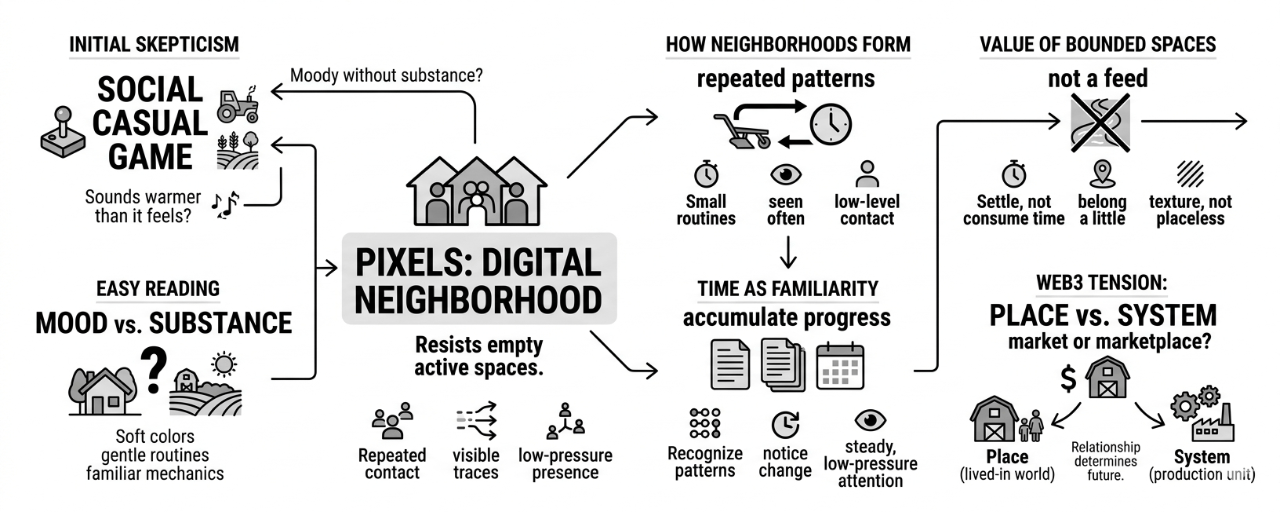
Pixels interests me less for farming than for its digital neighborhood feel.
Zastrzeżenie: zawiera opinie stron trzecich. To nie jest porada finansowa. Może zawierać treści sponsorowane. Zobacz Regulamin