

I used to think Pixels kept its economy in separate rooms.
Wallet stuff over here. Dashboard stuff over there. Staking somewhere else. A game in one place, finance in another, rewards in a third. Clean boxes. Easy to explain. Probably wrong.
The more I look at it, the more it feels like Pixels is trying to make those pieces behave like one loop.
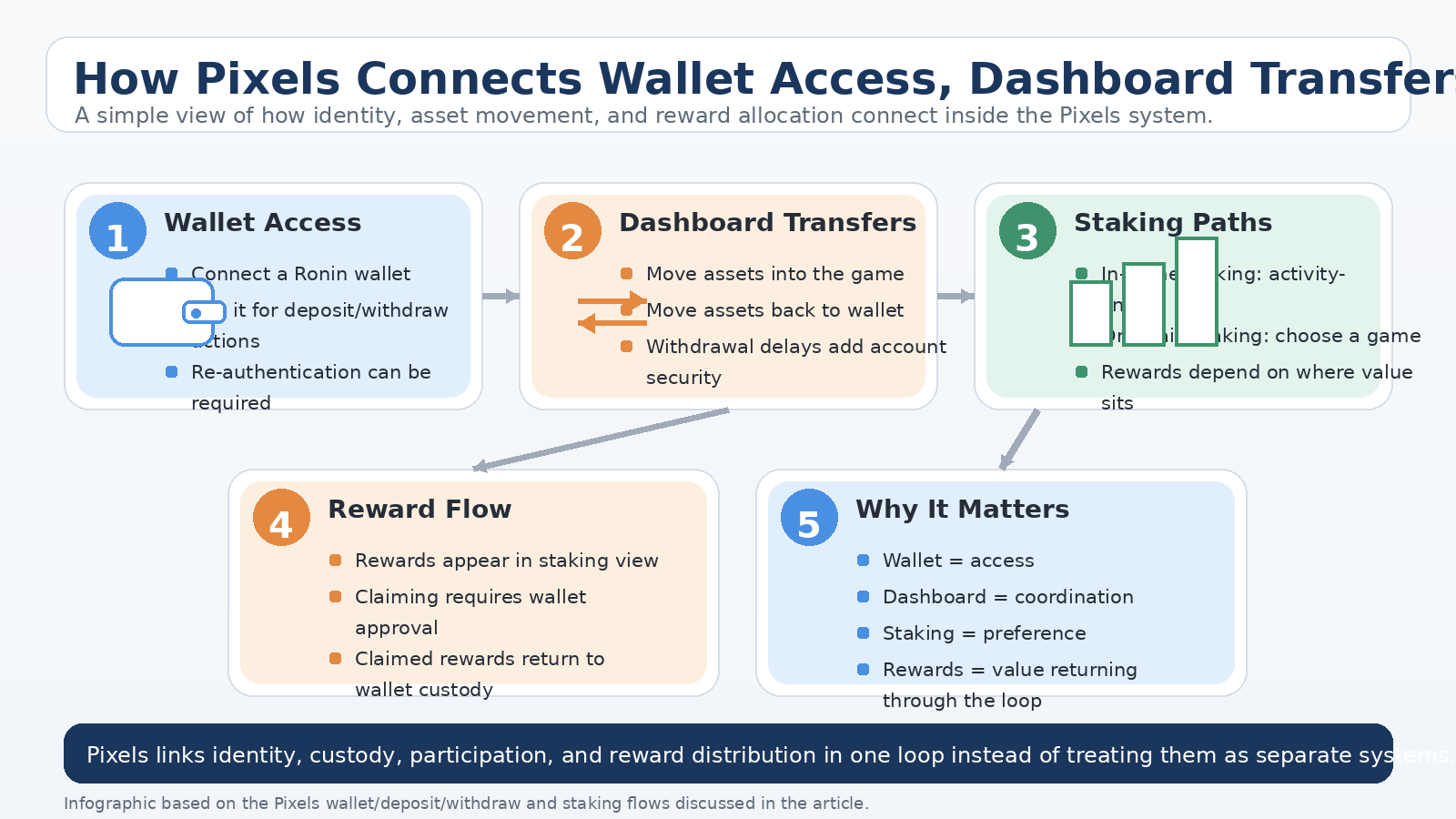
You log in with a wallet or attach one to your account because that wallet is not only a login method. It is the bridge between identity, custody, and movement. Pixels’ own help docs make that pretty plain. The dashboard handles wallet connections, deposits, withdrawals, and re-authentication, and some actions are gated by which wallet is attached to the account. Even basic asset movement depends on that setup being correct.
That sounds administrative. It is not.
Because once the wallet is attached, the dashboard stops being just a settings page and starts acting more like a traffic controller for the whole economy. Deposits move assets from the wallet into the game environment. Withdrawals move them back out. And Pixels is pretty explicit that you need a connected Ronin wallet to do that. It even adds a security delay for withdrawals to newly added wallets, which tells you the team understands that wallet access is not just convenience. It is control over the economic perimeter.
That is the first connection.
The second is what happens once assets are inside the system.
Pixels now splits staking into two different behaviors, and I think that split explains a lot. In-game staking is passive in one sense and conditional in another. If you have over 100 $PIXEL and have been active within the past 30 days, the system treats that balance as staked to Core Pixels for reward eligibility. On-chain staking through the staking dashboard works differently: there is no minimum deposit, no in-game activity requirement, and you actively choose which game to support. 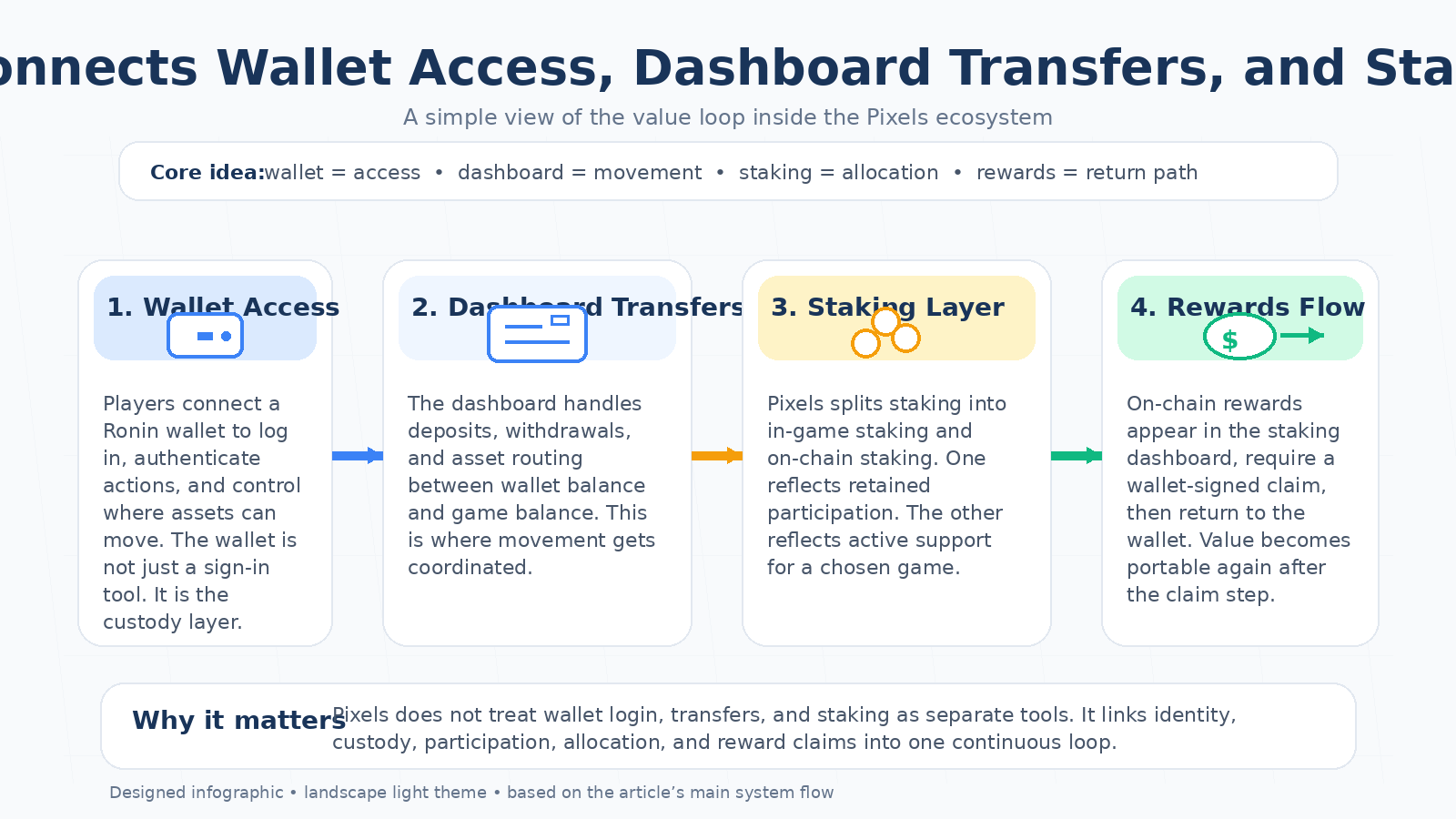
That difference matters more than people think.
It means wallet access, dashboard transfers, and staking rewards are not three disconnected features. They are three layers of the same design choice about where value should live and how intention should be expressed.
If you keep $PIXEL in-game, Pixels reads that more like retained participation. You are still inside the world. Still active. Still behaving like a player the system wants to reward. If you move into on-chain staking, the logic changes. Now you are not only holding value. You are allocating it. The docs say staking lets you support different game projects, and the litepaper goes further by framing the wider system around smarter reward targeting and an ecosystem flywheel built on data, incentives, and game growth.
That is where the dashboard becomes more interesting to me.
Most game dashboards are basically utility panels. Deposit here. Withdraw there. Maybe claim something if you remember. Pixels is pushing a little further. The staking dashboard is where rewards are shown, where claims are initiated, where restakes happen, where unstaked funds wait through the 72-hour lock, and where withdrawn amounts eventually go back to the connected wallet. That makes the dashboard less like a menu and more like an economic checkpoint between game balance and wallet balance.
And the claim flow says a lot too.
Rewards do not just magically appear as abstract numbers. For on-chain staking, they show up under “My Stakes,” then require a wallet-signed transaction to claim, and once approved they are sent to the wallet. That sounds obvious in crypto terms, but it changes the psychological feel of the reward. It is not only a game payout. It is a value path that leaves the staking interface, touches the wallet, and becomes portable again.
I think that portability is the real point.
Pixels has spent a lot of time trying to avoid the old play-to-earn trap where every reward loop immediately becomes extractive. So instead of one blunt system, it has built multiple routes. Keep assets in-game and your activity matters. Move through the dashboard and allocation matters. Claim to wallet and custody matters. The pieces connect, but they do not behave identically. That seems deliberate.
What I find interesting is that this design quietly teaches players a different habit. Not just “play and earn,” but “connect, move, allocate, claim.” The wallet is access. The dashboard is coordination. Staking is preference. Rewards are what come back when those layers stay linked.
That is a more mature system than it first looks like.
My only hesitation is that the more these layers connect, the more friction matters. Wallet attachment rules, re-authentication, withdrawal delays, lockup periods, manual claims for on-chain rewards — those are not bugs in the design, but they do mean the system asks players to understand more than a normal farming game would. The structure is smarter. It is also heavier.
Still, the title feels true to me.
Pixels is not only connecting wallet access, dashboard transfers, and staking rewards mechanically. It is connecting them philosophically. It wants value to move through identity, custody, participation, and allocation in one continuous loop.
And once you see that, the dashboard stops looking like a side feature.
It starts looking like the place where the game explains what kind of economy it is trying to become.
