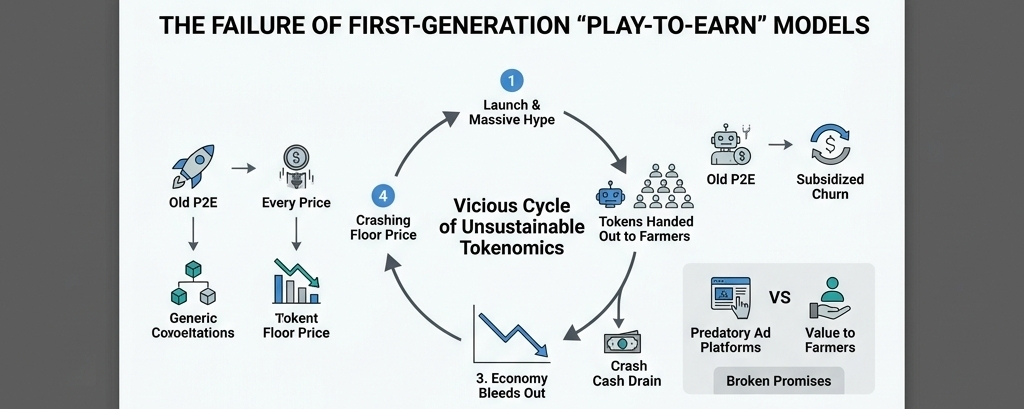
I spent much time watching supposedly brilliant founders set their own treasuries on fire by handing out tokens to anyone with a pulse and a browser extension. It was a gold rush where the only people getting rich were the ones selling the shovels and the bots programmed to strip mine every liquidity pool in sight. We all saw the same cycle where a game would launch with massive hype only to have its economy bleed out in weeks because they built a charity instead of a business. The team behind Pixels lived through that carnage in the trenches and they realized that most play to earn models are just elaborate ways to subsidize churn. That is exactly why they built Stacked because they got tired of watching generic rewards apps act as a funnel for farmers while the actual players got left with nothing but a crashing floor price.
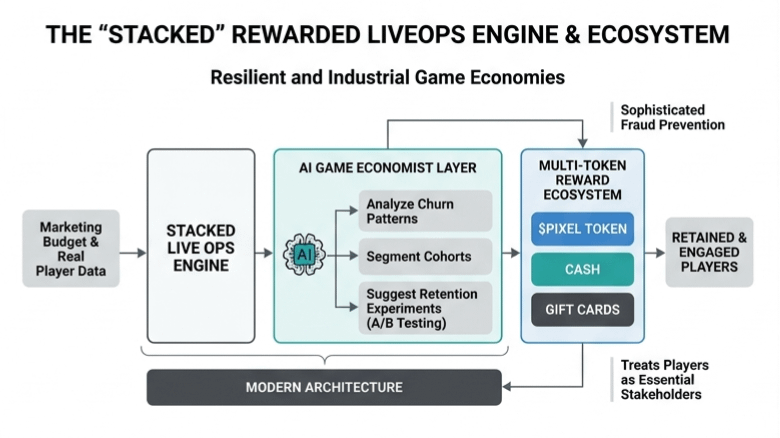
Stacked is essentially a rewarded LiveOps engine with a sophisticated AI game economist sitting on top of it but calling it a rewards app is like calling a Ferrari a golf cart. It represents the battle tested infrastructure that survived the actual adversarial chaos of the Pixels ecosystem. While most teams are busy shipping half baked quest boards that any script can defeat Stacked is already processing hundreds of millions of rewards across millions of users with a level of fraud prevention that took years of scars to develop. It turns the traditional marketing spend on its head by taking the massive budgets that studios usually hand over to predatory ad platforms and redirecting that value straight into the pockets of players who actually show up.
The real magic happens in the AI layer where the system stops guessing and starts calculating. I have seen too many studios wonder why their whales are dropping off between day three and day seven without having a single clue how to stop the bleed. This engine analyzes those specific cohorts and spots the exact churn patterns to suggest reward experiments that actually move the needle on long term retention. It is the difference between throwing money at a wall and knowing exactly which mechanics correlate with a user staying for thirty days. The $PIXEL token remains the heartbeat of this entire machine but the ecosystem is expanding to support cash and gift cards which gives the whole structure the kind of flexibility that a single token economy can never achieve on its own.
We are moving away from the era of idle time and spam quests toward a reality where your engagement has a measurable market value. The industry has spent a decade treating players like a product to be sold to advertisers but Stacked treats them like the essential stakeholders they actually are. It is not some theoretical whitepaper dream because the team already has the receipts from Pixel Dungeons and Chubkins to prove it works under pressure. We are finally seeing the transition from the fragile glass ornaments of early Web3 gaming into something much more resilient and industrial. If the old way of gaming was a leaky bucket then this new architecture is a high pressure pipeline that ensures every drop of value reaches the person who earned it rather than the middleman who just watched it pass by.