
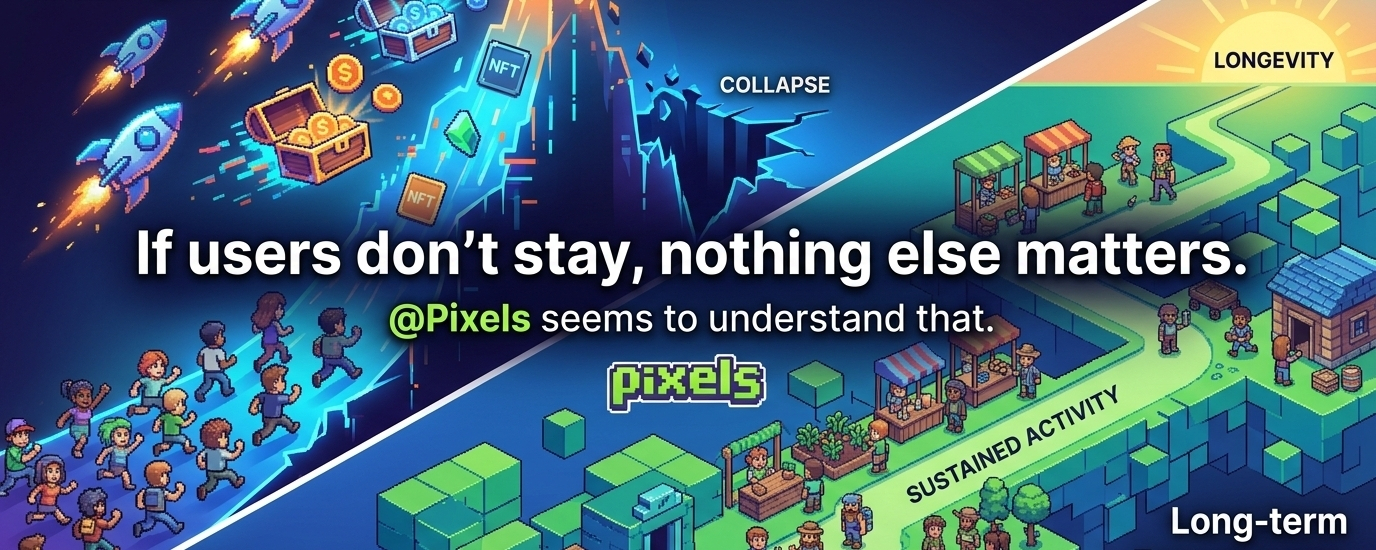
Most Web3 gaming projects don’t collapse because they lack ideas — they collapse because they fail to keep users engaged after the initial hype fades. I’ve seen this happen again and again, where attention spikes early but doesn’t translate into long-term activity.
Looking at @Pixels, I get a slightly different impression. It seems more focused on building an environment where players actually participate instead of just showing up for short-term gains. That difference might not be obvious at first, but over time it can decide whether a project survives or disappears.
What makes $PIXEL interesting in this context is how its role depends on user behavior. If players are active, trading, and interacting within the game, the token becomes part of a functioning system. If they aren’t, then it risks becoming just another asset with no real backing.
I’m not saying it’s guaranteed to succeed — most projects aren’t. But compared to the usual hype-driven approach, @Pixels at least appears to be building in a direction that gives it a better chance of lasting longer than the average Web3 gaming cycle.