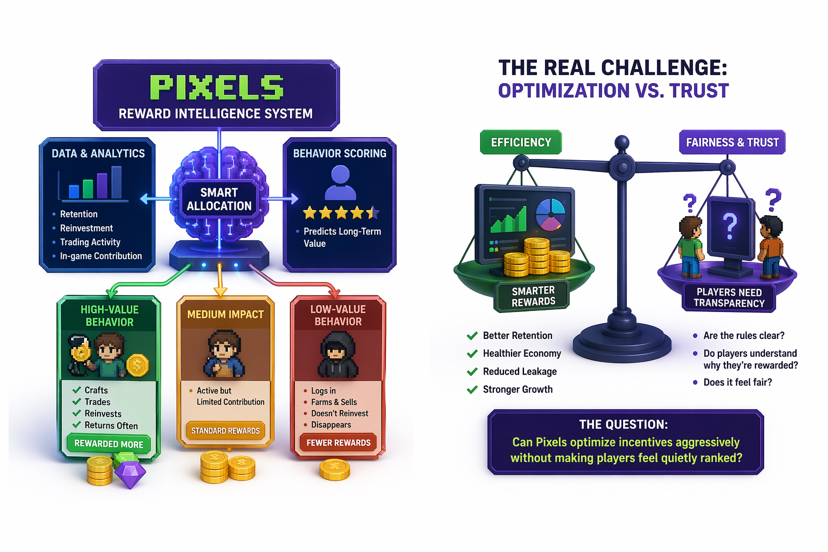

The part I’m not fully convinced about is also the part I find most interesting: Pixels may be building less of a token reward machine and more of a decision engine for who should be rewarded, when, and for what kind of behavior.#pixel @Pixels $PIXEL
That sounds efficient on paper. It also sounds a little uncomfortable.Because the practical question is not whether rewards attract users. Of course they do. The harder question is whether a game can tell the difference between activity that strengthens its economy and activity that simply drains it. Once that becomes the goal, the reward system stops looking like a faucet and starts looking like a filter.

That is why I think people may be slightly underreading what Pixels is trying to do.My read is that the project is moving away from the old web3 gaming habit of treating emissions as broad participation subsidies. Instead, it seems to be building a data layer around incentives. In that model, rewards are not just distributed. They are allocated. And allocation depends on interpretation.
The central claim here is simple: not all engagement is equally useful.A player who logs in, farms rewards, sells, and disappears may help a dashboard look busy, but may not help the economy stay healthy. A player who crafts, trades, reinvests resources, returns consistently, and participates in loops that keep value circulating is more important, even if both accounts look “active” in a surface-level metric. That distinction matters. Raw clicks and daily logins are easy to count, but they are weak signals if the goal is durable economic behavior rather than temporary traffic.
This is where the mechanism gets more interesting.Pixels has been increasingly explicit that smart reward targeting is a core part of the architecture. The idea, at least conceptually, is that machine learning and analytics can help identify which user behaviors produce stronger retention, more productive reinvestment, better spending patterns, healthier in-game circulation, and better long-term ecosystem outcomes. In other words, rewards become precision tools. They are meant to shape behavior, not just subsidize it.
That is a meaningful shift.A normal emission system asks: how much do we distribute?A more optimized system asks: what behavior are we trying to buy?A data-driven reward system goes one step further and asks: which users are most likely to convert incentives into compounding value?
That last question is much more powerful. It is also much more controversial.Because once rewards are filtered through models and behavioral scoring, the system starts making judgments. Maybe not moral judgments, but economic ones. It begins deciding that some forms of participation matter more than others. That a reinvesting player is more valuable than a short-term extractor. That someone creating liquidity inside the game economy deserves more support than someone merely passing through it. From a treasury-efficiency point of view, that logic makes sense. From a player-experience point of view, it creates tension immediately.
I can imagine the real-world scenario pretty clearly.Two players are both active. Both spend time in the ecosystem. Both believe they are contributing. But one starts receiving better quests, stronger incentives, or more meaningful reward opportunities. The other notices the gap but cannot fully see the model behind it. Now the issue is no longer just optimization. It becomes legitimacy. Players do not only care whether rewards are mathematically efficient. They care whether the rules feel understandable and fair.
That is the harder layer of the Pixels design.If the project is serious about turning rewards into a precision allocation system, then fairness cannot be treated as a side effect. It has to be part of the product. Invisible optimization may improve economic efficiency while weakening trust. And in games, trust in the logic of the system matters more than many token designers admit. A player can tolerate grind. A player can tolerate volatility. What is harder to tolerate is the feeling that an unseen model is deciding your value without telling you why.
This is why I think retention and reinvestment are much stronger signals than raw activity, but also why those signals need careful translation into player-facing design.On the economic side, rewarding retention makes sense because repeat participation is usually a better sign of product-market fit than one-time reward harvesting. Rewarding reinvestment also makes sense because it suggests value is staying inside the loop rather than being extracted immediately. These are better indicators of durable health than headline engagement numbers. But once those signals become inputs to an incentive model, the project has to answer a governance question as much as an analytics question: who defines “useful” behavior, and how often does that definition change?
That tradeoff is where the piece becomes interesting to me.A less optimized reward system wastes capital, feeds mercenary behavior, and hides behind vanity metrics.A more optimized reward system can improve efficiency, reduce leakage, and support healthier growth.But if it becomes too opaque, it risks feeling like hidden favoritism with better dashboards.
That is not a small problem. In web3, incentive design is not just an economy question. It is also a coordination question. The more precisely a platform can steer rewards, the more power it has over what kinds of users and actions become dominant. If this works, Pixels may end up with something stronger than a token loop. It may end up with a live behavioral allocation layer sitting underneath the game economy. That would be strategically important. It would also mean the reward engine itself becomes one of the most sensitive parts of the system.
What I’m watching next is not whether Pixels can make rewards smarter in theory. That part is believable enough. I want to see whether it can make smart targeting legible to players without losing the efficiency gains it is chasing. I want to see whether better allocation actually improves retention quality and economic durability, not just near-term metrics. And I want to see whether the system can distinguish between productive behavior and merely profitable-looking behavior.
The architecture is interesting, but the operating details will matter more.#pixel @Pixels $PIXEL
If Pixels really becomes a data layer for rewards rather than just an emission machine, can it optimize incentives aggressively without making players feel like the game is quietly ranking their worth?