
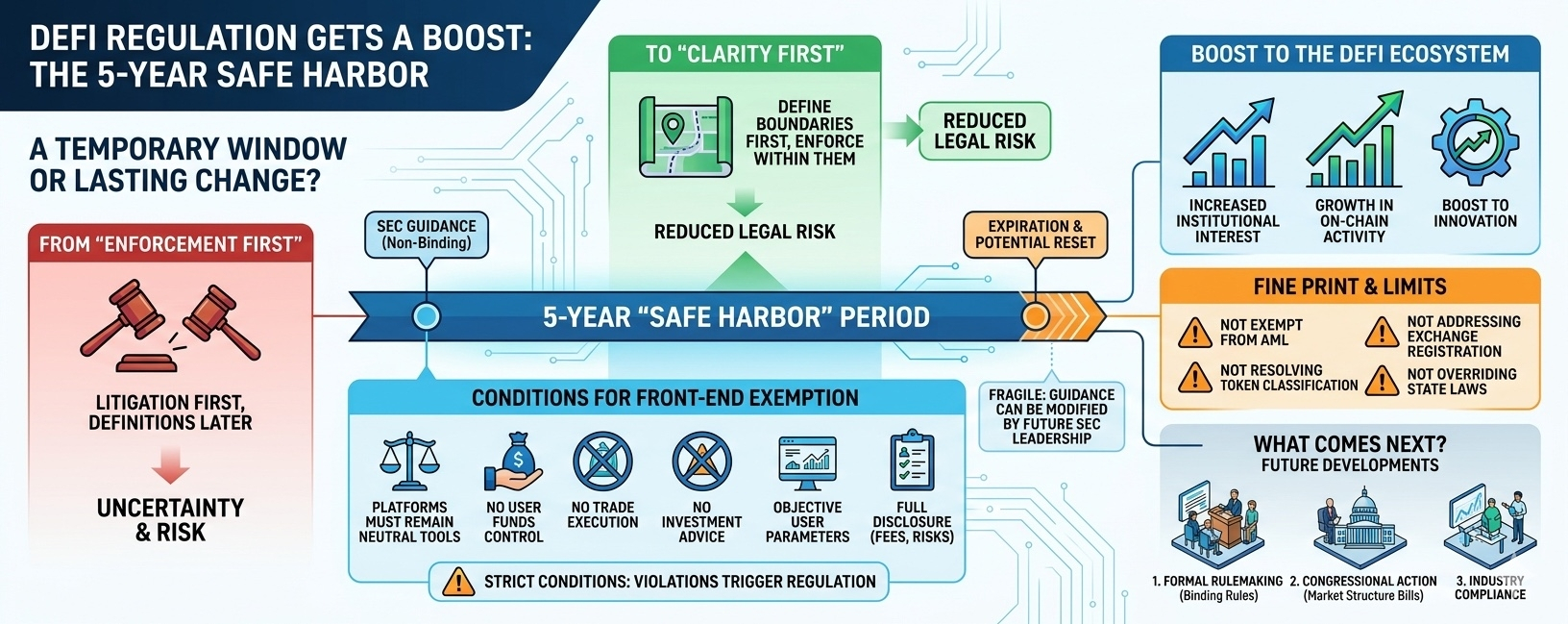
The U.S. SEC’s latest guidance marks one of the most significant regulatory developments for DeFi in recent years. By introducing a conditional exemption for front-end interfaces and a five-year “safe harbor,” regulators are signaling a shift toward clearer, more innovation-friendly rules. But beneath the optimism lies an important question: is this a lasting transformation or just a temporary window?
A Five-Year “Safe Harbor” — What It Really Means
At the core of this update is a five-year safe harbor period. During this time, certain DeFi front-ends—such as web interfaces, wallet swap features, DEX aggregators, and mobile apps—can operate without registering as broker-dealers, provided they meet strict conditions.
This is a major shift. Previously, many DeFi developers operated in a legal gray zone, uncertain whether their platforms could be classified as unregistered brokers. Now, the SEC has drawn a clearer line.
However, this is not a free pass. The exemption applies only if platforms remain purely neutral tools, meaning they must:
▪ Not hold or control user funds
▪ Not execute or match trades
▪ Not provide investment advice
▪ Not actively promote specific transactions
▪ Operate based on objective, user-driven parameters
▪ Fully disclose fees, risks (like MEV and slippage), and conflicts of interest
If any of these conditions are violated, the platform could still fall under traditional securities regulation.
From “Enforcement First” to “Clarity First”
One of the most important aspects of this guidance is the regulatory tone shift.
Previously, the approach was often described as:
“Litigation first, definitions later”
Now, the SEC appears to be moving toward:
“Define boundaries first, enforce within them”
This change reduces uncertainty and gives developers a clear compliance roadmap. It also lowers the legal risk that previously discouraged innovation and investment in DeFi.
Why This Matters for the DeFi Ecosystem
This guidance could have a multiplier effect across the entire crypto market, especially in ecosystems heavily reliant on decentralized applications.
1. Boost to Innovation
Developers now have clearer rules, which encourages building new products without constant fear of enforcement.
2. Increased Institutional Interest
Regulatory clarity is a key requirement for institutional capital. This move could attract more serious players into DeFi.
3. Growth in On-Chain Activity
With front-ends legitimized (under conditions), user access to decentralized trading becomes easier and safer, potentially increasing on-chain volume.
The Fine Print: Limits of the Exemption
Despite the optimism, it’s critical to understand what this guidance does NOT cover.
▪ It does not exempt platforms from AML (Anti-Money Laundering) requirements
▪ It does not address exchange registration rules
▪ It does not resolve securities classification of tokens
▪ It does not override state-level regulations
In short, this is a targeted exemption, not a full regulatory framework.
The Temporary Nature of the Policy
Here’s where things get uncertain.
This guidance is:
Non-binding (staff-level interpretation)
Time-limited (expires in 5 years)
If no permanent regulation replaces it, the industry could face a regulatory reset—bringing back uncertainty.
Even more importantly, future leadership changes at the SEC could:
Modify the interpretation
Revoke the guidance
Introduce stricter rules
This makes the current environment constructive but fragile.
Industry Reactions: Optimism with Caution
Industry leaders generally view the move as a step in the right direction, but not the final destination.
Some see it as a practical roadmap for compliance
Others highlight that true legal certainty requires Congressional action
There are calls for the creation of a permanent regulatory framework instead of temporary solutions.
وهناك دعوات لإنشاء إطار تنظيمي دائم بدل الحلول المؤقتة
The consensus is clear:
👉 This is progress—but not completion.
What Comes Next?
Several key developments will determine whether this becomes a lasting shift:
1. Formal Rulemaking
Will the SEC convert this guidance into binding rules?
2. Congressional Action
Legislation like market structure bills could solidify these definitions.
3. Industry Compliance
How well DeFi platforms adapt to these conditions will influence future regulatory decisions.
Final Take: Opportunity Window or Structural Change?
This SEC guidance is best understood as a strategic opening rather than a permanent solution.
It creates:
A 5-year innovation window
A testing ground for compliant DeFi models
A bridge toward future regulation
But it also introduces urgency.
Projects that use this period to:
Build compliant systems
Strengthen transparency
Align with regulatory expectations
…will be better positioned if stricter rules come later.
On the other hand, those treating it as a loophole may face challenges when the safe harbor expires.
Bottom Line
DeFi just received one of its clearest regulatory signals yet—but it comes with an expiration date.
Smart builders and investors won’t just celebrate this move—they’ll prepare for what comes after it.
#DeFi #CryptoRegulation #BlockchainInnovation #CryptoEducation #ArifAlpha