

I think a lot of people still misunderstand Pixels because they view it as only a farming game that became more popular.That version still exists. Crops, animals, land, routine, the familiar loop. It is still there on the surface. But the official material is pretty clear that Pixels no longer wants to be understood as one successful Web3 farm sim. The whitepaper says the ambition was always broader than a single game, and frames the project as an attempt to build a new model for game growth and user acquisition, not just a better reward loop for one title.
That is why “Farming 2.0” feels like the right phrase to me.
Not because the farming got shinier. Because the logic underneath it changed.
The old way of reading Pixels was simple enough: play the game, grind the loop, earn the token, maybe stay if the economy holds. The newer material sounds colder than that. More deliberate. Pixels now describes its reward system as a data-driven infrastructure, almost like a next-generation ad network, designed to identify which player actions actually create long-term value and then direct rewards accordingly. That is a very different idea from broad play-to-earn emissions.
And honestly, that is the real update.
The farming is no longer the whole product. It is the front-end behavior layer for a larger ecosystem machine.
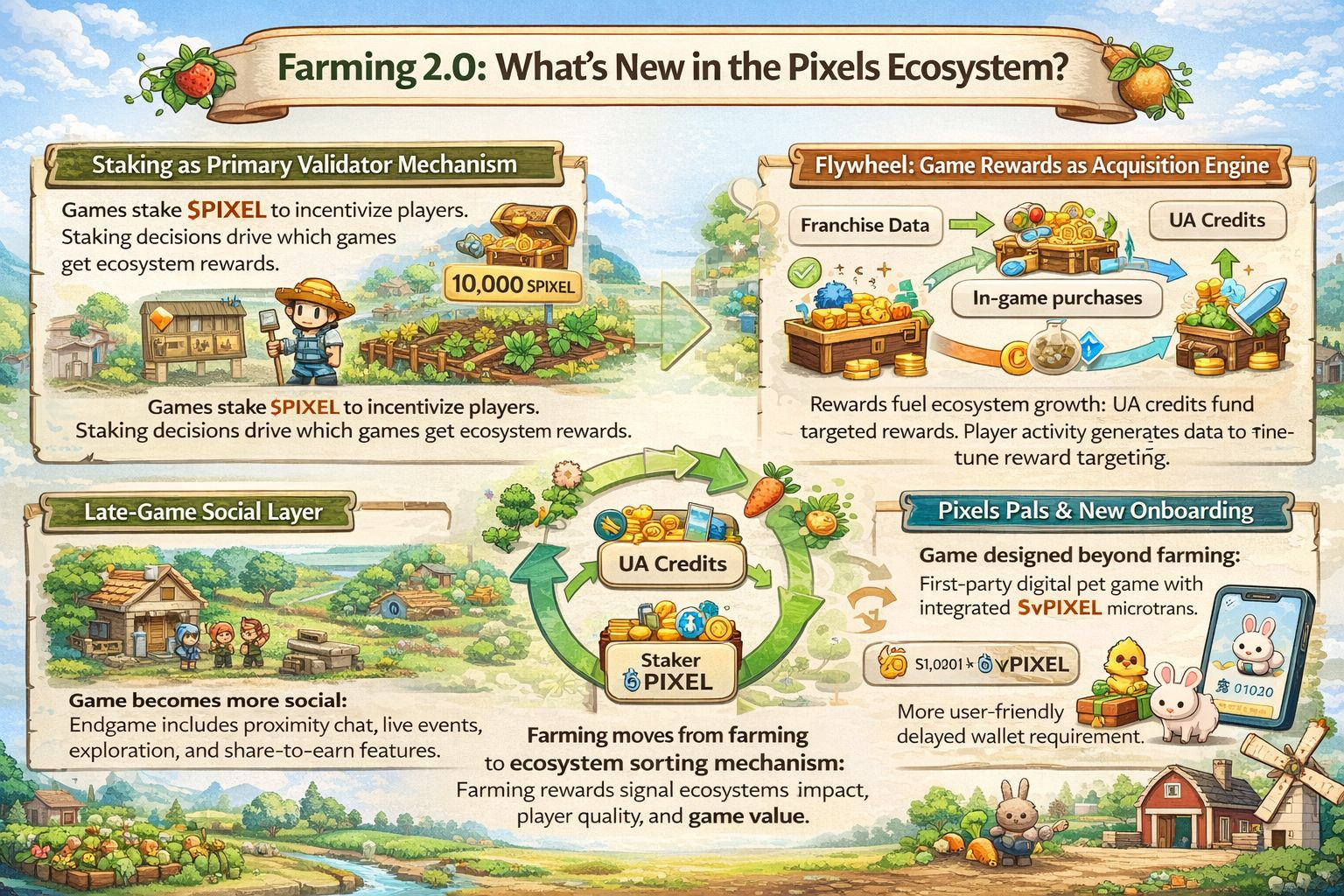
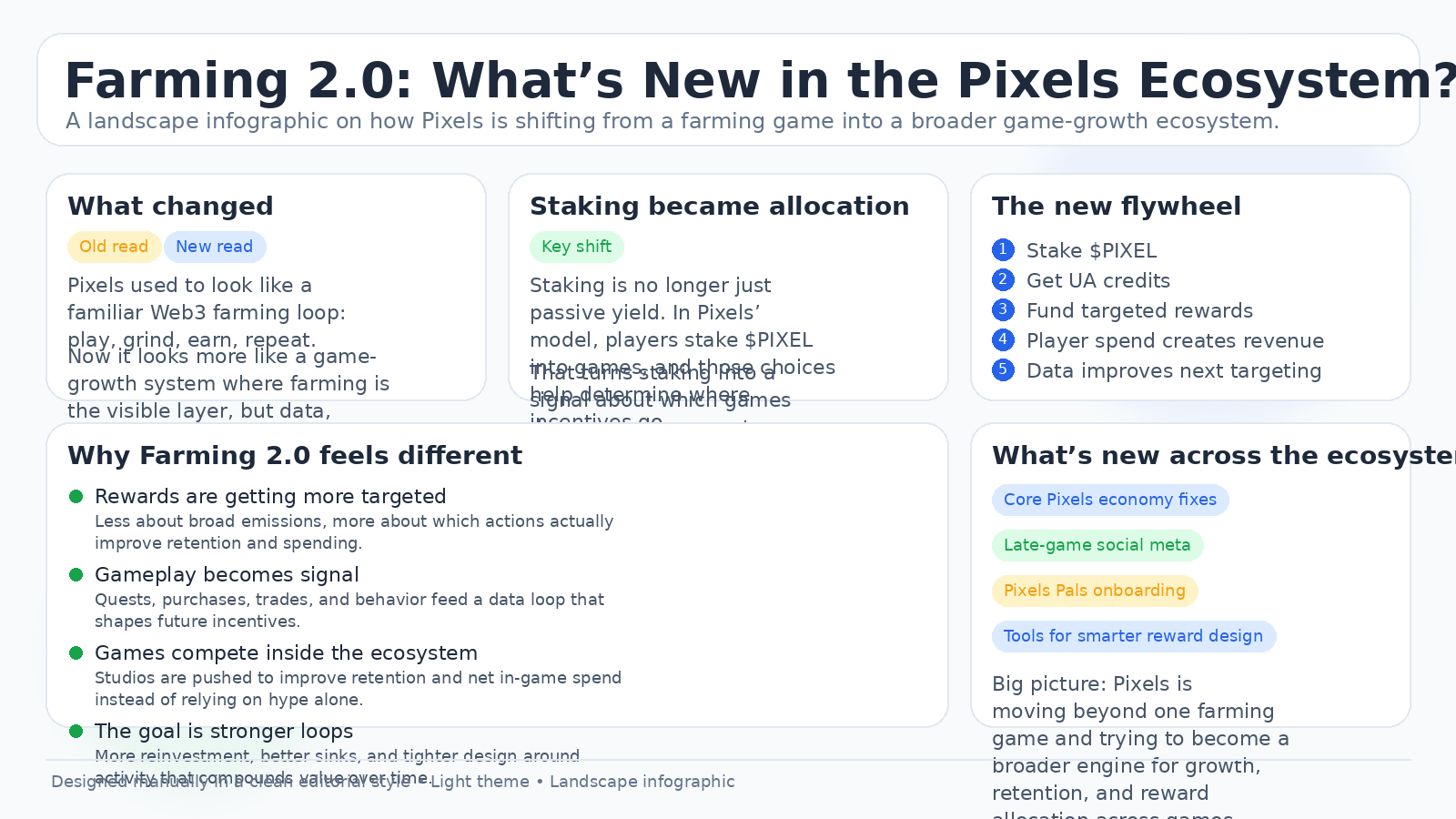
You can see it most clearly in staking. Pixels says staking is being redesigned so that games themselves become the ecosystem’s primary “validators.” Players stake $PIXEL into games, and those staking decisions influence which games receive incentives and how rewards get allocated. That means staking is not being framed as passive yield anymore. It is being reframed as capital allocation inside a publishing ecosystem.
That shift matters more than it sounds.
Because once games become validators, the question is no longer just “is this game fun?” It becomes “is this game retaining players, generating spend, and using ecosystem resources well enough to deserve more support?” Pixels says rewards are distributed based on game-specific performance, while studios compete by improving retention, increasing net in-game spend, and using Pixels tools effectively.
So Farming 2.0, at least in the Pixels version, looks less like digital agriculture and more like a sorting system.
Then there is the flywheel, which I think is where the project stops sounding like a game economy and starts sounding like infrastructure. The whitepaper lays it out almost mechanically: $PIXEL staking turns into UA credits, those credits fund targeted in-game rewards, player spend creates revenue share, rewards flow back to stakers, and the resulting activity generates richer data that improves future targeting. Pixels describes that loop as circular and compounding, with the goal of pushing return on reward spend above 1 and keeping it there.
That is not just a farming update.
That is a publishing model wearing farming clothes.
And I do not say that as a criticism exactly. I say it because I think people still talk about Pixels as if the main thing happening is tokenized gameplay. The official material suggests the team is trying to turn gameplay into signal: signal about retention, spending behavior, fraud risk, churn, and which kinds of rewards actually strengthen the ecosystem instead of draining it. The Events API and first-party data loop are central to that logic. Purchases, quests, trades, and withdrawals are treated as behavioral inputs that refine future reward allocation.
That is why the ecosystem feels different now.
Even the updates inside core gameplay are less cosmetic than they first appear. The whitepaper says Core Pixels exposed two big problems: the loop recycled coins without enough sinks, and late-game activity was too limited, which pushed players toward withdrawal instead of reinvestment. The proposed fixes are not random content additions. They are economic repairs: progressive speck upgrades, crafting durability, higher-tier recipes, inventory caps, and VIP gating for daily tasks and withdrawals. All of that is meant to tighten the cycle of craft, earn, upgrade, and craft again.
That part is important because it shows Pixels knows the old farming loop was not enough.
A game can look busy and still leak value everywhere.
The late-game changes are also telling. Pixels describes Chapter 3 as an “end-game social meta,” with exploration realms, live events, proximity chat, emote-based interactions, referrals, and share-to-earn features. That reads like an attempt to make the ecosystem stick socially, not just economically. In other words, they are not only trying to improve farming. They are trying to make staying inside the world more meaningful than extracting from it.
Then there is Pixels Pals, which might be the clearest sign that Pixels is thinking beyond the original game. The whitepaper describes it as a first-party digital pet game designed for broader adoption, with a delayed wallet requirement and integrated $vPIXEL microtransactions. That is a very different onboarding philosophy from older Web3 game design, where wallets and tokens were often shoved in front of the player too early.
So what is new in the Pixels ecosystem?
Not just more farming.
What is new is that farming no longer looks like the endpoint. It looks like the training ground. The visible loop still involves crops, land, energy, and routine.
Pixels is doing more than just running a game.Pixels is creating a setup that chooses which games deserve rewards, which players should be encouraged, and which actions make the whole ecosystem stronger little by little.Still, the official site presents the more friendly version: play with friends, earn rewards, own your world.The whitepaper tells the deeper story: staking as game validation, rewards as targeted acquisition, and gameplay as data infrastructure.
That is why I do not really read Pixels as “a farming MMO with extra features” anymore.
I read it as a game that used farming to build the user layer for something bigger.
Whether that bigger thing becomes a durable gaming ecosystem or just a very elaborate reward-optimization engine is still the open question. But the update is real. Farming 2.0 in Pixels is not about better crops.
It is about what the crops are being used to measure.
