


I usually get skeptical when a project says its token has “utility.” That word gets stretched so far in crypto that it often ends up meaning little more than “you can use it somewhere.” What caught my attention in Pixels is that the claim seems more specific than that. The whitepaper is not just saying pixel can be spent, staked, or held. It is trying to describe a system where the same unit of value keeps reappearing in productive roles inside one economic loop. That is a much stronger claim, and also a much harder one to prove.#pixel @Pixels $PIXEL
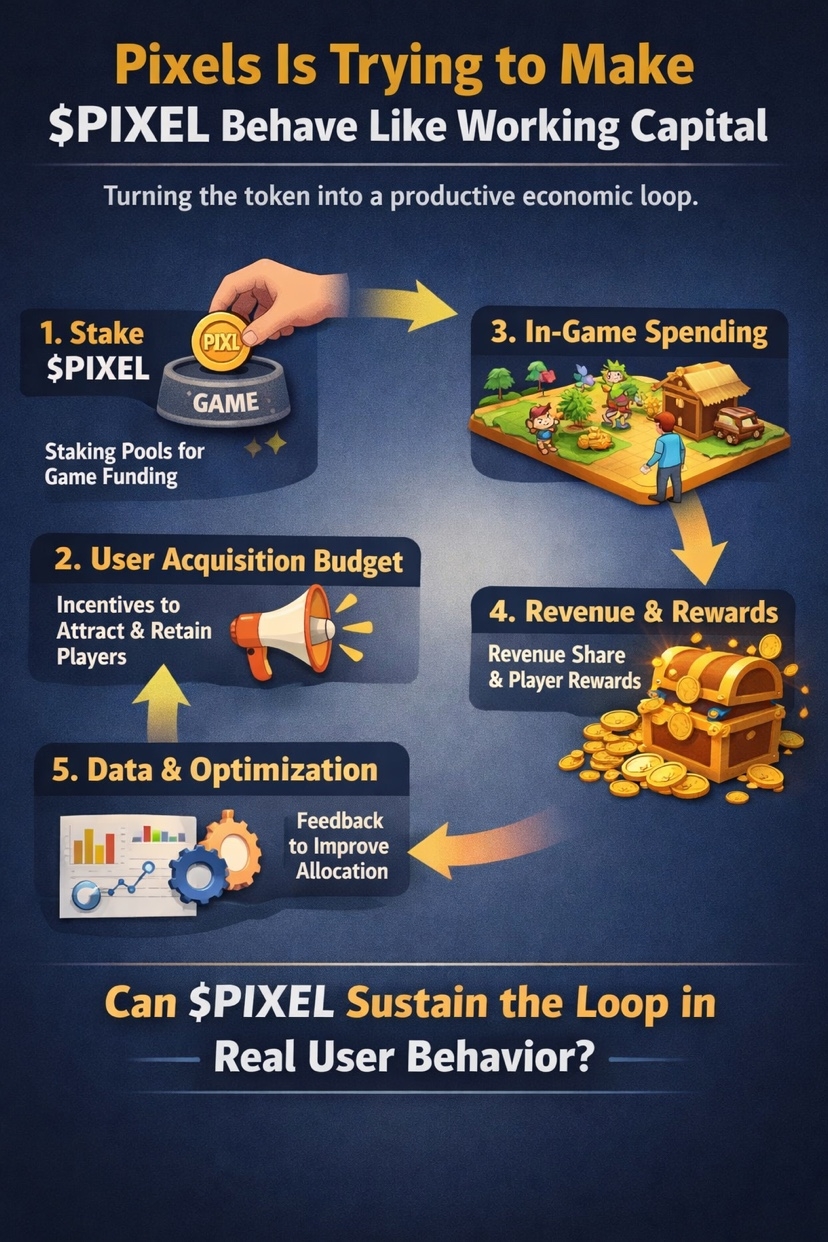
My read is that Pixels is trying to turn the token from a payout object into something closer to productive capital. In normal business terms, productive capital is not valuable because it exists in a wallet or account. It is valuable because it gets deployed, generates activity, produces measurable return, and then gets redeployed again. That seems to be the framing here. The project’s own loop is explicit: staking leads to user-acquisition credits, those credits drive player spend, that spend creates revenue share and rewards, that activity generates data, and that data is then used to improve the next allocation cycle.
That matters because a lot of gaming tokens never really circulate in a productive way. They are emitted, claimed, sold, and discussed as if distribution alone were an economy. Pixels is admitting that this model did not work well enough. In its revised vision, the team openly points to token inflation, sell pressure, and mis-targeted rewards as core problems from its earlier growth phase. It also says many users were extracting value without meaningful reinvestment, which is basically another way of saying the system had too much outward flow and not enough internal compounding.
So what is the alternative? Pixels seems to be trying to create closed circulation.Closed circulation does not mean nobody can exit. It means the system is designed so value does not immediately leak at every step. The token first appears as stake. According to the whitepaper, players can stake pixels behind specific games, and those staking pools influence which games receive ecosystem incentives. In other words, stake is not just passive lockup. It is closer to capital allocation inside the publishing ecosystem.
From there, Pixels says that stake can convert into an on-chain user-acquisition budget. That is one of the more unusual pieces of the design. Instead of thinking of token rewards as generic emissions, the system frames them as targeted growth spend. A game’s pool effectively becomes budget for incentives aimed at attracting or re-engaging players. So now the token is no longer just sitting as collateral. It is acting like deployment capital.
The next step is the one that decides whether this is a real loop or just elegant wording. If those targeted incentives bring players in, and those players actually spend inside the game, then the subsidy starts producing measurable economic activity. Pixels describes gross revenue accruing on-chain in the same contract path that issued the UA credits, creating a visible record of spend versus subsidy. That is important because it moves the conversation away from vanity metrics. The relevant question becomes: did reward spend produce durable monetization, or did it just buy temporary activity?
Then comes the feedback layer. The project says games determine rewards for stakers, and that first-party data from purchases, quests, trades, and withdrawals feeds into models that retrain and reweight future reward budgets. The stated goal is to push more incentives toward players and moments that improve retention, ARPDAU, and overall Return on Reward Spend, while reducing leakage to extractive users. In plain English, Pixels wants rewards to behave less like giveaways and more like reinvestment decisions.
This is why I think “productive capital” is a better lens than “utility.” Utility is often static. It asks whether a token can do something. Productive capital is dynamic. It asks whether the token can move through a loop, generate output, and come back more useful than before. Pixels is clearly trying to make that second argument. It even describes the economy as “deliberately circular” and says the loop is meant to compound until Return on Reward Spend stays above 1. That is a much more ambitious claim than saying the token has multiple use cases.
A simple real-world-style scenario makes the design easier to see.Imagine one holder stakes pixels behind a game inside the Pixels ecosystem. That stake contributes to the game’s reward budget. The studio uses those credits to target players who are more likely to stay, spend, or contribute economically rather than just farm and exit. Some of those players start spending in-game. Part of that activity flows back into rewards and data. The staker is no longer just waiting for emissions. They are backing a game’s economic efficiency. The token is no longer just a reward chip. It is functioning more like working capital inside a closed operating loop. That is the theory, at least.
The reason this matters is that web3 gaming has often confused motion with health. High DAU, lots of claims, lots of transactions, lots of token movement. But movement alone does not mean an economy is getting stronger. If tokens mostly leave the system after distribution, the loop is not compounding. It is draining. Pixels seems to understand that now, which is why its revised framing focuses on higher-quality DAU, smarter targeting, reduced extraction, and measurable return on reward spend rather than raw participation numbers alone.
I still think there is a real open question here. A closed loop only works if the circulation is genuinely productive. If rewards are still misallocated, if player spend is weak, or if games cannot convert subsidized activity into durable behavior, then “closed circulation” can become a nicer way of describing internally recycled incentives. That is the tension I would watch most closely.
So the interesting question is not whether Pixels has utility. Plenty of tokens can claim that. The harder question is whether Pixels can actually make one unit of token value cycle through stake, acquisition, spend, revenue, and data in a way that compounds instead of leaks.
If Pixels wants pixels to act like productive capital, can the loop stay efficient once real user behavior not just token design starts testing it?#pixel @Pixels $PIXEL