
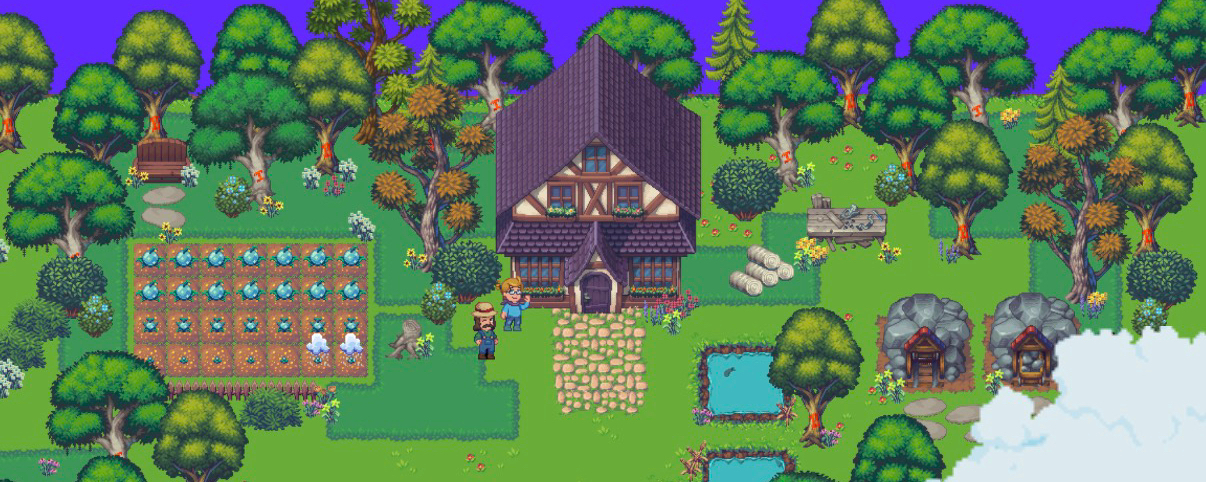
I’ve been revisiting again, and honestly, the reason is not just the chart. What pulled me back is that Pixels does not feel like one of those GameFi projects that had one hot phase, got attention, and then slowly faded into background noise. The more I looked at what the team has been doing lately, the more I felt this project is trying to evolve beyond the usual “game + token” setup. Pixels still presents itself as a live farming and exploration game on Ronin, still pushes Chapter 2 as a big step in its game design, and still frames @Pixels around staking, progression, and ecosystem participation rather than just raw emissions.
What stands out to me most is that Pixels seems to understand a problem that broke a lot of older Web3 games. In this space, teams usually want one token to do everything at once. They want it to be the reward token, the farming output, the daily spending currency, the premium asset, and the thing people speculate on. That usually ends badly because the token gets crushed under its own purpose. Pixels openly addressed that in its FAQ when it explained why it moved away from $BERRY and shifted toward an off-chain coin system for more routine in-game activity. The team said Chapter 2 was designed in part to protect $PIXEL, reduce sell pressure, and simplify the economy. For me, that is a much smarter direction than pretending the old play-to-earn model just needed better marketing.
That Coins versus split is still one of the biggest reasons I find the project interesting. I actually think a lot of people underestimate how important this kind of design choice is. If your normal repetitive in-game actions are handled through a softer internal currency, then the main token has a better chance of being tied to things that feel more strategic or premium. That creates some breathing room. It gives the team more control over balancing the gameplay economy without putting constant direct pressure on the token every time players grind. It does not remove risk, and it does not magically solve retention, but it shows the team is thinking about the economy like a real system instead of a reward faucet. In GameFi, that alone already puts Pixels ahead of a lot of projects I’ve watched over the years.
What makes this more interesting now is that Pixels is no longer talking only about one game. The newer Stacked push is the part that really changed how I look at the whole ecosystem. Official posts around Stacked describe it as the next layer of the ecosystem, built from everything the team learned while scaling Pixels. For players, the idea is simple on the surface: play games, complete missions, earn rewards, and cash out. But for studios, the system is being positioned as a LiveOps and rewards engine with event tracking, targeting, reward logic, fraud controls, payouts, testing, and even an AI-powered game economist layer. That is a very different story from just saying “our token has utility inside a game.” It starts to sound more like Pixels is trying to turn its experience with game economies into a broader infrastructure product.
And honestly, I think that is the more serious angle now. A lot of Web3 gaming teams wanted to build economies, but most of them never really knew how to manage incentives. They could launch quests, rewards, NFTs, and tokens, but they could not stop the system from attracting the wrong behavior. Too much farming, too much short-term extraction, too little focus on retention or real player value. Stacked looks like a response to that exact failure. The whole pitch is about rewarding the right player for the right action at the right time and then measuring whether that reward actually improved retention, revenue, or long-term value. That may sound like a small shift in wording, but to me it is actually a huge difference. It means the team is trying to build with more discipline instead of just chasing activity numbers.
I also like that Pixels has not abandoned the parts of the ecosystem that make the token feel tied to something bigger than a simple reward loop. The official site still leans hard into staking, and the staking FAQ makes it clear that $PIXEL is meant to support games in the Pixels ecosystem while giving users rewards and a role in the platform’s future. That is important because it shows the token is being framed less as something to constantly extract and more as something linked to ecosystem alignment. On top of that, the main site still pushes the world itself, the Chapter 2 upgrade, and the idea that what players build and own can earn blockchain-backed rewards. I think that matters because it keeps the token connected to a living game identity rather than just a dashboard narrative.
Another thing I find worth watching is that the ecosystem seems to be broadening instead of shrinking. Stacked’s rollout references Pixels, Pixel Dungeons, Sleepagotchi, and Chubkins as part of the first-party ecosystem it is launching through. That tells me the team is no longer thinking in terms of one title carrying everything alone. It is trying to build a shared rewards layer across multiple products. That is a stronger setup than the old model where one game had to generate all the excitement, all the token demand, and all the retention on its own. If this ecosystem approach actually gains traction, then becomes easier to understand as a cross-ecosystem asset rather than just a token attached to one farming loop.
At the same time, I do not want to act like this is some perfect setup, because it is not. Web3 gaming is still difficult, and I think it stays difficult even when the team is making smarter decisions than average. Good reward design helps, but it does not guarantee players will stay. Staking helps, but it does not automatically create premium demand. Ecosystem expansion sounds exciting, but it still has to translate into actual behavior from real users. The market can also stay harsh for gaming tokens much longer than people expect. So I am not looking at $PIXEL like a sure thing. I am looking at it as one of the few projects in this sector that at least seems aware of what broke the earlier model and is actively trying to redesign around that.
That is really why I keep coming back to it. I am not interested in $PIXEL just because it belongs to a Web3 game. I am interested because Pixels looks like a team that stopped treating tokenomics like decoration and started treating it like product design. The move away from direct inflation-heavy reward structures, the push toward a more controlled game economy, the staking direction, and now the broader Stacked layer all make it feel like this project is trying to become something more durable than a short-term GameFi narrative. Maybe it works, maybe it does not, but I can at least say it feels more thoughtful than most of what this sector usually gives us. And right now, that is enough to keep on my radar.