
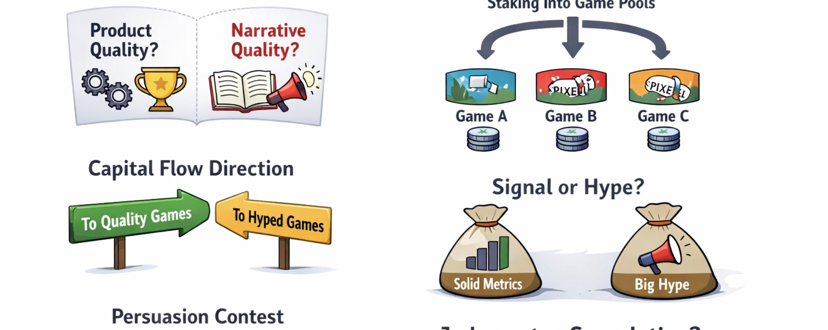

when Pixels says games become the validators, what exactly are stakers being asked to judge?That is the part I find more interesting than the headline novelty.On paper, the design sounds clever. Instead of staking into a generic network security pool, users stake $PIXEL behind specific game pools. Support is not spread evenly across the ecosystem. It becomes selective. Directed. Competitive. But the practical friction shows up immediately: most stakers are not game economists, and many are not even active players across every title they are expected to evaluate. So what are they really selecting? Better products, or better stories about future products?#pixel @Pixels $PIXEL
My read is that Pixels is quietly turning staking into a publishing decision.That changes the role of the token. In a traditional chain model, staking is mostly about security, uptime, and validator behavior. In the Pixels framing, staking looks more like capital assignment. A game pool attracts stake, that stake helps signal ecosystem support, and support influences where incentives, attention, and future economic flow may concentrate. The validator is no longer just infrastructure. The validator is the game itself.
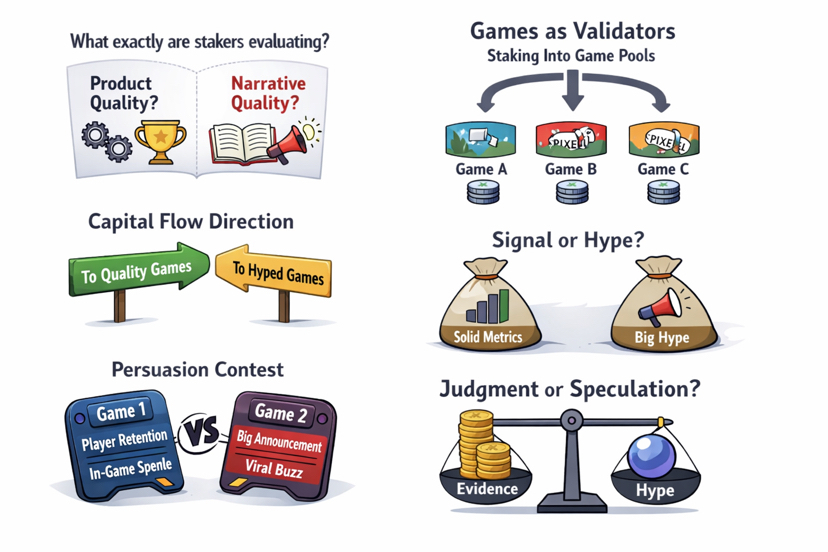
That sounds like a semantic change, but it is actually a power-allocation change.Once games compete for stake, the center of gravity shifts away from one flat ecosystem token story and toward internal market selection. Stakers stop acting like passive yield collectors and start acting more like allocators. They are indirectly deciding which game deserves backing, which loop looks healthier, which team seems more credible, and which product deserves a larger share of future momentum.
The mechanism matters here. Pixels describes a one-token system with many validators, where staking pools are attached to specific games. That means support is not only belief in the overall ecosystem. It is belief in one part of the ecosystem over another. In plain business terms, this starts to resemble publishing budgets more than classic staking. Capital flows toward the game that appears most likely to convert support into retention, spend, activity, and durable economic contribution.
That is the theory, at least.The reason I hesitate is that publishing decisions are notoriously messy even in traditional gaming, where publishers have access to richer data, internal dashboards, live cohort behavior, and teams they can directly pressure for execution. Here, the decision is partly pushed outward to token holders, who may not have that same visibility. So the elegant version of the model is that capital follows product quality. The less elegant version is that capital follows narrative quality.And those are not the same thing.A game with strong retention, disciplined sinks, healthy player behavior, and real monetization should, in principle, attract more stake over time. That would be the bullish interpretation. Staking becomes a market-based filter for quality. Better games get more support. Worse games get less. Incentives become more economically honest because they are not distributed as if every title contributes equal value.
But crypto has a habit of compressing long operating questions into short narrative windows. A game with the better deck, louder community, stronger token speculation, or cleaner marketing language may attract capital before it proves product strength. If that happens, staking does not become a quality signal. It becomes a persuasion contest.
That is the deeper tension in the Pixels design.Take a simple scenario. Two game pools compete for the same amount of staked capital. One game has modest branding but solid behavioral metrics: players return consistently, spend inside the loop, and do not immediately extract rewards. The second has a cleaner story: bigger announcement cycle, more visible partnerships, better social engagement, and a more exciting promise of scale, but weaker actual player quality. If stake flows faster to the second pool, then the system may be rewarding legibility rather than durability.
In that case, staking starts to resemble early-stage publishing at its most fragile. Money chases the title that can explain itself best, not necessarily the one building the strongest in-game economy.
This is why the model matters beyond Pixels itself.Web3 gaming has spent years struggling with a simple distortion: token incentives often treat activity as proof of value. Pixels seems to be trying something more selective. Instead of assuming every game deserves equal backing, it creates a structure where support can move. That is healthier in theory. It gives the ecosystem a coordination layer for internal capital allocation. It makes the token do more than sit, farm, or speculate. It asks the market to express preference.
The problem is that markets express preference through whatever information is easiest to read, not always whatever is most true.So the real advantage of this staking model is also its biggest vulnerability. It can surface quality, but it can also amplify narrative asymmetry. Teams that understand messaging may capture stake earlier than teams that understand game balance. Short-term excitement may outrun slower evidence. And once incentives begin flowing in that direction, the system can reinforce the original mispricing.
I do not think that makes the design bad. It makes it more serious.Because now the question is no longer whether staking produces yield. The question is whether staking produces judgment. Can the ecosystem distinguish between games that are genuinely compounding value and games that are simply easier to sell? Can capital move based on evidence instead of mood? Can game pools earn support through product quality, not just token-native storytelling?
That is what I want to see proven next.If Pixels is turning staking into a publishing layer, then transparency around game performance becomes more important than the staking mechanic itself. The architecture is interesting, but the operating details will matter more. If this becomes the new coordination layer, who is actually best equipped to control the incentives: the players, the stakers, the teams, or the narratives?#pixel @Pixels $PIXEL