
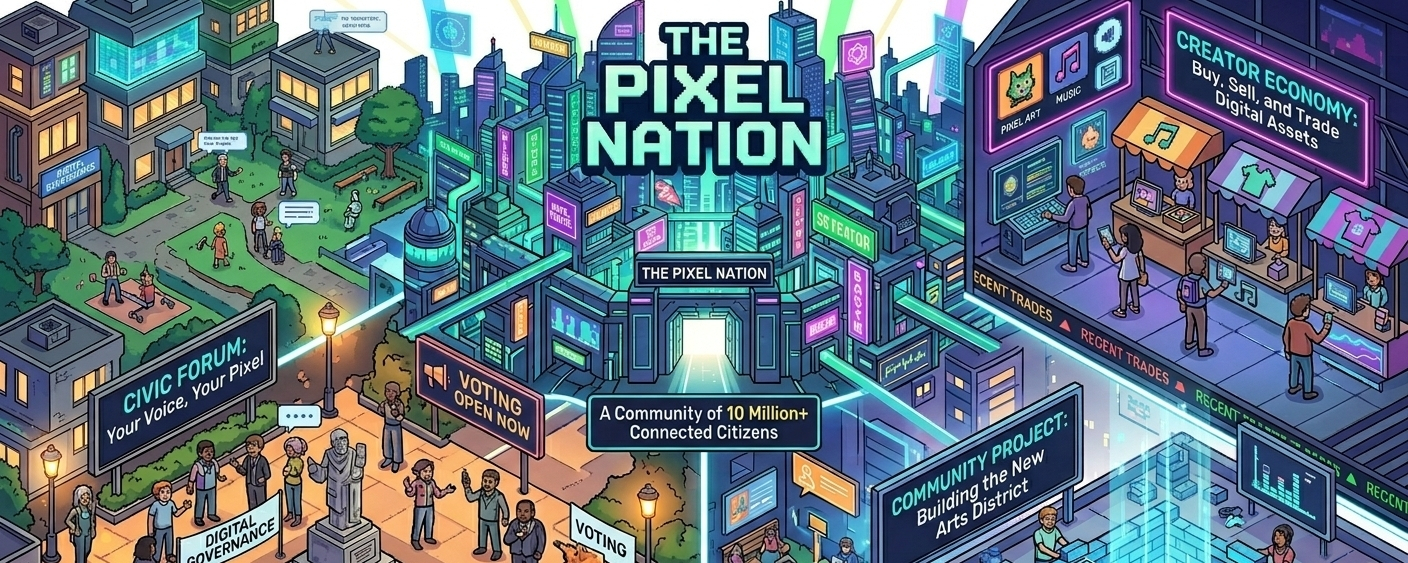
I think most games hand you a map and a mission. Pixel gives you something stranger and harder to define. A sense of place. Not in the geographic sense, but in the social one. The kind of place where what you do leaves a mark, where other people notice, where your presence accumulates into something resembling reputation.
That's nation-building logic. It's quietly embedded in everything pixel does.
I feel the economy is the first clue. Because most games treat their in-game currency as a scoring mechanism dressed up in blockchain clothes. Pixel doesn't do that. Resources flow between players in ways that create actual dependency. A farmer needs a crafter. A crafter needs a builder. a builder needs land. And land, in pixel, isn't infinite. That constraint does something to human behavior that no game designer can fully engineer. It creates stakes. Real ones.
I think when resources are finite and labor is specialized, people start forming alliances not because the game told them to, but because it makes sense. Guilds in pixel don't feel like optional side content. They feel like municipalities. Small economies with internal politics, shared interests, and collective memory.
Then there's the governance layer. Pixel has been slowly moving toward structures where players have a say in how the world evolves. That's not a feature. that's a constitutional principle. When a community can vote on its own rules, it stops being a user base and starts being a citizenry. The distinction matters more than it sounds.
What separates a game from a nation isn't graphics or mechanics. It's whether leaving costs you something. In most games, you log off and the world pauses. in pixel, the world keeps moving. Your guild makes decisions without you. Your land sits idle while someone else's thrives. Your reputation, built over weeks or months, doesn't freeze in place. It either grows or it quietly fades.
That's not gamification. That's consequence.
I think there's also something worth noting about identity. Pixel players don't just have accounts. they have characters in the deeper sense — histories, specializations, relationships. The avatar is a vessel for something that accumulates over time and resists easy replacement. You can't just spin up a new one and pick up where you left off. The continuity is the point.
Nations work the same way. You are, in some meaningful sense, defined by where you're from, what role you play in a shared economy, what obligations you carry. Pixel, almost accidentally, recreates that structure in digital form.
Whether it intended to or not, that's the product it's building. Not a game with blockchain mechanics. A territory with game aesthetics.
The players who stay seem to understand this. they talk about pixel the way people talk about places they've lived, not games they've played. They talk about what the community built together. What they lost. What they're still fighting for.
That's not nostalgia for a game. That's something closer to civic memory.
That distinction. Subtle, strange, easy to miss if you're just watching from the outside. Might be exactly why pixel has a ceiling most blockchain games will never reach.