
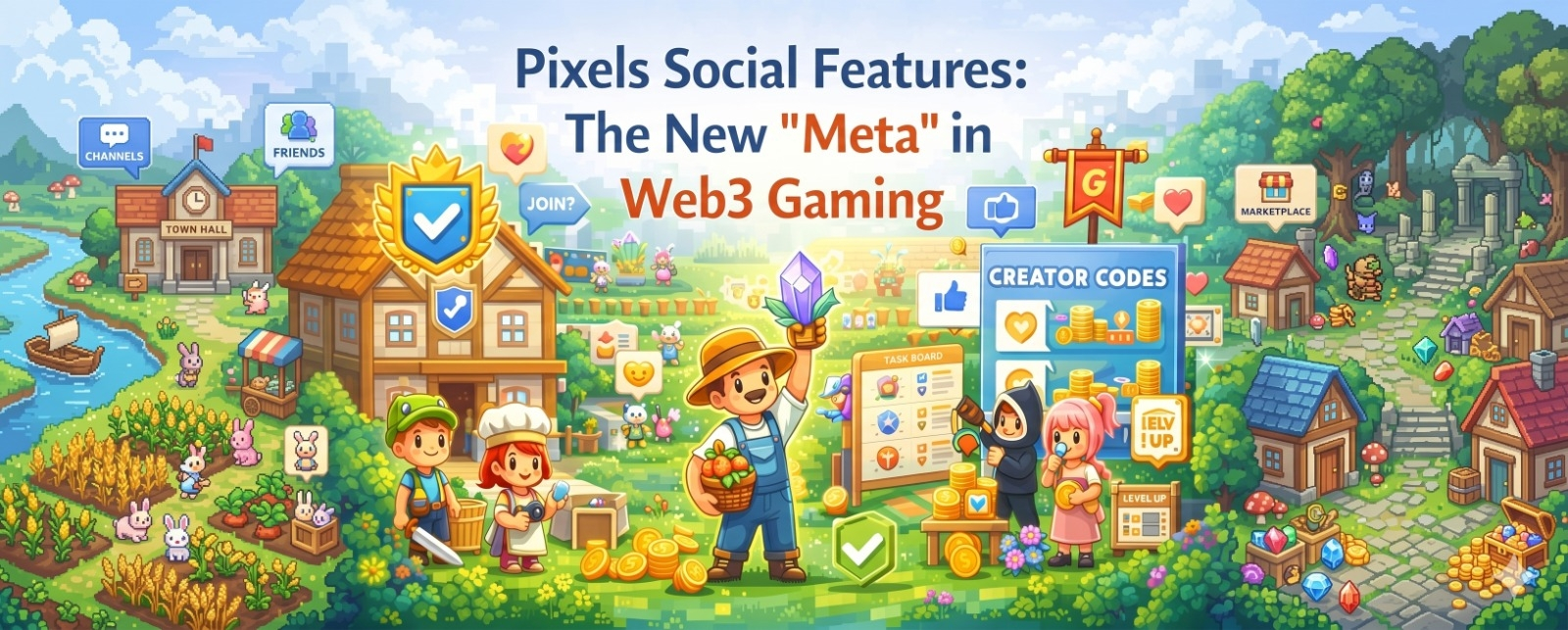

I think people still talk about social features in Web3 games like they are decorative. Nice to have. A Discord wrapper around the real product. Maybe a guild tab, maybe some creator perks, maybe a few badges to keep communities feeling active.
That reading feels too shallow for Pixels.
The more I look at it, the more its social layer stops looking like community garnish and starts looking like the actual meta. Not meta in the lazy “this is the trend” sense. I mean meta as the higher-order game sitting on top of farming, crafting, and progression. The part where relationships, access, reputation, and coordinated attention start affecting how value moves. In Pixels’ docs, the project is still explained through farming, exploration, skill progress, and social connections, but that social part carries more weight than it first seems. It has been part of the game’s identity from the start, not a later addition.That shift becomes obvious once you stop looking only at crops and start watching permissions.
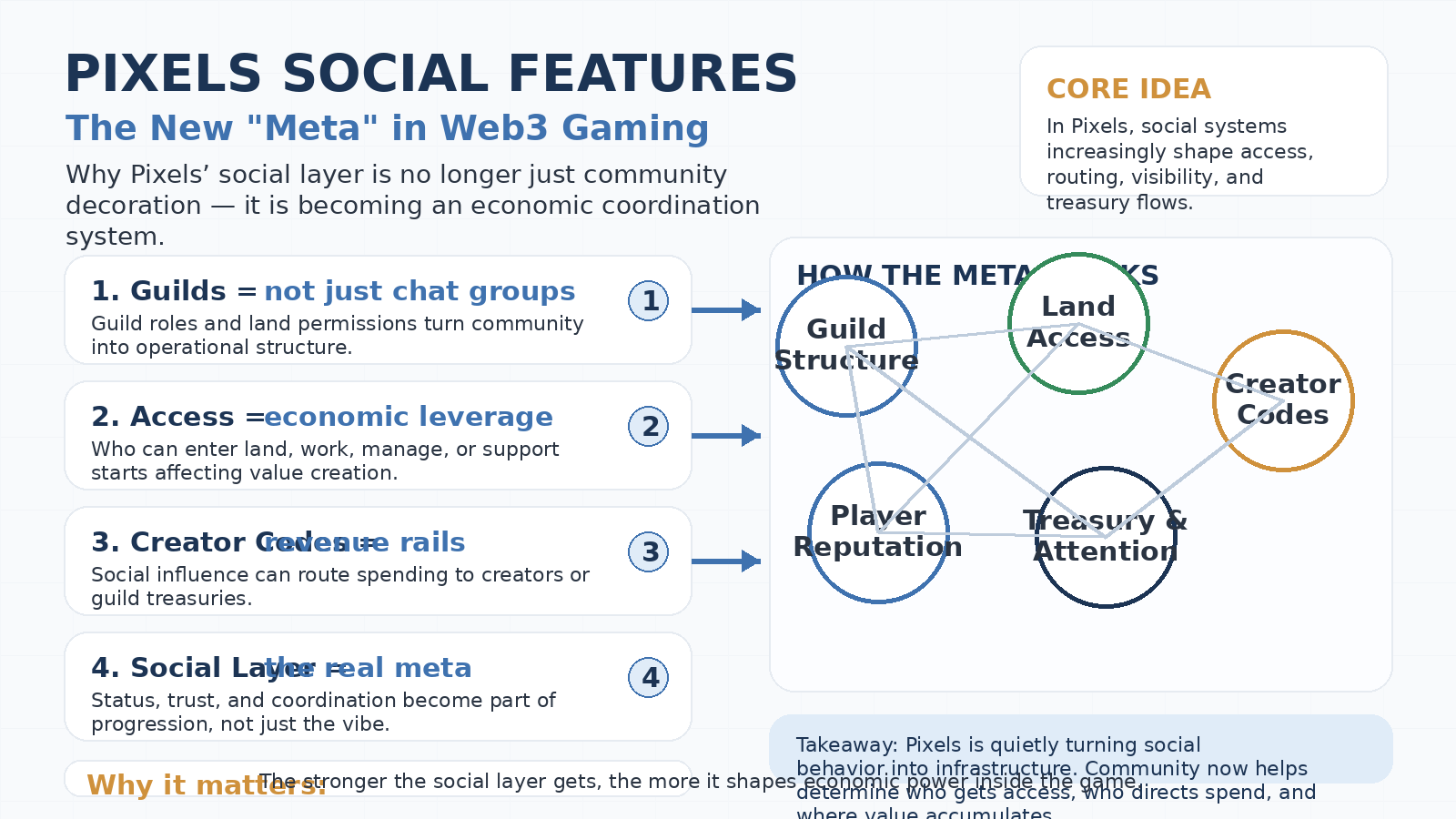
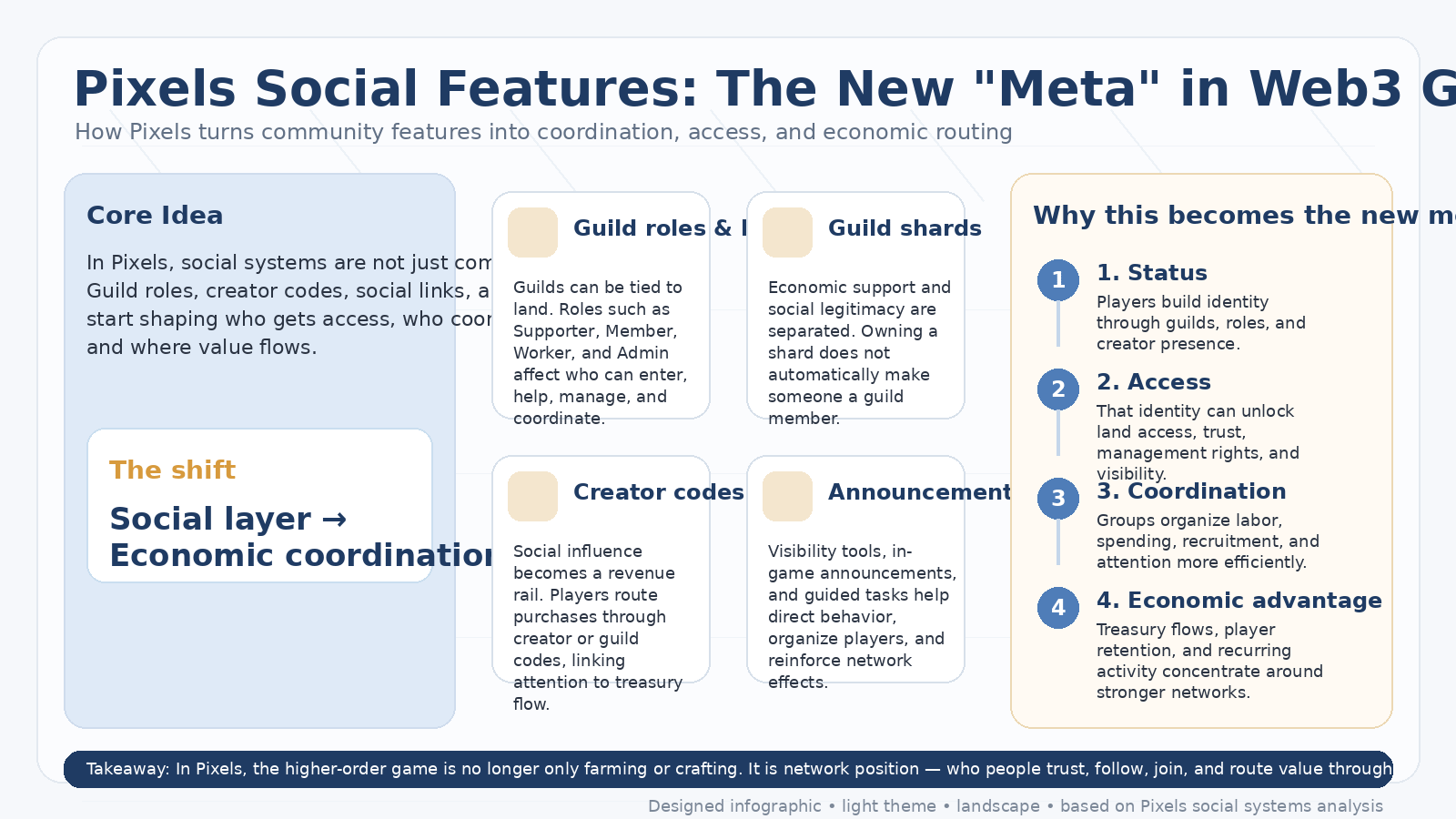
Guilds in Pixels are not just chat groups with a logo.NFT land can be tied to a guild by the landowner, who can set access directly in the land settings. Within the guild, players may have roles like Supporter, Member, Worker, or Admin, and admins can control members from the guild dashboard. That means the social graph is not floating outside the game. It is being tied directly to space, labor, and coordination rights inside the world.
That is the part I find more interesting than the usual “community engagement” language.
Because once social structure controls access, it stops being soft culture and starts becoming operational infrastructure. A guild is no longer only about people enjoying one game together. It is now a way to organize people by choosing who can join, who can work, who can be in charge, who is trusted, and who gets promoted. Even the shard system points in that direction. Guild shards are explicitly described as ownership in a guild, but buying one does not automatically make you a member. You can support financially without being socially admitted. Then, if you pledge your shard, the guild can decide whether to give you a role. That separation between economic support and social legitimacy is surprisingly mature for a game system.
It also tells me Pixels is not treating “social” as pure feel-good participation. It is treating it as something that can be filtered, ranked, and governed.
The creator-code system pushes that even further. Officially, creator codes let players receive a 5% discount on $PIXEL purchases while sending a portion of the transaction to a creator’s on-chain wallet or, if it is a guild code, to the guild treasury. Pixels later layered a creator tiering system on top, where creators can earn 3%, 5%, or 7% depending on tier, while guild and developer codes remain fixed at 5%. That is not just influencer marketing. It is a built-in revenue rail that turns social influence into a measurable economic input inside the game’s own economy.
And once that exists, the “best” player is not automatically the one with the best farm.
It might be the one who can gather a community, direct spending, recruit consistently, or create enough cultural gravity that other players want to route part of their activity through them. That is what I mean by the new meta. The game loop still matters, sure. But the higher game starts happening in attention, affiliation, and coordination. Farming becomes one layer. Network position becomes another.
You can see Pixels slowly building around that idea in smaller ways too. The official update logs show creator codes going live in beta for guilds and content creators, an in-game announcement system being added, dashboard social connection fixes, and task board changes that increasingly segment and steer what kinds of activities appear and get rewarded. Even older updates mention color-coding different task types and showing ownership more clearly. None of those changes sound dramatic on their own. Together, they suggest a game that keeps tightening the feedback loop between identity, visibility, and action.
That is why I do not think the social layer in Pixels is mainly about expression. I think it is about routing.
Who do players rally around? Which guild gets trusted? Which creator code gets entered? Which group gets access to which land? Which players get formal roles instead of just hanging around as supporters? These are social questions on the surface, but economically they are routing questions. They decide where treasury flows go, where labor gets coordinated, and where recurring player attention settles.
There is something slightly colder in that, and I do not mean that as a criticism.
A lot of Web3 gaming still acts like social energy is spontaneous magic. Build a Discord, throw in a token, hope a “community” appears. Pixels feels more deliberate than that. Its systems suggest that social behavior can be structured, monetized, permissioned, and folded back into progression. Even the verified guild checkmark process says something about this mindset: Pixels explicitly verifies some guilds as official, while also warning users to do their own research because verification is best effort, not a guarantee of behavior. That is a very Web3 kind of social design. Trust is encouraged, but never made fully passive.
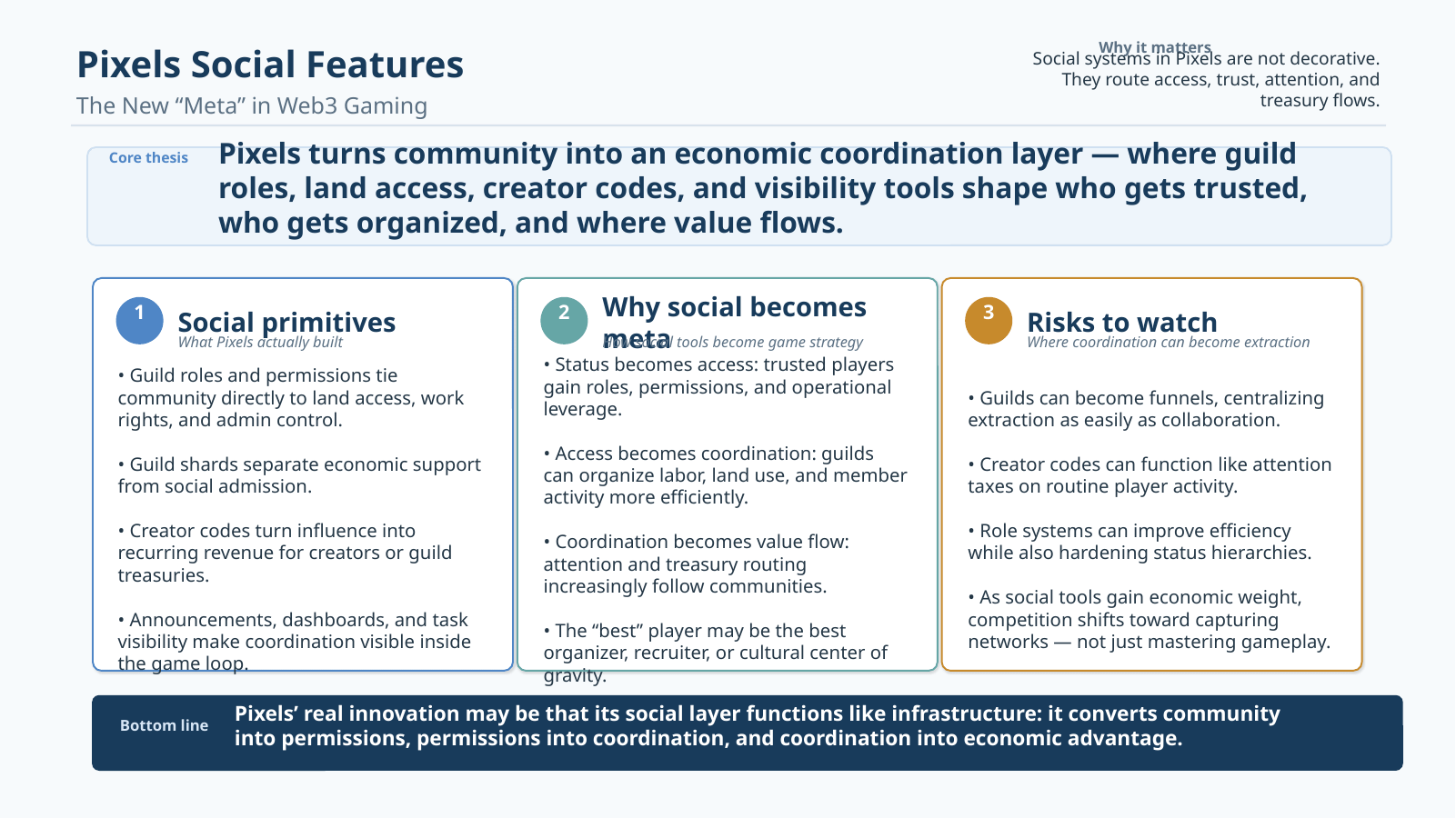
My only hesitation is that once social systems become this economically relevant, they can also become the real arena for extraction. A guild can become less like a community and more like a funnel. A creator code can become less like support and more like a tax on attention. Role systems can organize people, but they can also stratify them. The more value gets routed through social structure, the more social structure becomes something people compete to capture.
Still, that may be exactly why this title works.
Pixels’ social features are not just extra features anymore. They increasingly look like the layer where status turns into access, access turns into coordination, and coordination turns into economic advantage. That is not a side mechanic. That is the meta.
And honestly, I think that is where a lot of Web3 gaming is heading. Pixels just happens to be one of the clearer examples of it.