
I didn’t expect much when I first started looking into Pixels’ pet system. If you’ve seen one NFT collection, you’ve seen most of them—traits get generated, combinations are randomized, everything gets minted on-chain, and the word “unique” gets thrown around like it means something deeper than visual variation. It’s a formula that’s been repeated so many times that it’s hard not to approach new projects with a bit of skepticism. That mindset stuck with me here, and honestly, I still think it’s the right starting point. But as I dug a little deeper, I realized there’s at least an attempt to push beyond that surface-level approach, even if it’s too early to say how well it will hold up over time.
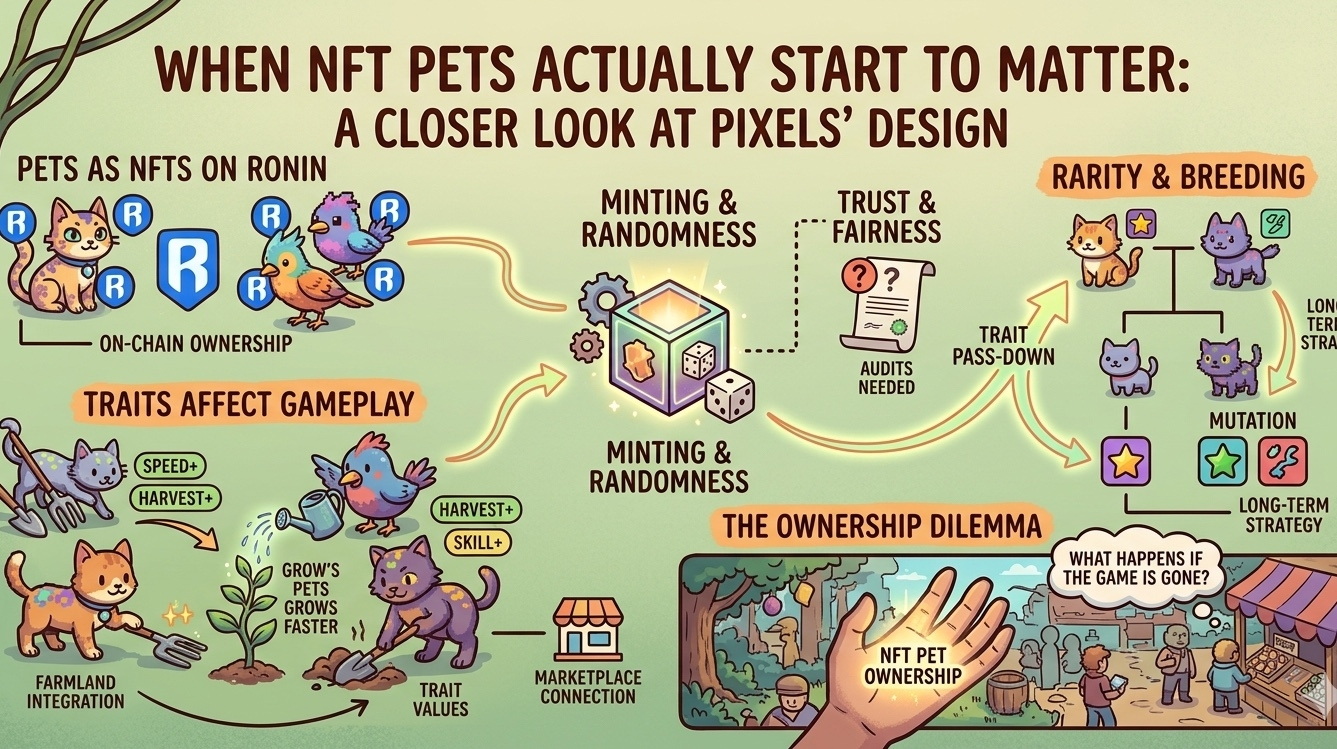
What stood out first is that these pets aren’t just designed to look different—they’re meant to actually do different things. Each pet is minted as an NFT on the Ronin network, carrying a mix of traits that don’t just define appearance but also influence how it performs in the game. That’s a small shift in concept, but it changes the conversation quite a bit. In most NFT-based games, rarity is purely aesthetic, something that matters more in marketplaces than in gameplay. Pixels is trying to tie those traits directly into farming mechanics, meaning what you get at mint could shape how efficiently your in-game setup works. It’s a more integrated approach, where randomness isn’t just cosmetic—it has consequences.
Of course, that brings up the question of how that randomness is actually handled. Blockchains aren’t naturally built for true randomness, which means every system has to rely on workarounds like verifiable random functions or commit-reveal methods. On paper, these solutions are solid, but in practice, they depend heavily on implementation. Without a clear and publicly verified audit of the minting contracts, it’s hard to fully trust that the process is as fair and unpredictable as it should be. And in systems like this, trust isn’t optional—it’s foundational. If players start to feel like outcomes can be influenced or predicted, even slightly, the whole structure starts to lose credibility.
The way rarity is distributed doesn’t break new ground, but it doesn’t really need to. There are tiers, some traits are more common than others, and the rarest combinations are naturally the most sought after. That’s standard across almost every NFT ecosystem. What matters more is whether those rare traits actually justify their value beyond resale potential. Pixels seems to be aiming for that by making rarer traits more effective in specific farming tasks. If that balance holds, it creates a system where gameplay and market value are connected rather than competing forces. That’s harder to achieve than it sounds, because most projects end up catering to one side at the expense of the other.
Another layer to think about is ownership itself. Since these pets exist on-chain, they’re not locked into the game in the traditional sense. You hold them in your wallet, which means they’re technically yours regardless of what happens to the platform. That sounds reassuring, but it also raises an uncomfortable question—what is that ownership really worth if the game disappears or loses relevance? Without an active ecosystem, even the most carefully designed NFT becomes just a static asset with no real purpose. It’s something people tend to overlook when they get caught up in the idea of digital ownership.
Where things get genuinely interesting is in the breeding system. This is where the design starts to feel less like a collection and more like a living system. Pets can produce offspring, passing down traits while occasionally introducing mutations. That adds a layer of unpredictability that isn’t just about minting anymore—it’s about long-term strategy. Suddenly, value isn’t just tied to what you own, but what your assets can potentially create. It opens the door to a kind of genetic economy, where certain combinations become desirable not just for what they are, but for what they might produce next. That’s a more dynamic approach, and it has the potential to keep the system engaging if it’s balanced correctly.
Still, all of this sits in that uncertain space between good ideas and proven systems. It’s easy to design something that looks compelling on paper, but much harder to maintain balance once real players start interacting with it at scale. Markets evolve, metas shift, and players tend to find the most efficient paths whether designers intend them or not. Pixels seems aware of these challenges, at least in how the system is structured, but awareness doesn’t always translate into execution.
For now, it feels like something worth paying attention to, but not something to fully buy into without question. There’s more thought here than I expected, especially in how it tries to connect gameplay with economic value in a meaningful way. Whether that connection holds up over time is the real test, and it’s one that only a growing player base and sustained use can answer. Until then, cautious curiosity feels like the most reasonable position to take.