
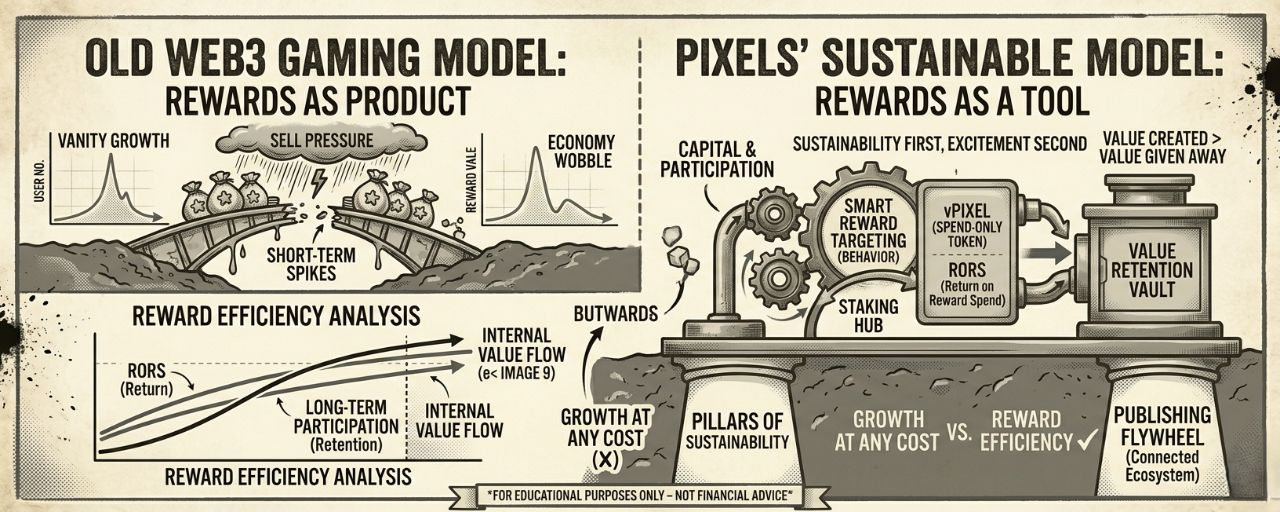


A lot of Web3 games still make the same mistake. They treat rewards like the product. That works for a while. Then the pressure builds. Players sell. incentives fade. and the economy starts to wobble.
That is why Pixels feels more interesting to me. It does not seem to be building around short term reward spikes. It looks more like an attempt to make the game economy sustainable first and exciting second.
I think that is the right order.
The real shift is simple. Pixels is trying to move away from the old play to earn pattern of pay out more and hope for the best. Instead it is trying to make rewards behave like a tool. Not the whole system. That matters because a game economy only survives when the value it creates is stronger than the value it gives away.
That is where RORS comes in. Return on Reward Spend is a much better lens than vanity growth metrics. It asks a harder question. Are rewards actually creating enough useful activity to justify the cost. If the answer is no. then the system is leaking. If the answer improves over time. then the economy has a chance to last.
I also think Pixels is smart to focus on smart reward targeting. Not every user action should be treated the same. A healthy game should reward behavior that improves retention. community quality. and long term participation. Not just quick farming. That is one of the clearest lessons Web3 gaming has learned the hard way.
The other part that stands out to me is vPIXEL. A spend only token changes the flow of value inside the ecosystem. It gives users a reason to stay in the loop instead of only cashing out the moment they earn. That does not remove sell pressure completely. Nothing does. But it can reduce the speed at which value leaves the system.
Then there is staking. I do not see staking here as just passive yield. I see it more as a way to align players. holders. and game activity around the same economy. That is important because the strongest game ecosystems usually are not the ones with the biggest reward budget. They are the ones that keep capital and participation moving in the same direction.
What I find most useful is the bigger picture. Pixels is not only trying to support one game. It is building toward a publishing flywheel where multiple games. shared data. and reward logic can reinforce each other. That gives the whole system more resilience. A single title can break. A connected ecosystem is harder to shake.
Of course. this is still not easy. A sustainable economy is hard to balance. If rewards are too loose. the system gets inflated. If rewards are too tight. users lose interest. If the games are not genuinely fun. no token model will save them. That is the part people still forget too often.
So my view is cautious but constructive. Pixels seems to understand that Web3 gaming does not need louder incentives. It needs better structure. Better reward design. Better retention. Better internal value flow.
That is a more serious vision than most projects in this space.
What matters more in Web3 gaming right now. growth at any cost. or reward efficiency that can survive the next cycle.
This is for educational purposes only, not financial advice.