
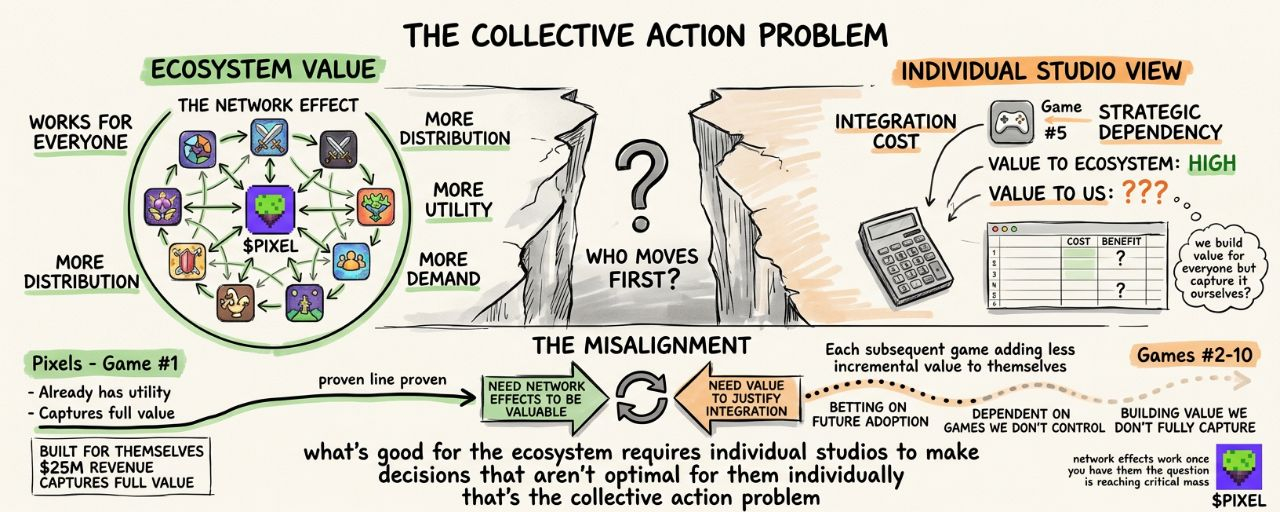
I keep watching @Pixels and trying to figure out if Stacked can solve the collective action problem where what's good for the ecosystem requires individual studios to make decisions that aren't optimal for them individually.
What I'm watching isn't whether cross-game rewards make sense theoretically. They do. What I'm watching is whether studios have sufficient incentive to integrate when integration benefits the ecosystem more than it benefits them specifically.
The collective action problem in multi-game infrastructure.
Not the vision narrative. The reality where network effects require critical mass but reaching critical mass requires early participants to build value they don't fully capture. Each studio that integrates makes the token more valuable for everyone. But most value accrues to the ecosystem, not to them.
That's where most network effect businesses struggle before reaching scale.
Pixels says PIXEL becomes more valuable as more games integrate. More distribution. More utility. That's accurate network effect logic.
What I can't tell is whether individual studios care about making PIXEL more valuable when they're not the primary beneficiaries.
The challenge is incentive misalignment between ecosystem value and studio value. When game five integrates Stacked, they're helping build cross-game utility that makes $PIXEL work better across all games. That's good for the ecosystem. Good for Pixels. Good for players.
But is it good enough for game five specifically to justify integration cost.
@Pixels has first-mover advantage. They built Stacked for themselves. PIXEL has utility in their ecosystem before any external integration. They capture full value of their own integration.
Games two through ten don't have that. They're integrating where utility depends on future integrations they don't control. They're betting other studios integrate after them.
Most studios don't optimize for ecosystem value. They optimize for their own metrics.
When Pixels pitches Stacked to external studios, the value proposition is "integrate our reward infrastructure and distribute PIXEL." The benefits are anti-fraud systems, AI economist insights, and cross-game utility.
Those benefits exist. What I don't know is whether they're compelling when weighed against costs.
The costs aren't just technical integration. They're strategic commitment. Once distributing PIXEL as rewards, you're dependent on Stacked's infrastructure continuing to work. Dependent on other games integrating. Dependent on $PIXEL maintaining value.
Significant dependency for infrastructure you don't control.
Most studios prefer dependencies they control or established platforms with proven staying power. Integrating into emerging multi-game infrastructure means betting on future adoption you can't guarantee.
Maybe the anti-fraud and AI economist features are valuable enough that studios would integrate even without cross-game token utility. Maybe those features alone justify integration.
Maybe they're not and studios need to see meaningful cross-game utility before integration makes sense individually.
I'm watching to see which one.
What I'm particularly watching is whether early integrations are motivated by infrastructure features or token network effects. If studios integrate for anti-fraud and AI capabilities, that suggests utility independent of network effects.
The stakes for PIXEL depend on solving the collective action problem. If infrastructure features are compelling enough that studios integrate for those reasons, network effects build organically. If studios wait to see network effects first, you get deadlock where nobody moves.
Most infrastructure tokens fail because they can't solve this. The token needs distribution across many participants to be valuable. But participants won't integrate until the token is already valuable.
Pixels has an advantage because PIXEL existing utility and proven demand. Studios aren't integrating into a cold start.
But "works in one ecosystem" and "works across many ecosystems" are different adoption curves. The second requires solving collective action problems the first didn't face.
I'd prefer Stacked's infrastructure features are strong enough that studios integrate regardless of token network effects.
I'm just not convinced infrastructure features alone overcome the strategic commitment required to depend on external infrastructure for core reward systems.
The collective action question's fundamental. You can build network effect value that benefits everyone. If individual participants don't capture enough value to justify participation, the network effect never materializes.
And honestly, I trust teams that acknowledge incentive misalignment more than teams that assume ecosystem benefits automatically motivate individual adoption.
#pixel @Pixels $PIXEL
