
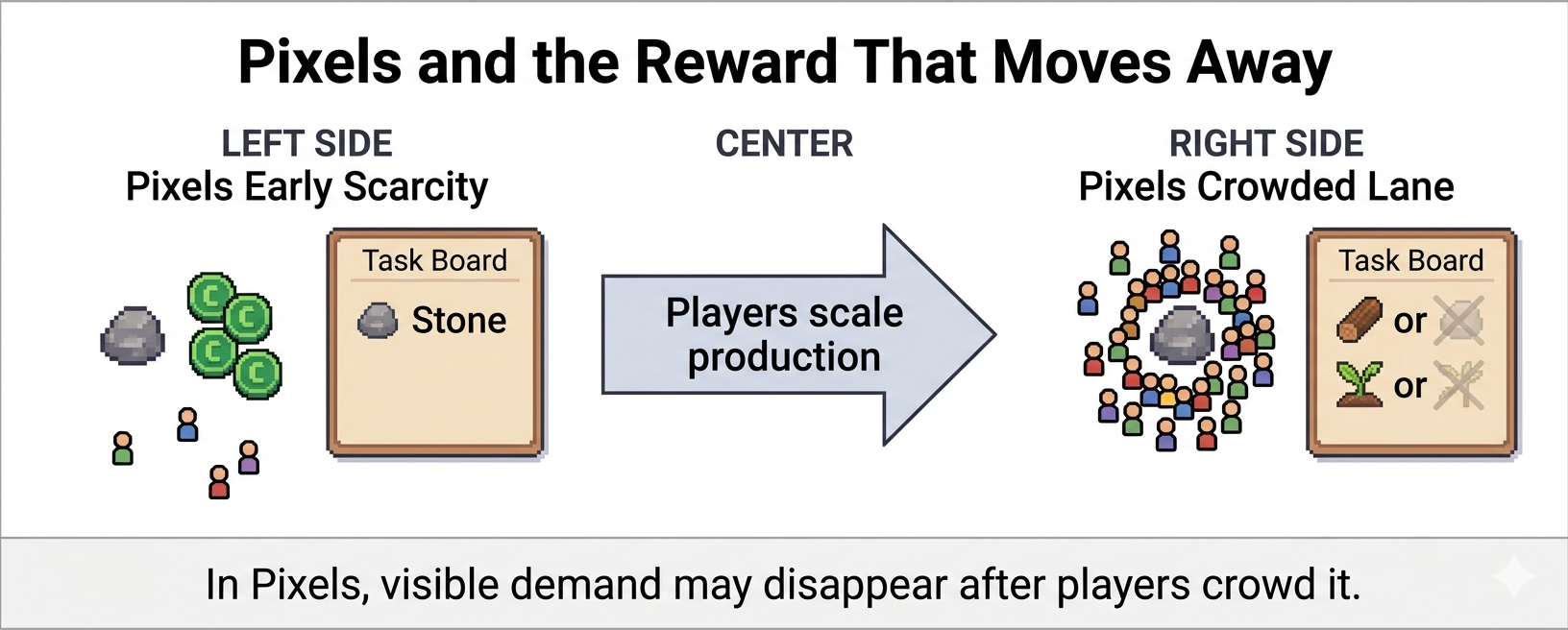

I scaled stone production three weeks ago because the Task Board kept asking for it.
Every session.
Multiple requests.
Clean payouts.
So I treated stone like the obvious lane.
Moved land use.
Changed crafting queues.
Committed real time to it.
By the time I had volume, the board stopped asking.
Not reduced.
Gone.
Stone tasks vanished from my rotation.
I kept producing into zero demand for four sessions before I admitted what happened.
At first I blamed timing.
Then oversupply.
Then myself for being late.
None of those explanations fully held.
Because the board didn't just stop wanting stone.
It started wanting whatever players seemed to be ignoring next.
That took me too long to understand.
The board may not reward what is hardest to make.
It may reward what is hardest to find enough of right now.
Different logic entirely.
When stone was scarce, stone paid.
When everyone chased stone, the signal moved.
Which means the board keeps leaning away from the crowd.
That matters.
I optimized for production.
The board may have been pricing scarcity.
Those are not the same game.
Scaling is the natural response to visible demand.
It's what efficient players do.
But scaling can also be what kills the demand window fastest.
Every player who rushes the same hot item helps erase the reason it was hot.
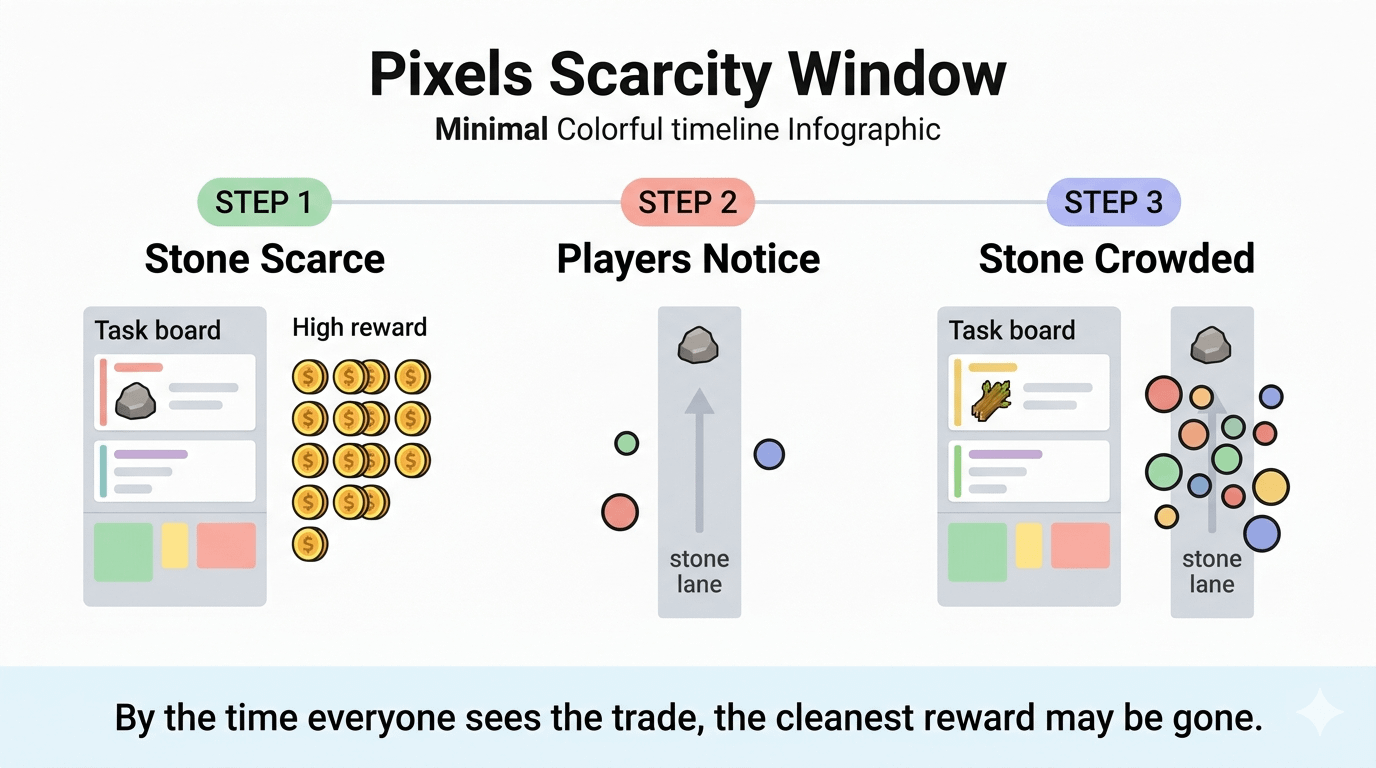
Efficient production can destroy its own reward signal.
The players who stay ahead of this may not produce more.
They may read absence better.
Not:
What is the board asking for now?
But:
What hasn't it asked for lately?
What lane is thinning before it becomes obvious?
By the time a task looks clear to everyone, the cleanest part of the trade may already be gone.
That's where $PIXEL starts looking different too.
It may flow less toward effort,
and more toward whoever positioned early into scarcity before scarcity became visible.
Very different games.
Stacked keeps sitting in the back of my mind here.
If connected systems start reading production behavior faster than players can react, scarcity windows shrink.
Maybe sharply.
Or maybe I'm overestimating that layer.
I honestly don't know yet.
But I know the direction matters.
If the board stays slower than players, opportunity remains open.
If the board learns faster than players, late reactions get taxed.
So the real test may not be whether Pixels rewards work.
It may be whether Pixels rewards work early enough to matter.