
I have been looking at roadmaps in this space long enough to know that most of them are marketing documents dressed as development plans. Lists of features, approximate dates, language designed to sound ambitious without committing to anything real. So when I sat down with the Pixels roadmap I was not expecting to find anything that shifted how I was thinking about this project. Then I read the April 1st AMA transcript and one line from Luke stopped me cold.
He said about Stacked: "The release is not the real celebration. It is celebrating starting the marathon."
You do not say that at a product launch if the product is the point. It only makes sense if what you are building is not a feature but a foundation, and the feature you just shipped is the first mile of something much longer. I sat with that framing for a while and the more I turned it over the more I think the Pixels roadmap is communicating a platform architecture in the language of game updates. And almost everyone reading it is only hearing the game updates.
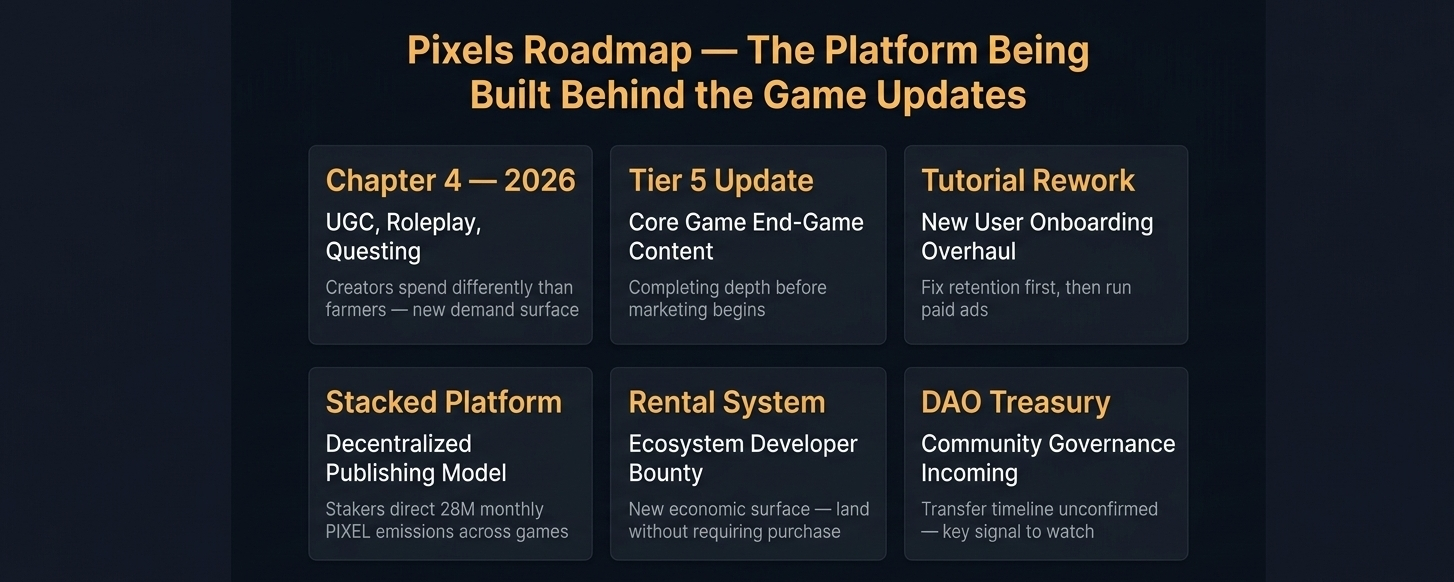
Start with what is actually in front of us. Chapter 3, Bountyfall, launched October 31st 2025 and introduced team-based competition, Unions, Yieldstones, and prize pools. By the team's own 3 to 4 month chapter cycle, Chapter 4 is expected somewhere in early to mid 2026. The roadmap shows it focusing on User Generated Content, roleplay, and questing a shift from competitive extraction mechanics toward creative ownership. Players building things inside the world rather than primarily farming and withdrawing. That design choice matters because creators who build inside a game spend on it differently than farmers who extract from it. The token demand surface changes when the player behavior changes.
But Chapter 4 is not the part of the roadmap I find most interesting. The Tier 5 update coming before it is. In the April AMA the team said Pixels is working on a big end-of-game update at Tier 5, and after that a full tutorial rework to make onboarding genuinely understandable for new users. Then paid advertising to actually grow the base. That is a sequenced plan, not a feature list. They are completing the game's depth layer first, then fixing how new players enter, then spending money to bring people in. That order tells you something real about how this team thinks build the product before marketing it. In crypto that is rarer than it sounds.
Stacked is the piece I keep getting pulled back to. The team launched it in late March 2026 and the description of what it actually is was more architecturally significant than most coverage suggested. On the surface it is a cross-game platform where players complete missions across multiple titles and earn $PIXEL rewards. Underneath that is a governance mechanism. Stakers direct which games receive ecosystem emissions. The team explicitly said they are building a decentralized publishing model where games themselves replace traditional validators. That is not a gaming feature. That is a token utility architecture being assembled in public while the market reads it as a product launch. The 28 million PIXEL monthly emission cap flowing through the staking system is the budget. Stakers are the allocation committee. New games joining Stacked are competing for a share of that budget by building experiences worth staking toward.
What I find genuinely underappreciated is the sequencing of who benefits and when. Right now Stacked is live in core @Pixels , Pixel Dungeons, and Chubkins. In the AMA Luke said there are already games waiting and wanting to use Stacked, they have just been getting the product stable first. A rental system is also being built through an ecosystem developer bounty, which would create a new economic surface land accessible without requiring purchase. DAO governance is on the roadmap for the community treasury, which has been accumulating since launch. When that transfer happens, PIXEL stakers will have governance over a material treasury, not just emission allocation.
Now I have to argue against my own reading, because the roadmap picture flatters the project more than execution history fully justifies.
The first problem is Stacked has one outside integration after twelve months of building Forgotten Runiverse. Every other game in the ecosystem was built by Pixels directly or sits very close to it. The claim that games are waiting to use Stacked is promising but has not yet become a verifiable second independent integration. A platform thesis requires external adoption and external adoption requires proof. One integration does not establish a pattern, and I would feel more confident in this thesis with three names on that list instead of one.
The second problem sits closer to the core. Roadmaps in Web3 gaming get revised quietly all the time. Chapter 4's UGC focus is genuinely interesting but User Generated Content in blockchain games has historically been difficult to monetize in ways that create token demand rather than just community activity. If players build things using Coins rather than PIXEL, the Chapter 4 roadmap item adds engagement without adding token demand. The roadmap and the token story are not automatically the same story, and I have not seen a clean argument for why UGC specifically drives PIXEL spending.
The signals I am watching are specific. Whether the Tier 5 update and tutorial rework complete before Chapter 4 launches, because that sequence matters for whether paid acquisition actually retains anyone. Whether Stacked onboards a second independent studio with no prior Pixels relationship within the next two quarters. And whether the DAO treasury transfer gets a concrete timeline or stays an open roadmap item. The marathon Luke described is real. Whether it stays on pace is what the next six months will actually answer.