
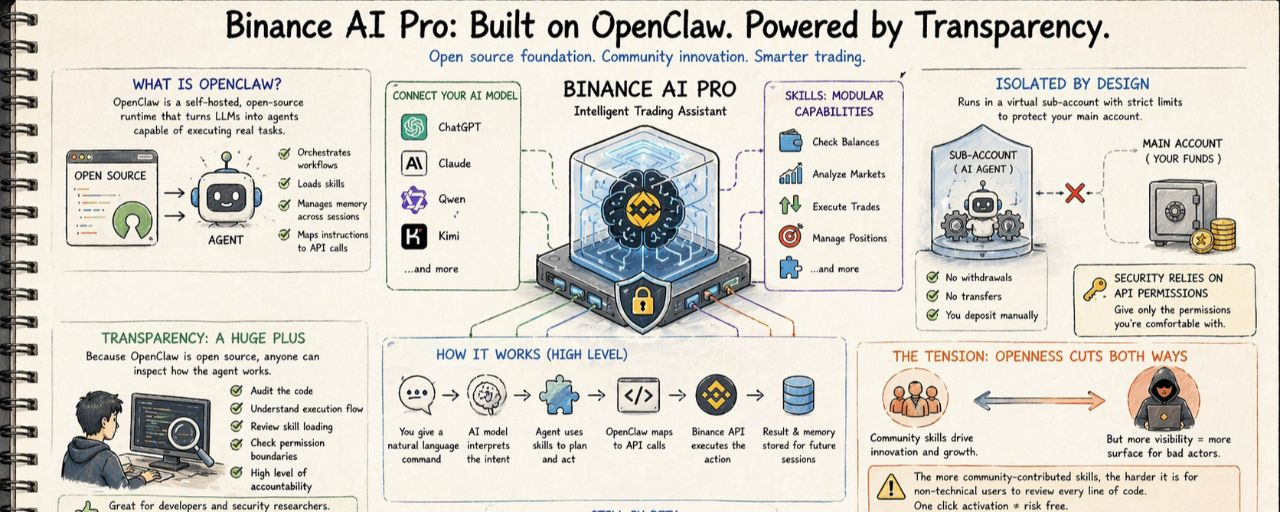
I didn’t expect to feel this uneasy while reading about Binance AI Pro’s architecture. The announcement proudly highlights that it’s built on OpenClaw, an open source AI agent framework. It sounds great on paper: transparent, community driven, extensible, and developer friendly.
Then the implications started sinking in.
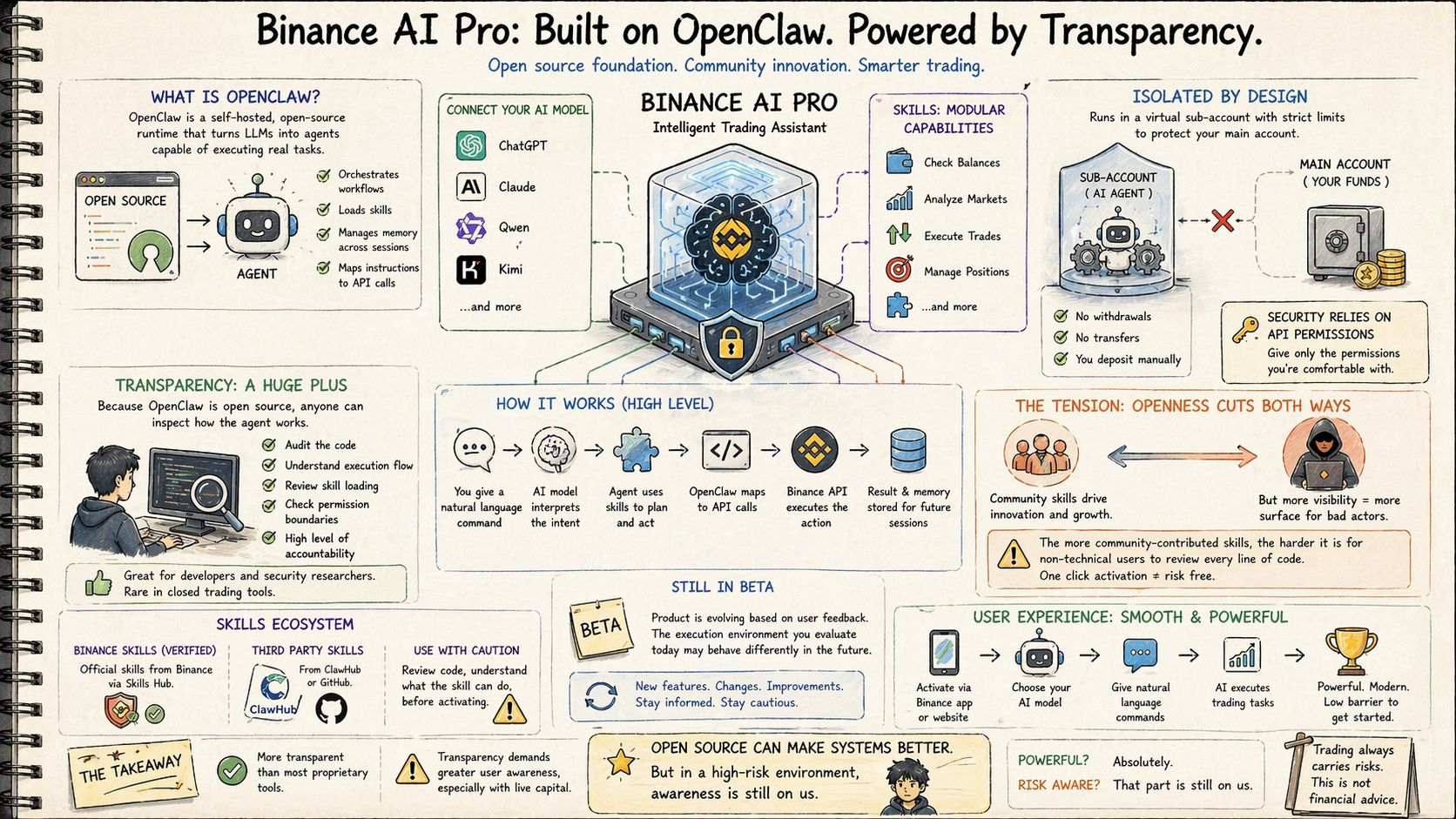
OpenClaw is a self hosted, open source runtime that turns large language models into actual agents capable of executing real tasks. Binance AI Pro uses it as the foundation for its intelligent trading assistant. You can connect popular models like ChatGPT, Claude, Qwen, or Kimi, and give the agent “skills”, modular capabilities that let it check balances, analyze markets, and execute trades on Binance through natural language.
The transparency is real. Because the core infrastructure is open source, anyone can inspect how the agent orchestrates workflows, loads skills, manages memory across sessions, and maps instructions to API calls.
But visibility works in both directions.
For developers and security researchers, this openness is a huge plus. You can audit the skill loading mechanism, understand permission boundaries, and see exactly how execution flows. That level of accountability is rare in closed trading tools.
For the average retail user, though, it creates a different reality.
Binance AI Pro runs in an isolated virtual sub account with strict limits (no withdrawals or transfers to your main account). The security model relies heavily on API key permissions. Binance also provides its own verified “Binance Skills” through the Skills Hub and warns users that third party skills from ClawHub or GitHub should be carefully reviewed before activation.
Here’s the tension: the more the ecosystem grows with community contributed skills, the harder it becomes for non technical users to review every line of code. One click activation feels convenient, but it assumes a level of code literacy and caution that most traders simply don’t have.
On top of that, the product is still in beta. The architecture is evolving based on user feedback, meaning the execution environment you evaluate today may behave differently in a few months.
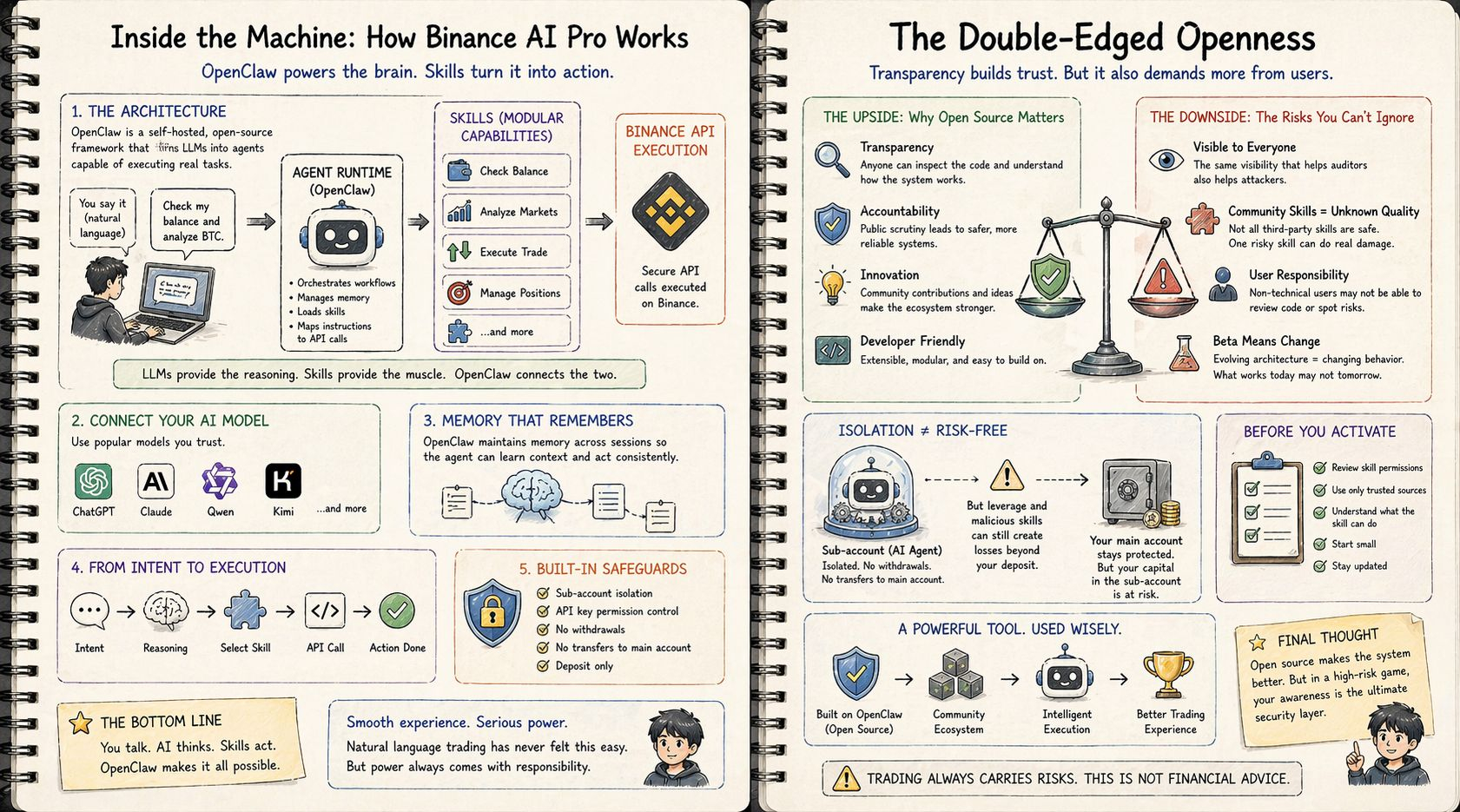
From a user experience perspective, the whole thing is impressively smooth. You activate it easily through the Binance app or website, choose your AI model, and start giving natural language commands for trading tasks. It lowers the barrier for experimenting with agentic trading in a way that feels powerful and modern.
For the crypto trading world, building on open source infrastructure like OpenClaw feels like a real step in the right direction. It adds transparency and opens the door to more innovation in a space that has relied on black box systems for too long. But openness cuts both ways. The same visibility that makes a system easier to audit can also make it easier for bad actors to probe for weaknesses.
That’s what Binance AI Pro really shows: open source can make these systems better and more trustworthy, but in a high risk environment, it also means users have to be a lot more aware of the risks.
It’s more transparent than most proprietary tools, but that transparency demands greater user awareness, especially when live capital and automated execution are involved.
Powerful? Absolutely. Risk aware? That part is still on us.
Trading always carries risks. This is not financial advice.
@Binance Vietnam #BinanceAIPro $XAU

Giao dịch luôn tiềm ẩn rủi ro. Các đề xuất do AI tạo ra không phải là lời khuyên tài chính. Hiệu quả hoạt động trong quá khứ không phản ánh kết quả trong tương lai. Vui lòng kiểm tra tình trạng sản phẩm có sẵn tại khu vực của bạn.