
Been stuck on this thought for a few days now 🤔
May be because I genuinely enjoy games but this one isnot leaving my head.
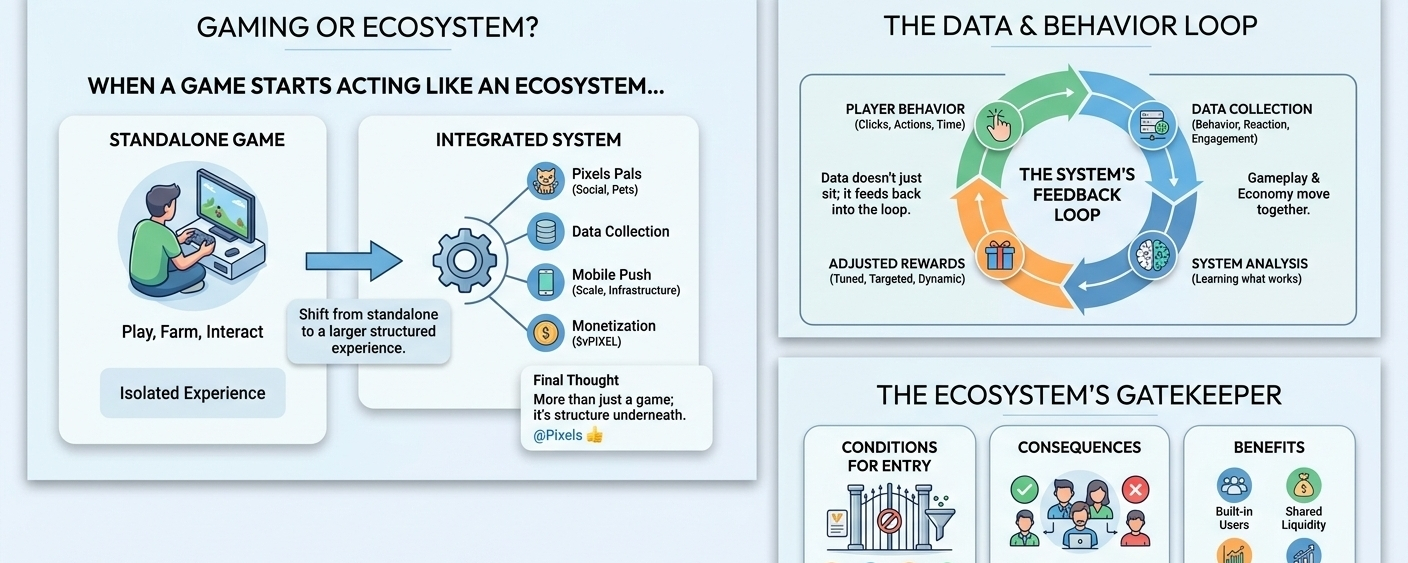
What happens when a game slowly stops being just a game and starts behaving more like a system?
With Pixels it is starting to feel like that shift is already happening.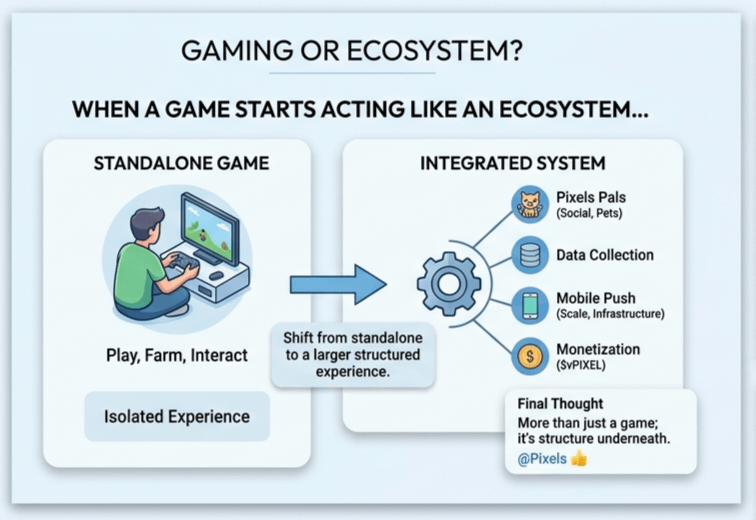
At first it looks simple. You play you farm you interact same as any other game.
But the more I look at it, the less it feels like a standalone experience and more like something structured underneath.
Take their early projects like Pixels Pals. On the surface it is light and social raising pets interacting, casual vibes.
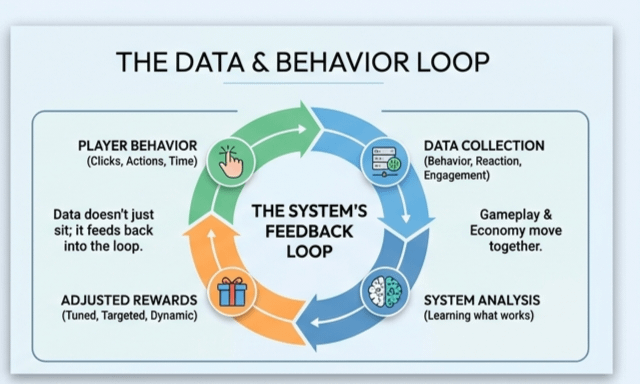
But if you think about it for a second it is also collecting behavior.
What players click how they react to rewards what keeps them coming back.
That data doesnot just sit there it feeds back into the system.
And that is where the shift starts.
Rewards donot feel random anymore.
They feel adjusted like the system is learning what works and slowly tuning around it.
Then you look at their mobile push.
It’s not just let is bring the game to phones.
It is more like how do we make this scale properly? Handle more users smoother access less friction.
At that point it stops sounding like game design and starts sounding like infrastructure.
Another thing I noticed monetization isnot something added later.
With $vPIXEL itis already built into the loop from the start.
So gameplay and economy arenot separate anymore.
They move together.
But the real shift at least for mebshows up when you look at how they’re bringing in other games.
This isnot open entry.
There are conditions performance expectations data sharingvconversion benchmarks.
Stuff like RORS targets basically says if your game takes rewards it should also generate value back.
That changes the tone completel
Now it is not just about making a fun game
it is about fitting into a system that measures efficiency
Even developers arenot just building games anymore
they are feeding into a larger loop that is constantly adjusting itself.
And yeah that creates pressure.
Only certain types of games will fit.
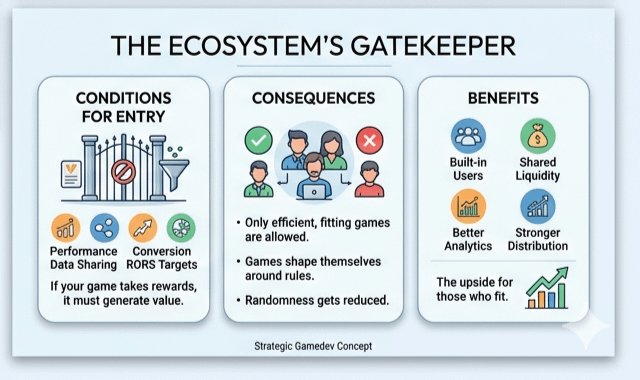
And the ones that do will probably start shaping themselves around these rules.
At the same time the upside is obvious built-in users shared liquidity better analytics stronger distribution
So it is not one side.
But it does raise a question I canot really ignore:
When a system decides
who gets in
how rewards flow…
and what kind of behavior gets amplified
is it still an open game world?
Or something more controlled just quieter about it?
Because the more structured things get the less room there is for randomness.
And honestly, unpredictability is what makes games feel alive.
Feels like @Pixels is trying to balance that
using data to guide behavior without killing the experience.
Not sure yet if that balance holds.
But it is definitely not just a game anymore.