
I almost dismissed the Sleepagotchi partnership when I first read about it. A wellness gamification app joining a Web3 farming ecosystem felt like the kind of move projects make when they need a headline more than a real strategy. Then I looked at what was actually built underneath the announcement, and something shifted in how I was thinking about this entire ecosystem.
The thing I keep coming back to is this: most people are reading the $PIXEL partnership map as a content story. I think it is an infrastructure story. The specific partners matter less than the architecture they are plugging into, and that architecture was deliberately built to reach beyond Ronin before any of the current partners existed.
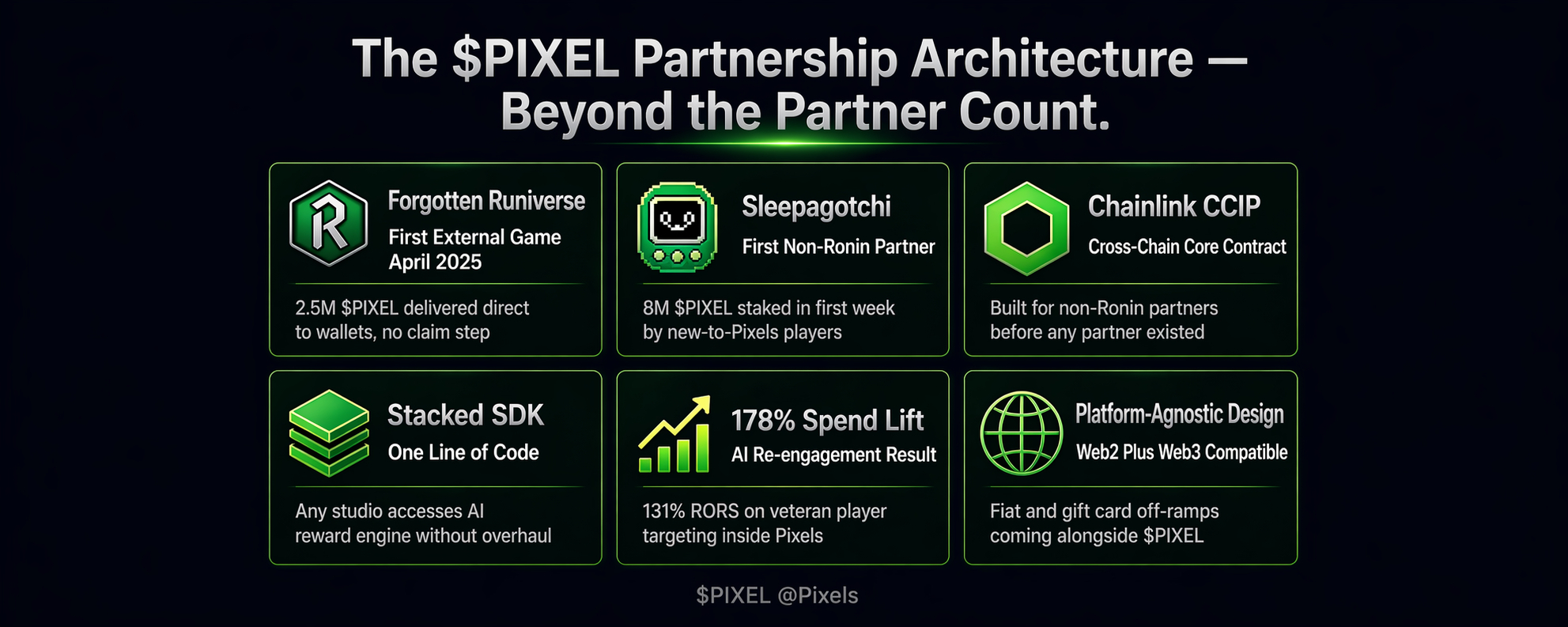
Forgotten Runiverse came first in April 2025. An MMORPG by Bisonic, it became the first external game to integrate PIXEL's into its economy. Players could stake toward it, earn from it, spend inside it. What caught my attention was not the partnership itself but one small operational detail the team delivered 2.5 million $PIXEL directly to player wallets with no claiming process required. That sounds minor. It is not. Removing the claim step eliminates a friction point that has quietly killed engagement in dozens of Web3 reward programs. That design choice does not come from reading whitepapers. It comes from four years of running a live economy and learning where players actually drop off.
Pixel Dungeons and Chubkins followed, both close to the Pixels orbit. If the story stopped there the ecosystem would look like one organization running multiple products under a shared token. That is a fair read and one I find hard to fully dismiss. The picture changes with the next partner.
Sleepagotchi is a wellness gamification app, not a blockchain game. It does not run on Ronin. It reaches an audience with no prior relationship to Web3 farming. When its founder announced the PIXEL's staking integration, he specifically cited Pixels' Return on Reward Spend metric as the reason for choosing the partnership saying the RORS framework had set a new industry standard for performance benchmarking. That is not promotional language. That is a studio choosing a partner because of the methodology they built over four years, not because of token price or brand visibility. In its first week inside the staking ecosystem, 8 million $PIXEL were staked through Sleepagotchi by players who had never touched the Pixels farming game before.
That cross-genre staking behavior was possible because of what LimeChain actually built. When LimeChain architected the staking smart contract system, they embedded Chainlink CCIP as a core component to handle multi-chain expansion. That cross-chain layer was not added reactively when a non-Ronin partner arrived. It was in the original architecture, written for a partner profile that did not yet exist when the contracts were deployed. Sleepagotchi is the first evidence that the design assumption was right.
Stacked takes the infrastructure story further. One line of code added to any game logs player activity to Stacked. That feeds an AI engine which personalizes reward offers, identifies churn risk, and deploys targeted incentives without any manual segmentation. The same system that produced a 178 percent lift in conversion to spend and a 131 percent return on reward spend inside Pixels becomes available to any studio that integrates the SDK. When asked whether Stacked works only for Web3 games, the team answered directly: the core functionality is platform-agnostic. Any digital business focused on retention can use it. That scope is considerably larger than the blockchain gaming market.
Now I have to argue against my own reading honestly, because the partnership thesis is easier to believe from inside the ecosystem than it deserves to be.
The first problem is independence. Every current partner either built by @Pixels , sits adjacent to the ecosystem, or joined through a formal arrangement with pre-established terms and incentives. None of them is a genuinely arm's length studio that discovered Stacked on its own and found the economics compelling without any prior contact. A real platform thesis requires studios arriving without being invited. That has not happened at visible scale yet.
The second problem cuts directly at the token. Stacked's most powerful capability the AI targeting and reward optimization does not require PIXEL's to function. A studio could integrate the SDK, run the AI engine to reduce churn, and pay rewards in their own token, gift cards, or fiat. Luke mentioned all three as upcoming off-ramp options explicitly. If the value of Stacked is the AI economist rather than the $PIXEL token, the partnership map could expand while $PIXEL demand from those partnerships stays thin. The platform succeeds. The token does not necessarily follow.
The signals I am watching are narrow. Whether a studio with no prior Pixels relationship integrates Stacked through the public SDK without a formal partnership announcement because that is the only signal that tells me genuine platform pull exists rather than curated expansion. Whether $PIXEL remains the dominant Stacked off-ramp or fiat and gift card options absorb a growing share as non-Web3 studios come in. And whether the cross-genre staking behavior Sleepagotchi demonstrated holds six months after the initial excitement or quietly drifts back to baseline. The architecture is more serious than the partner count. Whether it produces durable $PIXEL demand is what the next two or three integrations will actually answer.