

Strategic market analysis of KAT/USDT and the Katana Network ecosystem in the context of the 2026 crypto economy
The evolution of decentralized finance (DeFi) in the middle of this decade has led to the emergence of specialized infrastructure solutions that move away from traditional venture funding models in favor of sustainable economic cycles. The emergence of Katana Network (KAT) and its market dynamics against Tether (USDT) in April 2026 is a key indicator of the maturity of Layer 2 markets. Analyzing this asset requires a deep understanding of the divergences between modern protocols and legacy assets, as well as a detailed examination of the liquidity coordination mechanisms underpinning Katana Network.
Asset differentiation and historical context of the KAT ticker
A primary task for a professional analyst studying the KAT ticker is to clearly delineate between two fundamentally different projects that use the same designation. The market has Kambria and Katana Network, whose tech stacks and market goals do not intersect, despite using the same abbreviation.
Comparative characteristics of projects with the KAT ticker
CharacteristicsKatana Network (KAT)Kambria (KAT)ArchitecturePolygon AggLayer / Layer 2Ethereum Mainnet (ERC-20)Core AreaDeFi and liquidity coordinationAI and roboticsFunding ModelDirect Listing (no venture capital)Initial Coin Offering (ICO 2018)Max Supply10,000,000,000 KAT5,000,000,000 KAT2026 Listing StatusBinance, OKX, KuCoin (Seed Tag)Uniswap, low-liquidity DEXKey UtilityvKAT (staking and emission governance)Licensing of intellectual property
Kambria is a legacy project launched in 2018 as an open innovation platform for deep technologies such as artificial intelligence and VR/AR. As of 2026, its market capitalization stands at around $35,000, while daily trading volume often does not exceed a few hundred dollars. In contrast, Katana Network is a modern Layer 2 blockchain, incubated by Polygon Labs and GSR, focused on solving liquidity fragmentation in DeFi. Katana Network exhibits significant volatility and high trading volumes in the KAT/USDT pair on leading exchanges.
Technological architecture of Katana Network: "Opinionated" DeFi stack
Katana Network positions itself as an "opinionated" blockchain. Unlike universal Layer 2 networks that allow any protocol to deploy smart contracts without restrictions, Katana deliberately directs capital and users to a limited set of vetted applications. This architectural solution minimizes liquidity fragmentation, ensuring low slippage even for large institutional orders.
Integration with Polygon AggLayer and CDK
Utilization of the Polygon Chain Development Kit (CDK) and AggLayer allows Katana Network to operate as part of a unified liquidity space with other networks in the Polygon and Ethereum ecosystem. This is critical for the VaultBridge model, which automatically generates income from assets in bridges and directs these funds back into the system to support liquidity.
The gas token of the network is Ethereum (ETH), ensuring direct compatibility with wallets and mainnet development tools, while the KAT token serves as a coordination tool for incentivizing markets. This structure of functional separation prevents volatility in transaction costs associated with speculative demand for the native governance token.
Economic model: Liquidity flywheel and the role of vKAT
At the core of KAT/USDT's success is the vote-escrowed emission mechanism, adapted to the needs of Layer 2. Users who lock their KAT tokens receive vKAT, which grants the right to determine which liquidity pools (e.g., in Sushi or Morpho) will receive additional rewards in the next epoch.
Treasury filling mechanisms and rewards
The economic cycle of Katana is based on "real yield" rather than endless inflation. Analysis indicates three main sources of income that fuel the ecosystem:
Income from VaultBridge (interest from assets in bridges).
Sequencer fees of the network.
Fees from major DeFi protocols in the stack (Sushi, Morpho, Katana Perps).
These funds are used to create Chain-Owned Liquidity (CoL) — liquidity owned by the network itself, making Katana less dependent on "mercenary capital" that typically leaves networks after liquidity mining programs end.
Tokenomics analysis and asset unlock schedule
The total supply of KAT is 10 billion tokens. An important feature of the project is the absence of venture investments (No-VC model), meaning there are no early investors who could execute mass token sales at low cost.
KAT token distribution
Distribution SectorPercentageNumber of TokensEcosystem and Treasury48.35%4,835,000,000Core Contributors (team)15.65%1,565,000,000Airdrops to the community (for POL stakers)15.00%1,500,000,000Core and ecosystem applications10.00%1,000,000,000Liquidity mining10.00%1,000,000,000Public sale1.00%100,000,000
Despite the absence of venture cliffs, the token unlock schedule remains an important factor for the market. The next significant unlock is scheduled for May 18, 2026. On this day, approximately 176.79 million tokens (1.8% of the total supply) will enter the market, which may create short-term price pressure unless demand from vKAT stakers balances the supply.
Analysis of market dynamics and exchange metrics in April 2026
In April 2026, the KAT/USDT pair demonstrated exceptional strength, significantly outperforming the overall market. The asset price increased by more than 70% within 24 hours on April 24, reaching a local peak around $0.023.
Liquidity metrics and market depth on leading exchanges

An explosive increase in trading volumes to over $640 million indicates deep participation of institutional capital ("Smart Money"), rather than just retail speculators. Notably, activity on OKX and Binance, where the bulk of liquidity for both spot and perpetual futures markets is concentrated, was particularly pronounced.
Technical analysis: Indicators and key levels
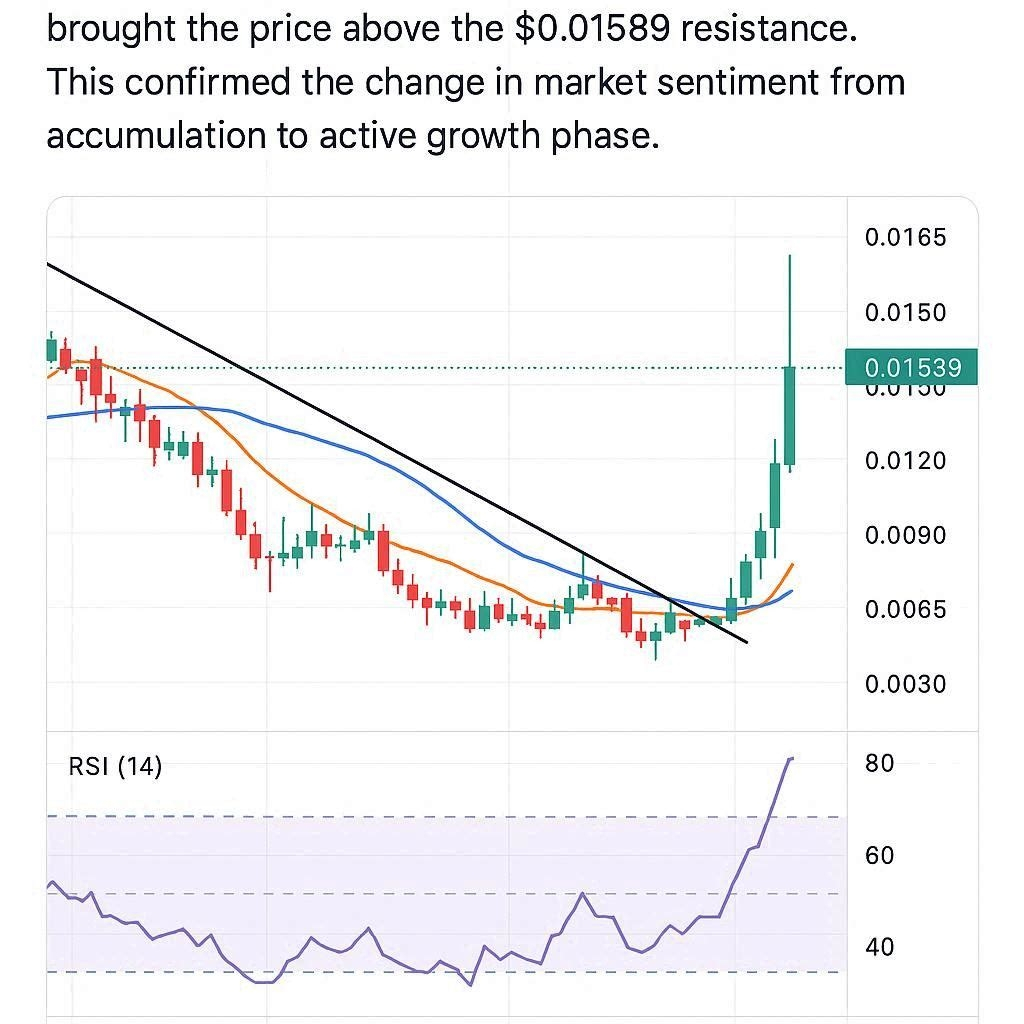
From a technical analysis standpoint, KAT/USDT has broken a prolonged downtrend structure, forming a powerful "bullish" candlestick that lifted the price above the resistance of $0.01589. This confirmed a shift in market sentiment from accumulation to an active growth phase.
Momentum indicators and moving averages
Analysis indicates the following technical parameters:
RSI (14 days): Currently in the overbought zone (above 80), indicating the likelihood of short-term consolidation following a sharp rally.
EMA (200 days): Level $0.01273 serves as a critical dividing line between "bullish" and "bearish" markets. Securing above this mark is a fundamental signal for mid-term investors.
MACD: Shows a positive histogram that is expanding, confirming the strength of the upward momentum, although signs of divergence are starting to appear on the 4-hour timeframe.
Key support and resistance levels for trading:
Resistance 1 ($0.0175 - $0.0190): Zone of the previous triple peak, breaking which will open the way to $0.025.
Support 1 ($0.01589): Former resistance that should now serve as a base for new buyers.
Support 2 ($0.0126): Level coinciding with the 200-day EMA, which is the final point of protection for the bullish trend.
Macroeconomic context and correlation with the market
The year 2026 has been a testing ground for cryptocurrencies due to the U.S. tariff wars and a shift in the paradigm of "digital gold." Bitcoin and Ethereum have faced pressure due to capital outflows from ETFs and rising yields on U.S. Treasury bonds.
The phenomenon of decoupling in Katana Network
Against the backdrop of falling major assets, KAT has demonstrated the ability to decouple. This is attributed to several factors:
Sectoral interest: Investors are actively reallocating capital into gaming Layer 2 solutions, where Katana plays a leading role due to low transaction costs.
Internal utility: Demand for vKAT for liquidity management creates an organic flow of buyers, independent of the overall market "beta."
Infrastructure stability: In times of "extreme fear" (Crypto Fear & Greed Index at level 8), capital shifts towards projects generating real income from network activity.
While Bitcoin attempts to hold above the $70,000 level, KAT demonstrates a gain of over 12% relative to BTC, indicating a shift of institutions from passive holding to active liquidity management in ecosystems with high capital efficiency.
Social factors and institutional perception
In 2026, social media continues to play a role as catalysts; however, their influence has become more structured. Events on X (formerly Twitter) and statements from thought leaders are perceived by the market as signals for institutional capital entry.
Key events and their impact on sentiment
EventDateMarket ImpactListing on Binance (Seed Tag)March 18, 2026
Spike in volatility, establishment of base liquidity
Launch of Katana PerpsApril 2026
Growth of TVL and network revenues
Meme coin summit (address Trump)April 25, 2026
Rotation of capital from meme tokens to infrastructure
Upcoming token unlockMay 18, 2026
Expectations of a short-term correction
The Katana community demonstrates a high level of "bullish" sentiment (about 81% positive ratings on CoinGecko), supported by regular updates from developers and a transparent governance model via vKAT.
Development forecast and strategic conclusions
Katana Network (KAT) is an example of a successful implementation of a DeFi-oriented Layer 2 blockchain that has managed to go beyond traditional speculative models. The absence of venture pressure at launch and a focus on liquidity concentration through an "opinionated" stack makes the project resilient to market shocks in 2026.
Analysis indicates that the further trajectory of KAT/USDT will depend on the network's ability to absorb the token unlock on May 18 and scale trading volumes on the Katana Perps platform. If the staking yield of vKAT remains above 30%, demand for the token from institutional players is likely to continue to grow, allowing the asset to test new highs around $0.030 by the end of the second quarter.
For market participants, it is critically important to continue monitoring the depth of order books on OKX and Binance, as any significant liquidity reduction at +/-2% can serve as a leading signal for trend change. In the current macroeconomic instability, KAT acts not just as a speculative asset but as a capital coordination tool in an ecosystem aiming to become a fundamental layer of liquidity for future DeFi.
#CryptoForgeAlpha #APE #ApeCoinAdventure #apechain #YugaLabs
The KAT/USDT ecosystem: A new paradigm of liquidity and the "No-VC" model in modern DeFi — emphasizing the uniqueness of a funding model without venture capital and the project's architecture.