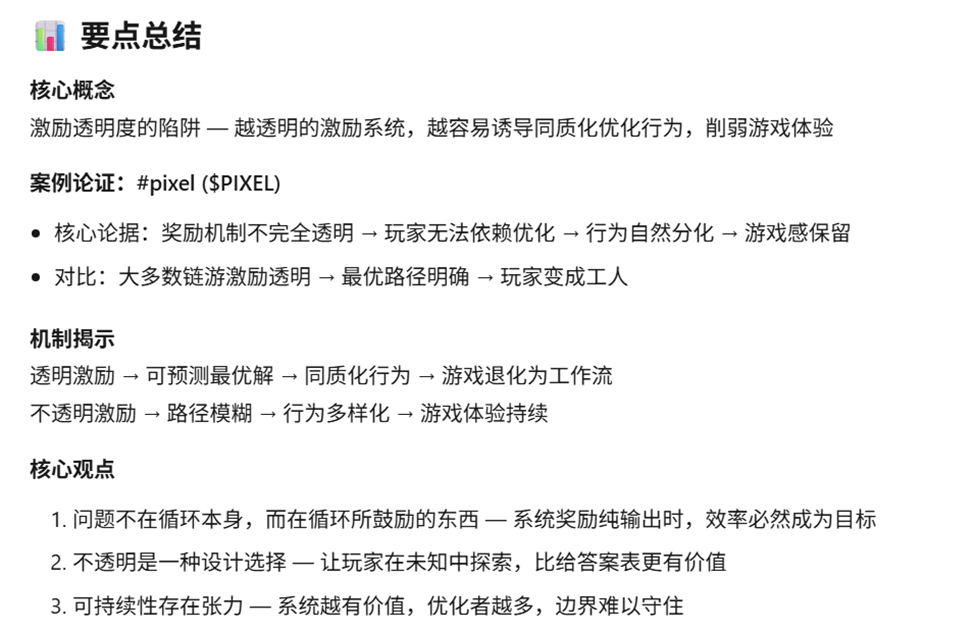
The clearer a game is about "what to do, what to earn", the less you want to play it. It sounds counterintuitive—doesn't transparency in information mean good things? But the fact is, when incentives are precisely quantified, the game turns into a calculation problem. And once someone starts calculating, more people lose interest in playing. Oddly, a game with a completely opaque reward system keeps me hooked.
It's not the designer's fault. When a system clearly tells you "do X to get Y", your brain automatically starts crunching the efficiency numbers. It's not about being forced, it's instinct. Once optimization kicks in, the gameplay takes a backseat, leaving only repetition. Predictable rewards create predictable behavior. Efficiency becomes the goal, and fun is just a byproduct.
Most chain games fail here. The collapse of Axie Infinity's SLP is a textbook case: dual-token model + fixed output formula = supply curve predictable to the point of suffocation. Once the output rate is exposed by on-chain data, arbitrage windows turn into tickets for arbitrage doors—smart people use scripts to mine, while ordinary players can only passively endure inflation. This isn't a design flaw; it's the inevitable convergence of fixed emission mechanisms in an open information environment: when incentives are precisely modeled, the game becomes a math problem, and there's always someone who solves it before you.
I entered #pixel with the same expectations. What new ideas can the farming setup attached to the token bring? It's just the standard script of early speculation, stable farming, and then cashing out.
But after spending some time, I sensed something was off. It's not slower, it's just not as forced.

The core difference lies in the reward distribution mechanism. Most chain games use a fixed emission schedule—how many tokens are produced per unit of time is clearly stated in the smart contract; you just need to read the contract and calculate compound interest. #pixel hasn't taken this path. Its rewards are closer to a dynamically adjusted model: output is deeply coupled with on-chain activity and interaction depth, not just a simple f(x)=y linear mapping. Output weights are dynamically adjusted based on interaction frequency, time spent, and behavior combinations, with no publicly available precise parameter table. You can see token flow on-chain, but you can't reverse-engineer the complete output function.
This opacity isn't a flaw; it's a deliberate design choice. The aim is to create systemic information asymmetry, fundamentally invalidating computable farming strategies.
The deeper issue with fixed emissions is that it naturally creates a precisely modelable Nash equilibrium. When everyone knows the optimal solution, everyone tends to do the same thing. In game theory, this is called pure strategy Nash equilibrium: each rational player's optimal choice is to follow the system's predefined optimal path. Behavior inevitably homogenizes, and the game degrades into a production line.
#pixel's design is closer to the variable ratio reinforcement schedule from behavioral psychology. The reason slot machines are so addictive isn't because of how high the rewards are, but rather because unpredictability itself drives continued behavior. You don't know when the next reward will come, but you believe that continuing to try will pay off. This mechanism blurs the boundaries of the 'optimal solution'—you can't optimize a function you can't even calculate. That's exactly what #pixel aims for: to make the act of 'playing' itself a more reliable strategy than calculating output.
From a tokenomics perspective, the design of $PIXEL has a more precise description: it's not a simple output-extraction linear pipeline, but a participation-weighted behavior proof model. You farm once and leave? The time decay mechanism makes your single yield extremely low. You keep interacting? Rewards accumulate non-linearly over time, with marginal returns increasing rather than decreasing. This is essentially an anti-extraction mechanism: time decay + interaction weight work together to prevent short-term arbitrage, forcing value to be anchored in continuous participation.
But this mechanism has structural tension that cannot be ignored.
Dynamic reward adjustments depend on oracles feeding prices and off-chain parameter calculations. When the parameter adjustment logic is reverse-engineered from long-term data—it's just a matter of time in a fully transparent on-chain environment—uncertainty will disappear, and the system will revert to deterministic gameplay. The more valuable it is, the more investment goes into reverse engineering. Information asymmetry is the safety margin of the dynamic model, but this margin decreases with scale.
Digging deeper, there's MEV (Maximal Extractable Value). On-chain behavior can be observed, sorted, and front-run. In a fixed emission system, MEV manifests as gas bidding wars; but in a dynamic model, higher-order MEV is an information warfare—whoever cracks the parameter adjustment logic first can systematically harvest before others react. The tools have evolved from scripts to machine learning models, yet the essence of the game remains unchanged.
$BTC's history is another version of the same story. In the early days, no one could accurately price it; it was all based on faith and intuition, with varying participant behaviors and an ecosystem full of possibilities. Later, pricing models matured, arbitrageurs flooded in, and the ecosystem standardized. $ETC, on the other hand, chose to uphold the principle of on-chain immutability during another fork, at the cost of relative market cap shrinkage. Both directions are rational choices—#pixel, however, is on a third path: not defining value, nor rigidly adhering to rules, but generating value through participation itself.
So the real question is: is the sense of looseness in #pixel a result of its design, or just an illusion due to insufficient scale?
I don't know. But I know one thing: every valuable system will eventually attract optimizers. This isn't a flaw of a specific project; it's a human issue.
$BTC has redefined the potential of value storage through scarcity. $ETC has upheld the principle of immutability in on-chain contracts. What #pixel aims to prove is that participation itself can become value—even if it means going against the smartest players to decode everything they want to crack.
It's easier said than done to enjoy now and profit later.
But what can make players forget about profiting is what’s truly valuable. $BTC defined value storage through scarcity, $ETC upheld fundamental principles through immutability—and what Pixel aims to prove might be that participation itself can become value.
Can Pixel maintain this boundary?