
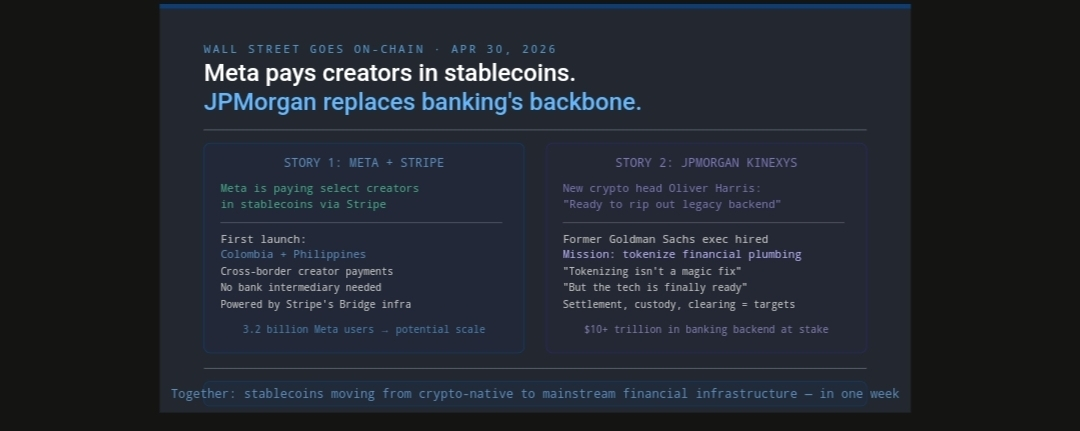
Two announcements dropped this week that — taken separately — look like incremental news. Together, they mark a structural inflection point in how value moves through the global economy.Meta pays creators in stablecoins via Stripe.Tech giant Meta started paying some creators in stablecoin with Stripe's support, first offering the feature to select creators in Colombia and the Philippines.
Think about what's actually happening here. Meta has 3.2 billion monthly active users. Millions of those users are content creators — people who earn money through Instagram Reels, Facebook videos, and similar products. For creators in Colombia and the Philippines, getting paid by Meta traditionally means waiting for bank transfers, dealing with currency conversion fees, and navigating cross-border payment friction that can eat 5–10% of earnings. CointelegraphStablecoin payments via Stripe's Bridge infrastructure mean: instant settlement, no intermediary bank, minimal FX friction. The creator in Manila gets their USD equivalent within seconds, not days.The significance isn't the Colombia and Philippines pilot — it's the infrastructure being tested. Meta is building and validating a global stablecoin payment system. When the pilot works, the rollout doesn't go to the next country. It goes to all 3.2 billion users simultaneously.JPMorgan is tokenizing the banking system's backbone.JPMorgan hired former Goldman Sachs executive Oliver Harris for Kinexys, with Harris believing the technology is finally ready to "rip out" and replace the financial industry's legacy backend. Harris has previously warned that tokenizing assets isn't a magic fix for liquidity, but believes the technology is now mature enough to address settlement, custody, and clearing infrastructure — the unglamorous plumbing that keeps global finance running.
This is different from JPMorgan launching a token or a stablecoin product. Kinexys is targeting the settlement and clearing infrastructure that banks use internally — the systems that process trillions of dollars daily in the background. If JPMorgan can tokenize those processes, settlement that currently takes T+2 days becomes real-time. Counterparty risk collapses. Capital efficiency improves dramatically. CointelegraphThe reason this matters for crypto: every time a traditional financial institution adopts blockchain infrastructure for its own internal processes, it creates another layer of demand for the underlying networks — Ethereum, Solana, or purpose-built chains like JPMorgan's own Kinexys network. It also normalizes the technology for the regulators, auditors, and risk managers who currently resist it.Meta and JPMorgan are not building crypto products. They're building financial infrastructure that happens to run on blockchain rails. That distinction is important — and it's what mainstream adoption actually looks like.