
The centralization of Artificial Intelligence poses a significant bottleneck to innovation. Heavyweight tech conglomerates control the computational pipelines, datasets, and foundational models, locking individual developers and smaller enterprises out of the value chain. OpenLedger aims to rewrite this narrative by introducing a decentralized, blockchain-powered infrastructure designed to democratize AI development, deployment, and monetization.
By establishing a transparent, attribution-heavy economic layer, the platform aligns the incentives of data contributors, developers, and end-users.
The Open Value Loop: Tokenomics and Network Utility
At the center of this decentralized network is the OPEN token, the native utility and coordination engine that fuels the entire ecosystem. As illustrated in the structural breakdown of 1001457836.jpg, the platform operates on a self-sustaining economic flywheel known as the Open Value Loop. This loop consists of four key operational phases that drive continuous network utility:
Gas (Network Access): The OPEN token serves as the fundamental currency to settle transactional gas fees and execute smart contracts across the network infrastructure.
Inference (Access & Usage): To interact with deployed AI architectures and run localized inferences, users utilize OPEN tokens to pay for the underlying computational consumption.
Model Building (Build & Deploy): Developers and machine learning engineers are required to stake OPEN tokens to train, fine-tune, and ultimately publish their proprietary or open-source models onto the ledger.
Contributor Rewards (Incentivize): High-quality inputs are the bedrock of reliable AI. The ecosystem directly rewards contributors with OPEN tokens for supplying premium data repositories, foundational models, and rigorous evaluations.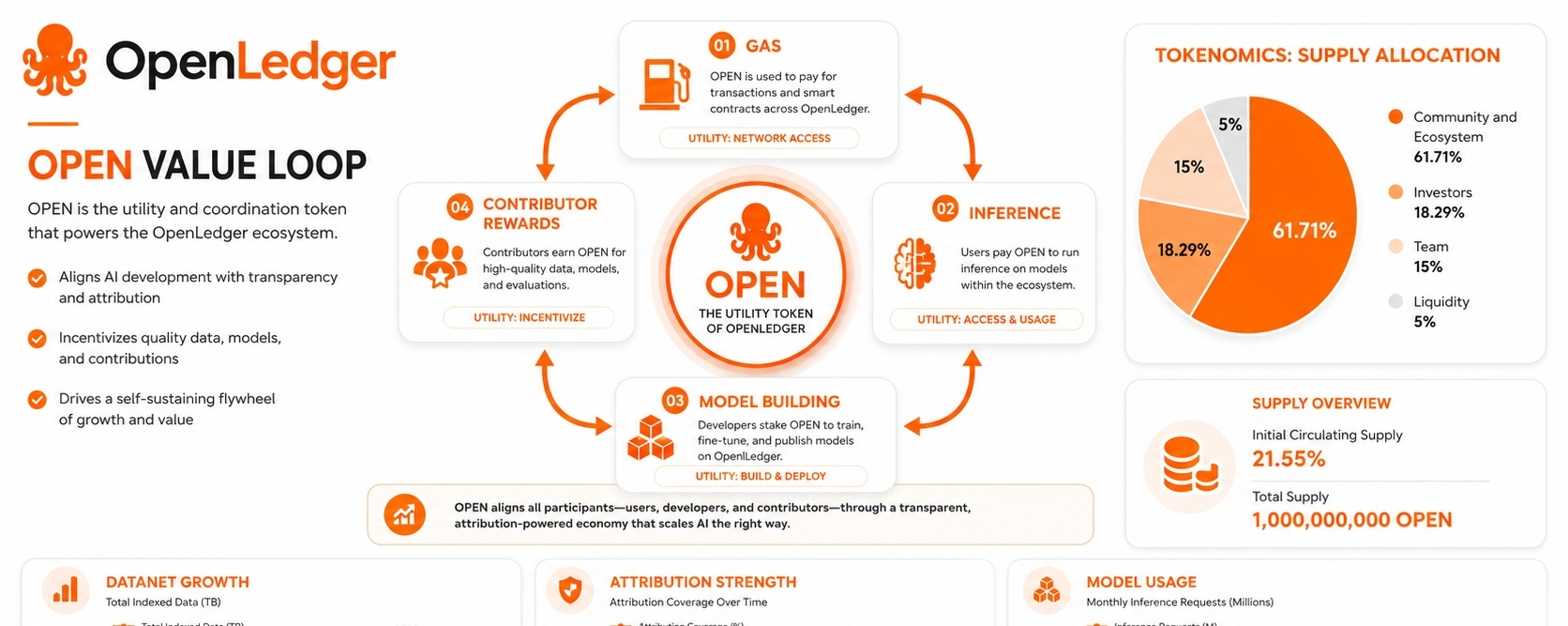
A Comprehensive Builder’s Sandbox
OpenLedger provides an extensive, multi-layered framework designed to host a diverse array of decentralized applications, specialized autonomous agents, and commercial marketplaces. The technical roadmap outlined in 1001457837.jpg demonstrates exactly what developers can architect on the platform, spanning across ten specialized operational pillars:
1. Consumer Applications & Developer Tooling
Building consumer-facing products requires reliable modular infrastructure. Developers can launch pay-per-use AI apps, task-based productivity tools, specialized AI copilots, and creative generation engines. This layer is fully supported by robust developer tools, including dedicated Software Development Kits (SDKs), custom Application Programming Interfaces (APIs), pre-configured agent templates, and comprehensive monitoring suites.
2. Autonomous Agents & Infrastructure
The future of productivity relies heavily on autonomous workers capable of independently executing complex workflows. OpenLedger natively supports task, research, transaction, and multi-step workflow agents. To ensure these agents operate fluidly, the underlying infrastructure provisions native crypto-wallets, secure cryptographic identities, granular access permissions, and decentralized verification layers.
3. Agent Economies & Financialization
When agents can transact with other agents, a native economy emerges. The network enables micro-payments, agent-to-agent transactional settlement, flexible usage-based pricing structures, and real-time automated revenue splitting among independent digital entities.
4. Data, Memory, & Services
AI models require continuous context. OpenLedger integrates specialized Retrieval-Augmented Generation (RAG) knowledge bases, structured data graphs, shared datasets, and versioned, immutable memory protocols. On the intelligence side, the ecosystem hosts task-specific architectures, fine-tuned consumer weights, onchain inference engines, and broader decentralized AI services.
5. Marketplaces & Enterprise Systems
To monetize these assets, the platform implements localized marketplaces where entities can openly trade datasets, autonomous agents, raw model weights, and compute services. For institutional deployment, OpenLedger incorporates enterprise-grade infrastructure complete with compliance layers, immutable verification logs, real-time AI audit dashboards, and decentralized governance systems.
6. Attribution & Fairness
One of the most profound issues plaguing traditional AI is the uncompensated scraped utilization of intellectual property. OpenLedger tackles this directly via an open attribution registry. By leveraging precise contribution tracking, the network calculates usage analytics to execute fair, automated revenue distribution to the original data creators and model optimizers.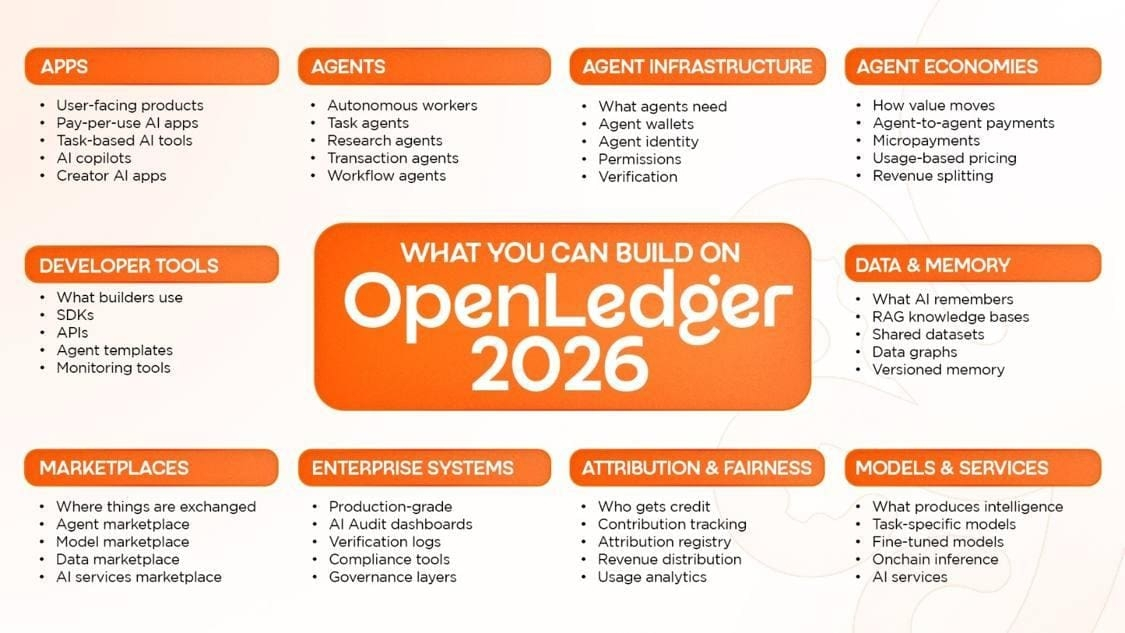
Driving Long-Term Growth Metrics
By embedding transparency and fair attribution directly into the consensus layer, OpenLedger corrects the inherent imbalances of legacy AI development. Data providers no longer have to worry about their proprietary assets being exploited without consent, as every single query and data call is cryptographically tracked and compensated.
Concurrently, developers gain unhindered access to open-source models, verifiable training sets, and specialized agent toolkits without relying on centralized single points of failure. As data indexes scale up, model usage metrics surge, and attribution strength tightens, the Open Value Loop accelerates. OpenLedger creates a self-sustaining ecosystem where high-quality contributions directly foster high-performance intelligence, paving the way for a more equitable, open, and decentralized future for artificial intelligencDriving Long-Term Growth Metrics
By embedding transparency and fair attribution directly into the consensus layer, OpenLedger corrects the inherent imbalances of legacy AI development. Data providers no longer have to worry about their proprietary assets being exploited without consent, as every single query and data call is cryptographically tracked and compensated.
Concurrently, developers gain unhindered access to open-source models, verifiable training sets, and specialized agent toolkits without relying on centralized single points of failure. As data indexes scale up, model usage metrics surge, and attribution strength tightens, the Open Value Loop accelerates. OpenLedger creates a self-sustaining ecosystem where high-quality contributions directly foster high-performance intelligence, paving the way for a more equitable, open, and decentralized future for artificial intelligence.
