
For years, the term "Ethereum Killer" was a marketing joke used by every new blockchain seeking attention. As of January 2026, the joke is no longer funny to anyone among Ethereum maximalists.
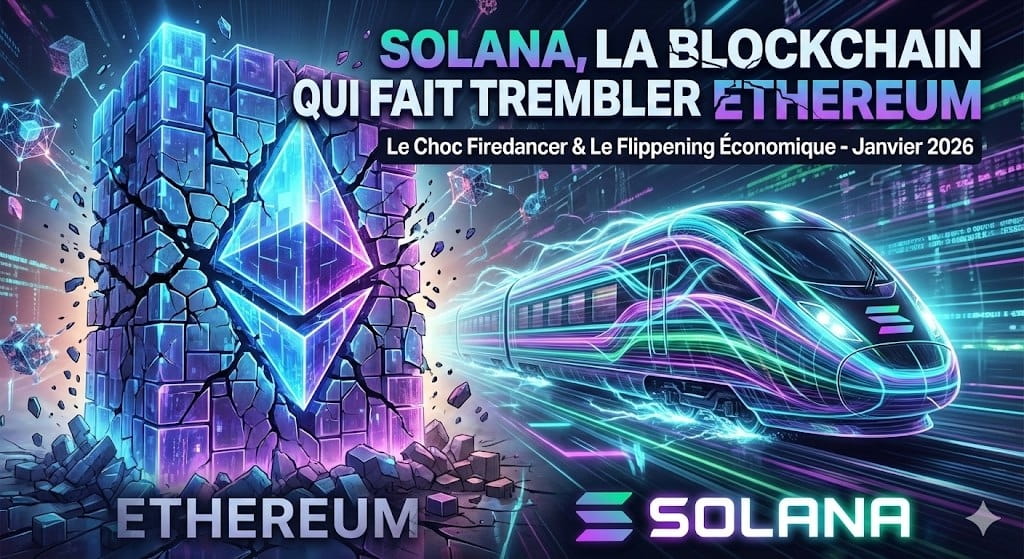
Solana is no longer a fast but unstable "outsider." It has become the default infrastructure of the modern financial internet. While Ethereum remains the digital vault, Solana has become the global highway for financial information.
This is why, at the start of this year, Vitalik Buterin's throne is more precarious than ever, brought down by two major and very recent events.
1. The "Firedancer Shock": The end of the scalability debate
The first tipping point has just materialized at the end of 2025 with the complete and successful deployment of Firedancer on the mainnet.
While Ethereum continues to fragment across dozens of "Layer 2" (Base, Arbitrum, Optimism...) forcing users to constantly "bridge" (transfer) their funds, Solana has succeeded in its crazy technological gamble.
With Firedancer, Solana proved at the beginning of 2026 that it could handle more than 1 million theoretical transactions per second, without any congestion.
This is a fundamental difference in user experience.
On Ethereum in 2026: Users must choose their network, pay fees to move their funds, and manage liquidity fragmentation. It's an archipelago of isolated islands.
On Solana in 2026: Everything happens on a single channel, at the speed of light. It's a connected megalopolis.
Solana's fluidity is now attracting developers of consumer applications (social networks, AAA video games) who have abandoned the idea of building on an Ethereum ecosystem deemed too complex for "the average person".
2. The economic "Flippening": Real payments have migrated
The second key factor is the volume of stablecoins. This is the most honest metric, as it doesn't lie about the actual use of blockchain for commerce.
Since December 2025, a strong trend has been confirmed: <u>Solana has definitively surpassed Ethereum in stablecoin (USDC, PYUSD) transfer volume for daily payments.</u>
Why? Because payment giants like Visa and PayPal, which intensified their pilot programs last year, have massively favored Solana's architecture for their final settlements.
Institutions don't want to pay $2 in fees on Ethereum or wait 15 minutes for finality. They want instant gratification and a fee of $0.0002.
This is no longer speculation, it's usage. Ethereum remains the king of institutional DeFi (large amounts, low velocity), but Solana has become the blockchain of the people and global commerce (high frequency, high velocity).
Conclusion: Coexistence or replacement?
Should you sell all your ETH for SOL? Not necessarily. Ethereum is becoming an ultra-secure settlement layer, a bit like the Fed for cryptocurrencies.
But for the end user, for the applications of 2026, and for mass adoption, Solana has won the user experience battle. If Ethereum is the "Bitcoin 2.0," then Solana is indeed the first "World Computer" capable of running the Nasdaq on-chain.
In 2026, ignoring Solana is like ignoring Apple in 2007.