


Why it is so uncommon
When individuals come across the term, privacy, they automatically think it is a closed or a private blockchain. Privacy has been dealt with that way most of the time. But Dusk follows another way.
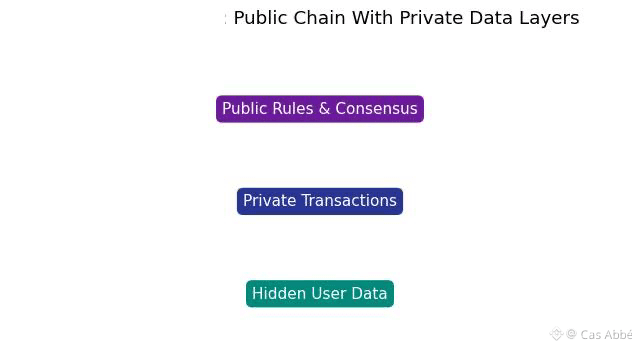
Dusk is meant to be open, unrestricted, and unrestricted. Any person is able to operate a node, develop applications or even join the network. It does not have a central gatekeeper or a club of its own. Meanwhile, transaction data are confidential in nature.
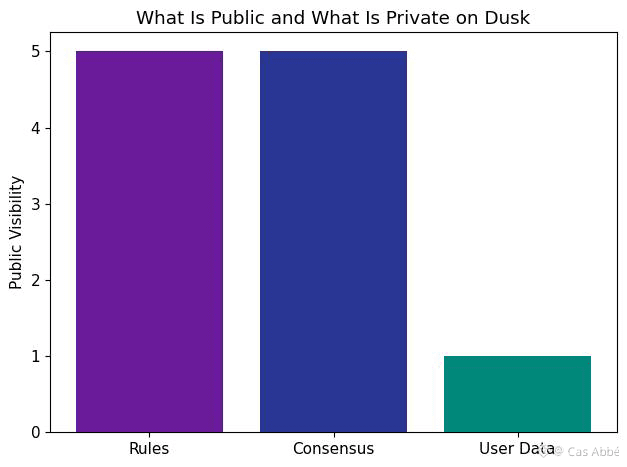
Such a combination is not common, as most systems select one side:
Public blockchains are privacy invasive.
Systems privatized are less open and decentralized.
Dusk tries to keep both.
One can explain it in a straightforward way as follows:
The rules are public. Any person can check the functionality of the system.
The data is private. Financial details of sensitive nature are not transmitted to the entire internet.
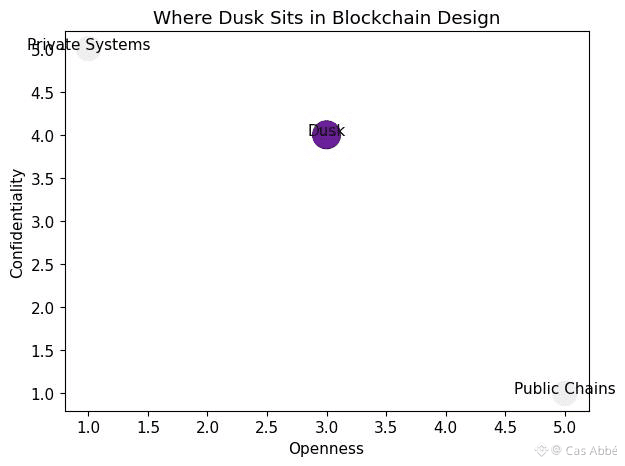
What it explains:
Public chains: open, low privacy
Private systems: private, closed
Dusk sits in the middle open and private
Dusk is rare. Most projects choose one extreme. Dusk intentionally balances both.
This is important since public networks tend to be more neutral and difficult to manipulate by an individual party. That's important for trust. However, it is impossible to have finance functioning correctly when all is open. This tension has to be acknowledged by Dusk, and it is tailored to it, rather than being disregarded.
In serious uses, such as financial markets, or tokenized assets, or regulated activity, this model of a public chain, private data is far more appropriate than making all things open.
