Hello everyone. I am so glad you are here today to dive into a topic that affects all of us even if we do not see it happening. We spend so much of our lives putting photos and documents online but have you ever stopped to wonder if that data is truly safe forever. Today I want to walk you through a very cool technology called #Walrus and a concept it uses called Asynchronous Complete Data Storage.
I know that sounds like a mouthful of technical jargon but I promise to keep it simple for us. Think of Walrus as a giant digital vault that does not live in just one building but is spread out across the whole world. Because it is spread out it needs a very specific set of rules to make sure your files do not get lost or broken. We are going to explore how those rules work and why they matter for you and me.
Understanding The Basics Of Complete Data Storage
When we talk about storing data in a network like Walrus we have to assume that things will eventually go wrong. Some computers might crash or some people might even try to be dishonest within the system. That is why the researchers created a standard called Complete Data Storage. This is basically a guarantee that your information stays put no matter what happens to the individual machines.
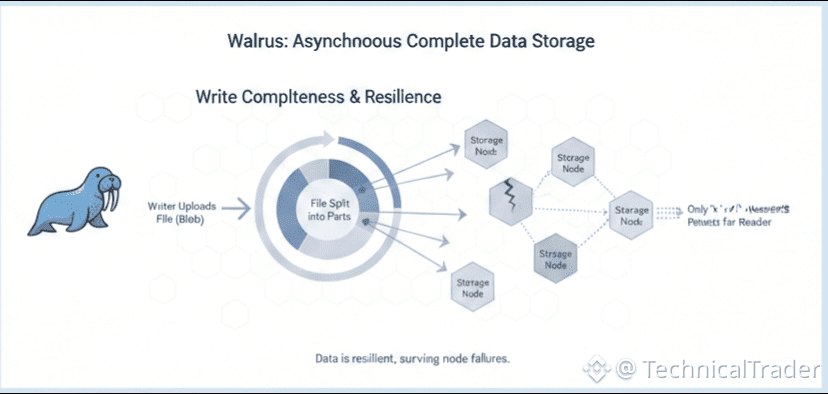
In this setup we imagine a writer who wants to share a big file or a blob with the world. We use a network of many storage nodes to hold that file. The goal here is to make sure that even if some of those nodes fail any reader who wants to see your file can still get it. It is all about building trust in a world where technology is not always perfect and I think that is a goal we can all get behind.
How Walrus Makes Sure Your Work Is Never Lost
One of the most important things for us to understand is something called Write Completeness. Imagine you are uploading a very important project to the Walrus network. You want to be 100 percent sure that once you hit send the file is actually there. If you are acting honestly the system guarantees that every good node in the network will eventually get a piece of your file.
I like to think of this like sending a letter. You want to know that the post office did not just lose it halfway there. In the Walrus system your file is turned into many small parts. Even if some of those parts disappear we only need a few of them to rebuild the entire thing. This means your data is incredibly resilient and that gives us a lot of confidence when we use these types of tools.
Keeping Things Fair With Read Consistency
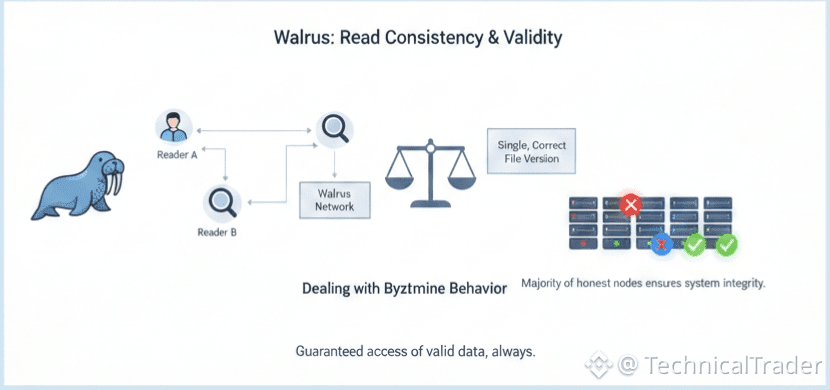
Have you ever been in a situation where two people saw the same thing but had totally different stories about it. That is exactly what we want to avoid when reading data from a network. This is why Walrus uses a rule called Read Consistency. It ensures that if you and I both go to look at a file saved on the network we will both see the exact same thing.
This rule is mainly there to stop a dishonest writer from trying to trick us. If a writer tries to show one version of a file to you and a different version to me the system will catch it. We will either both get the correct file or we will both get a message saying it failed. This level of honesty is what makes a digital storage system actually usable for important tasks in our daily lives.
Why You Can Always Access Your Valid Data
Now let us talk about the idea of Validity because this is where the real magic happens for the user. If you successfully save something to Walrus the system promises that any honest person with the right permission can read it back. This sounds like it should be easy but when you have nodes acting like bullies or trying to hide information it gets tricky.
The Walrus protocol is designed so that the storage nodes cannot hold your data hostage. If you have the proof that your file was written then the system makes sure you can get it back. We never have to worry about a single computer error or a bad actor standing between us and our important information. It is a very powerful way to protect our digital footprint.
Dealing With Bad Actors In A Smart Way
You might be wondering what happens if some of the computers in the network start acting weird or stop following the rules. This is something the creators of Walrus thought about deeply. They built the system to handle what we call byzantine behavior. This is just a way of saying that even if some nodes are being intentionally difficult the rest of the network can work around them.
In a typical Walrus setup we can have a large number of nodes and as long as most of them are doing the right thing the system stays alive. This is great for us because it means we do not have to rely on every single computer being perfect. It is a realistic approach to technology that assumes things will go wrong and prepares for it in advance so our data stays safe.
Growing And Changing With The Network
The last thing I want to share with you today is how Walrus stays flexible. Most old systems were built for a fixed group of computers. But the internet is always changing. People join and people leave all the time. Walrus is special because it can handle this movement which the experts call churn. It allows the storage nodes to change while still keeping the data intact.
This means that as the Walrus project grows it becomes even more stable. Your data is not tied to one specific machine that might get old and break down. Instead your information lives on through the entire community of nodes. It is a very forward thinking way to handle storage and I am excited to see how it continues to develop as more people start using it.
What you think about this? don't forget to comment 💭
Follow for more content 🙂