

Most discussions about blockchains focus on money, trading, or applications. But behind every useful digital system, there is a quieter problem that matters just as much: where the data lives, how it is kept, and how long it can be trusted to exist. Walrus was designed to live in this quieter layer of the stack. It is not trying to replace blockchains or compete with them. Instead, it treats the blockchain as a control plane, a place for rules, metadata, and coordination, while the actual data is handled by a separate network of storage nodes built for that purpose.
At its core, Walrus is a decentralized secure blob store. A “blob” here simply means a large piece of data, such as a file or application content. The system is built around a simple but powerful idea: the blockchain should not store heavy data, but it should be able to control who stores it, for how long, and under what rules. In Walrus, the Sui blockchain plays this coordination role, handling metadata, commitments, payments, and governance, while a distributed committee of storage nodes handles encoding, storage, and recovery of the actual data.
This separation of roles is what makes the system practical. The blockchain stays small, fast, and focused on coordination. The storage network focuses on capacity and reliability.
A System Built Around Encoding, Not Copies
Instead of copying files to many servers, Walrus uses a modern encoding and decoding method called Red Stuff. When a user wants to store a file, the file is first encoded into many small pieces, often called slivers. These slivers are created in such a way that the original file can be reconstructed even if many of them are missing. This is combined with Merkle trees, which are used to create compact commitments to the content, allowing anyone to verify that the stored pieces are correct without needing to trust the storage nodes.
From these commitments and some basic metadata, a unique blob identifier is created. This identifier is what the blockchain knows about. The blockchain does not know or care about the actual content. It only knows that a blob with this identifier exists, how big it is, and how long it should be stored.
This is where the design becomes very clean. The heavy data never touches the chain, but the chain still controls the rules.
What It Means to Write a Blob
Writing data into Walrus is not just a matter of uploading a file. It is a process with clear steps and clear guarantees. First, the user encodes the file using the Red Stuff algorithm. This produces the slivers, the commitments to those slivers, and a single commitment to the whole blob. From this, the blob identifier is derived.
Next, the user submits a transaction to the blockchain to reserve storage space for this blob for a chosen number of epochs. An epoch is simply a period of time during which storage obligations are fixed. This transaction includes the blob’s size and its commitment, and it also handles the payment or allocation of storage resources.
Once this transaction is confirmed, the storage nodes are informed that they are now responsible for storing specific slivers of this blob. Each node receives its assigned pieces together with proofs that these pieces are consistent with the registered blob. The nodes verify what they receive and respond with signed acknowledgements.
The user then waits until enough of these acknowledgements are collected. Specifically, the system requires more than two thirds of the nodes to confirm. When this happens, the user creates a write certificate and publishes it on the blockchain. This moment is called the Point of Availability. From this point on, the network is formally committed to keeping the data available for the agreed time.At this stage, the user can even delete the local copy of the file. The system itself has taken responsibility for it.
Reading and Recovery as a Normal Operation
Reading data from Walrus is simply the reverse process. A client asks the network for enough slivers, verifies them against the commitments stored on chain, and reconstructs the original file. No single node needs to be trusted, and no single node needs to be available.
What makes the system robust is that recovery is not treated as an emergency feature. It is part of normal operation. If a node joins the network late or comes back after downtime, it can look at the blockchain, see which blobs have passed their Point of Availability, and fetch the necessary slivers from other nodes. Over time, all correct nodes will converge to holding the required data.
Living With Change: Epochs and Reconfiguration
Real networks are not static. Nodes go offline, new ones appear, and some may misbehave. Walrus is built around epochs to manage this. During each epoch, the set of storage nodes and their responsibilities are fixed. When a new epoch begins, the system can reconfigure, changing the committee and redistributing responsibilities without breaking the guarantees for existing data.This makes the system flexible without making it fragile. Change is expected, planned, and managed by the protocol itself.
More Than Honest or Malicious
Walrus is also designed to go beyond the simple idea that nodes are either honest or malicious. It can support storage challenges, which are ways to check that nodes are still actually holding the data they promised to store. This adds another layer of safety, not by assuming good behavior, but by continuously verifying it.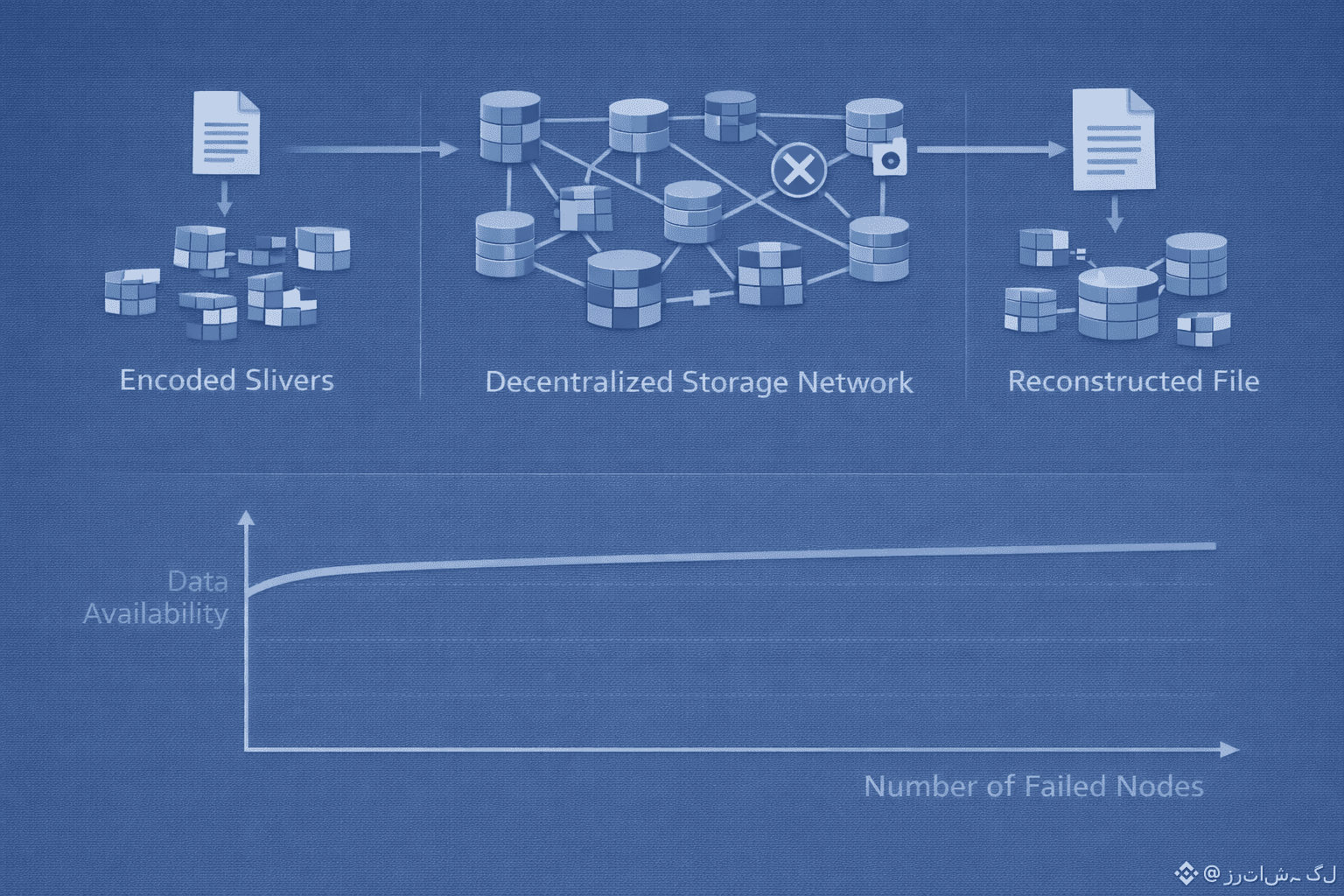
Quiet Infrastructure That Just Works
Walrus is not a flashy system. It does not try to turn storage into a spectacle. It treats storage as what it really is: a long-term responsibility. By combining blockchain coordination, strong encoding methods, and a decentralized storage network, it creates a system where data can outlive individual machines, companies, and even individual users.
If it succeeds, most people will never think about it. Their applications will just work, their data will just be there, and the system will quietly do its job. That is usually how real infrastructure proves its value.

