
In the ever-evolving landscape of digital finance, the "Holy Grail" has always been a way to move value as easily as sending a text message—without the "gas fee" headache or the "wait ten minutes for confirmation" anxiety.
Enter Plasma, a Layer 1 blockchain that isn't trying to do everything; it’s just trying to do money better. By tailoring its entire architecture to stablecoin settlement, Plasma is shifting the narrative from "speculative assets" to "functional digital cash."
The "Coffee Shop" Problem: Why We Need a Specialized Layer
Imagine you’re at a local café in an emerging market. You want to pay with USDT. On a traditional chain, you’d need to:
1. Buy the native network token (like ETH or BNB) just to pay for gas.
2. Wait for the transaction to clear (hoping the network isn't congested).
3. Pay a fee that might be 20% of your coffee’s price.
Plasma deletes this friction. Through its Protocol-Managed Paymaster, simple USDT transfers are gasless. You don't need a secondary token; you just send the value. If a transaction does require a fee (like a complex smart contract), you can pay it directly in USDT or even BTC.
The Architecture: Speed Meets "Old School" Security
Plasma isn't just a "fast" chain; it’s a strategically engineered stack.
1. The Engine: Reth Execution
By using Reth (a high-performance Rust implementation of the Ethereum Virtual Machine), Plasma remains fully EVM-compatible. Developers can port their Ethereum dApps to Plasma in minutes, but they gain the benefit of millisecond timestamp precision and massive throughput.
2. The Heartbeat: PlasmaBFT
Based on the "Fast HotStuff" consensus, PlasmaBFT allows the network to reach sub-second finality. In real terms: your payment is settled before you’ve even put your phone back in your pocket.
3. The Anchor: Bitcoin Security
To ensure institutional-grade neutrality, Plasma periodically "anchors" its state to the Bitcoin blockchain. This means the ledger isn't just secured by its own validators; it inherits the immutable censorship resistance of the world’s most secure network.
Visualizing the Flow: How Money Moves on Plasma
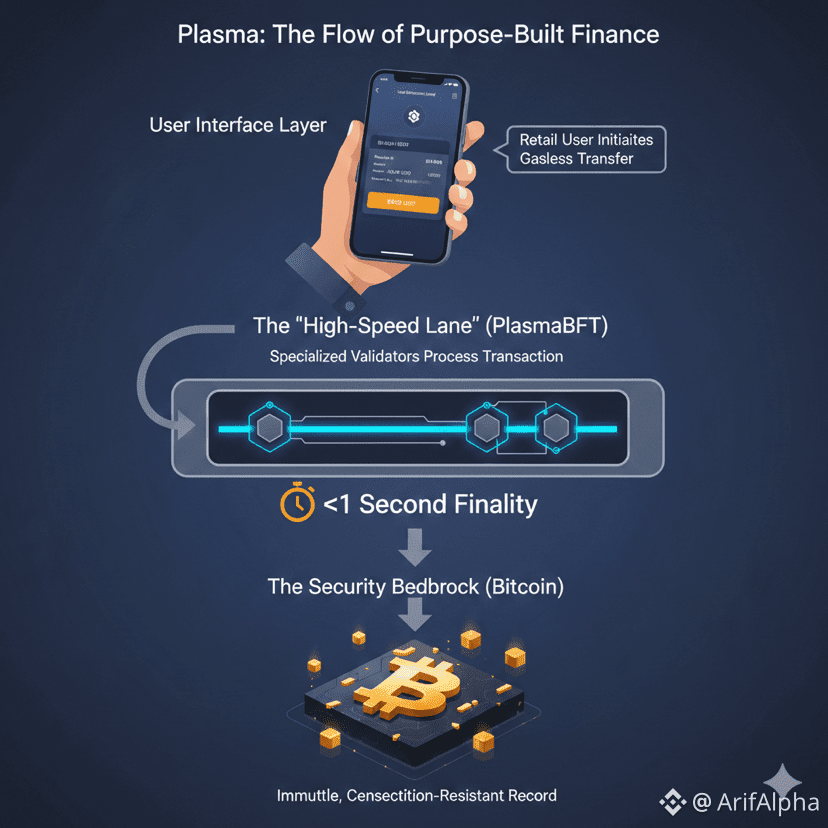
• User Interface Layer: A retail user sends $50 USDT via a mobile wallet. No gas token is required.
• The "High-Speed Lane" (PlasmaBFT): The transaction is picked up by specialized validators optimized for stablecoin volume. It hits finality in <1 second.
• The Security Bedrock (Bitcoin): Every few blocks, the network "checkpoints" its state onto the Bitcoin ledger, creating a permanent, unalterable record.
Real-World Impact: More Than Just Tech
The true genius of Plasma lies in its Real-World Asset (RWA) and institutional readiness.
• Global Remittances: A worker in Europe can send digital dollars to family in Southeast Asia with zero fees, bypassing the 5-10% "vampire fees" of traditional wire services.
• Institutional Settlement: Finance firms can move millions in stable liquidity with the confidence of Bitcoin-anchored security and the speed of a private ledger.
• Regulatory-First Approach: Unlike chains that run from regulation, Plasma has embraced it, recently acquiring VASP (Virtual Asset Service Provider) status in Italy to align with upcoming EU MiCA frameworks.
Why This Matters for the "Mindshare"
We are moving away from the era of "General Purpose" blockchains that are "jack of all trades, master of none." Plasma represents the rise of Purpose-Built Finance. It treats the digital dollar as a first-class citizen, not an afterthought.
By removing the "Gas Fee" barrier, Plasma isn't just courting crypto-natives; it’s opening the door for the next billion users who don't care about "gas" or "consensus"—they just want their money to move.
Given that "gasless" transfers remove the biggest hurdle for retail adoption, do you think specialized Layer 1s like Plasma will eventually replace general-purpose chains for everyday payments?

