

Data has emerged as a new constraint as blockchain applications grow beyond straightforward transactions. Large amounts of data are necessary for rollups, AI-powered dApps, on-chain games, and media-rich protocols to be accessible, verifiable, and financially sustainable over time. Although settlement layers have been optimised for security and execution layers for speed, data availability and storage are still among the weakest points in the stack. A specialised solution to this issue is the Walrus Protocol, which positions storage as the fundamental infrastructure of contemporary blockchains rather than as an add-on service.
Instead of going up against general cloud providers or long-term archival networks, Walrus focusses on a more specific use case: efficiently handling large binary data for high-performance, modular blockchain systems. This focus is part of a bigger change in the architecture of crypto. As blockchains become more modular, storage can no longer be an afterthought. It needs to work well with execution and settlement while keeping costs down and trust to a minimum.
The blob-based storage model is what makes Walrus work. Erasure coding is used to encode large files and spread them out across many independent nodes. This way, data can be rebuilt even if some nodes go offline. This method cuts down on the need for full replication by a huge amount, which lowers costs while keeping reliability. The design is better for data availability layers, application state storage, and large datasets than for simple file hosting because it prioritises throughput and scalability over very fast retrieval of small files.
A big plus for Walrus is how well it works with Sui. Walrus can anchor commitments, metadata, and permissions directly on-chain without making execution slower because Sui's object-centric architecture. Walrus lets developers store a lot of data off-chain, while Sui smart contracts let them control who owns it, who can access it, and how it works. This separation keeps apps safe and makes sure they can work together, and it also avoids the performance problems that come with storing large amounts of data directly on a base layer.
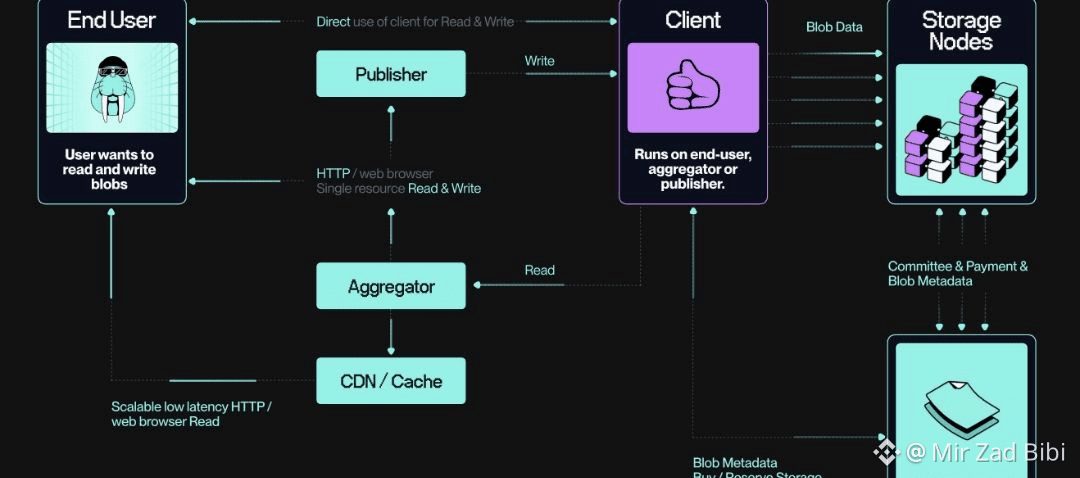
The WAL token connects the economic layer. People use WAL to pay for storage and data availability services, which directly links the demand for tokens to how the network is used. Storage providers must stake WAL to take part, and slashing mechanisms make sure that they are available and act honestly. Governance is also based on tokens, which give stakeholders control over things like pricing models and levels of redundancy. Instead of centralised control, this structure aligns long-term reliability with economic incentives.
Early activity on the network suggests Walrus is starting to find real footing. The amount of data being stored is climbing, more storage nodes are coming online, and a noticeable share of WAL is locked in staking. That combination points to growing confidence from operators and early users. On-chain interactions that reference Walrus-stored data are also becoming more common, which shows the protocol is moving past experimentation and into actual use. Adoption is still early, but it’s increasingly shaped by real needs rather than hype.
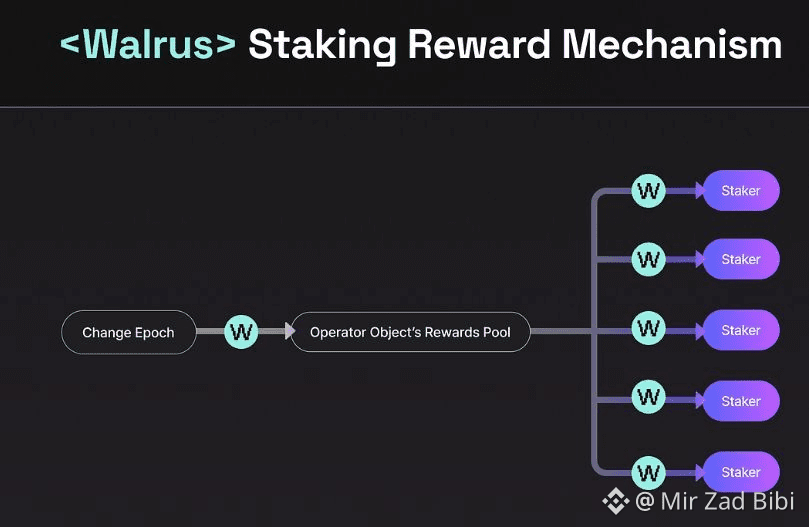
From a broader market view, Walrus sits in a clearly defined lane. Developers get a storage layer that feels practical—designed for large files, predictable behavior, and on-chain verification. Node operators earn based on storage demand instead of chasing transaction volume. For those looking at WAL long term, the appeal is less about short-term price moves and more about exposure to a part of the stack that benefits as modular blockchains and AI-driven applications continue to grow.
Of course, it’s not without challenges. Erasure-coded storage is complex by nature and needs to keep proving itself under pressure. Paying for storage with a volatile token can also make long-term costs harder to plan for. At the same time, competition in decentralized storage is heating up, with different projects pushing hard on permanence, privacy, or cross-chain reach. Walrus can’t afford to chase everything at once. Its edge comes from staying focused on performance, tight integration, and a clear economic model.
Looking ahead, the real question is how deeply Walrus gets woven into live applications. If teams begin treating it as a default choice for data availability and large-scale storage, its role could quietly become essential. As data keeps turning into one of the biggest constraints in Web3, Walrus is aiming to make storage feel less like a limitation and more like a native, programmable part of decentralized systems.

