


Stablecoins have quietly become one of the most used products in crypto. They are no longer experimental instruments for traders; they are payment rails, treasury tools, and settlement layers for businesses operating across borders. As stablecoin usage grows, the technical requirements behind them change as well. Speed alone is no longer enough. What matters is whether settlement behaves like infrastructure rather than an application.
This is the problem Plasma is designed to solve.
Plasma is a Layer-1 blockchain built specifically for stablecoin settlement. Instead of treating stablecoins as just another token type, Plasma puts them at the center of the system. Its architecture combines full EVM compatibility with sub-second finality through PlasmaBFT, while introducing stablecoin-first features such as gasless USDT transfers and stablecoin-denominated gas. The goal is not to optimize speculation, but to optimize predictable value movement.
Why Stablecoins Need a Different Design
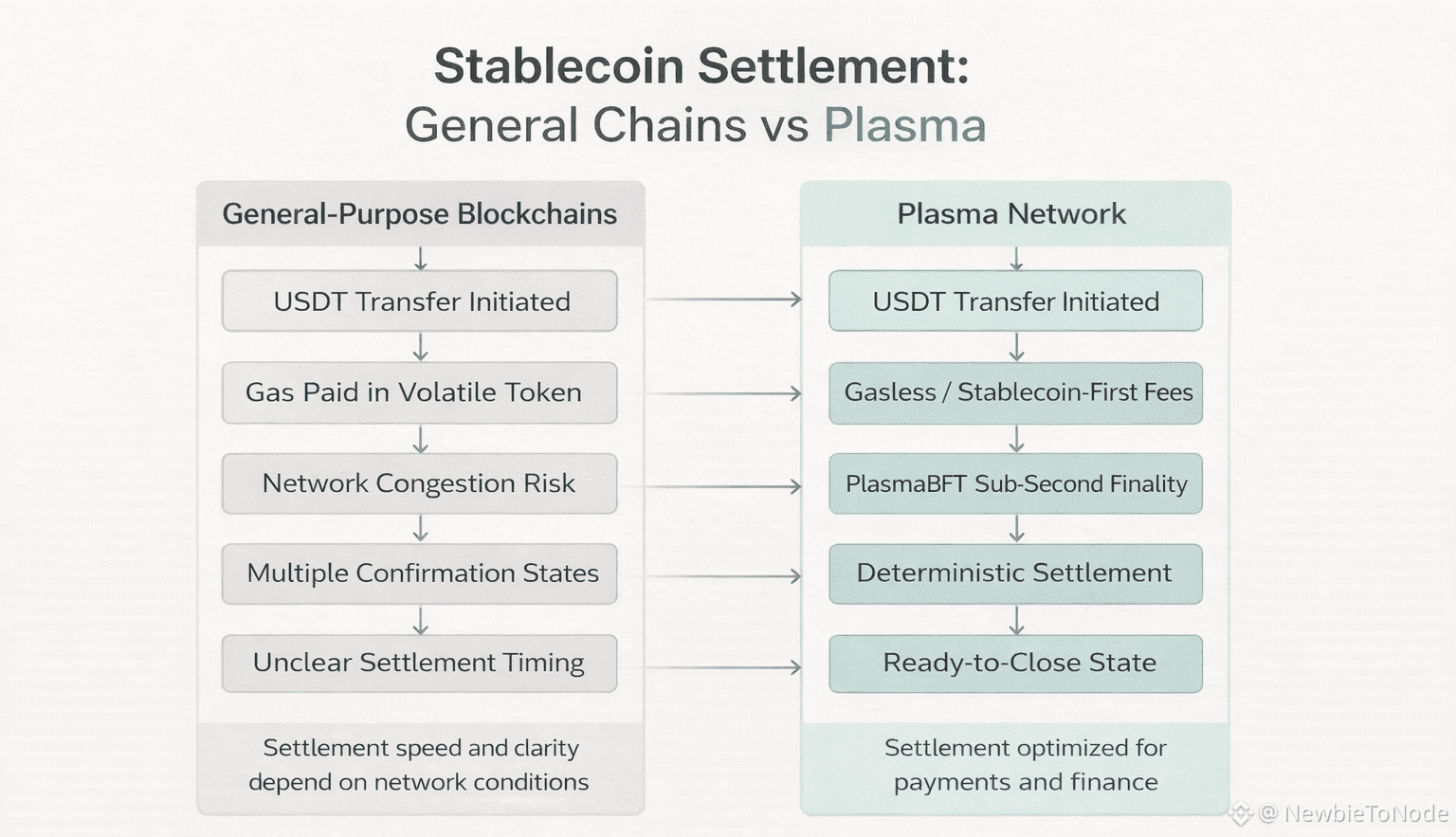
Most blockchains were built with general purpose computation in mind. Stablecoins were added later as assets running on top of that infrastructure. This works well for DeFi experimentation, but it creates friction in real payment and settlement scenarios.
For merchants, payment processors, and financial desks, the main concern is not throughput or block space. It is whether a transfer can be completed quickly, clearly, and reliably enough to move on to the next operational step. Delays, unclear confirmations, or complex fee mechanics introduce uncertainty, which directly impacts trust and efficiency.
Plasma addresses this by reducing friction at the protocol level. Gasless USDT transfers remove the need for users to manage a separate volatile asset just to move stable value. Stablecoin-first gas aligns network incentives with how the chain is actually used. These choices seem small, but they change user behavior by making stablecoin settlement feel closer to traditional financial workflows.
Finality as an Operational Requirement
Sub-second finality matters most when time is a constraint. In cross-border payments and institutional settlement, delays are not just inconvenient; they create operational risk. PlasmaBFT is designed to provide fast and deterministic finality so that transactions reach a clear, closeable state without extended uncertainty.
This is especially important for stablecoins, which are often used in time-sensitive contexts such as payroll, merchant payments, or treasury movements. In these cases, “almost final” is not good enough. Systems need to behave consistently under pressure, not just under ideal conditions.
Infrastructure with a Long-Term Focus
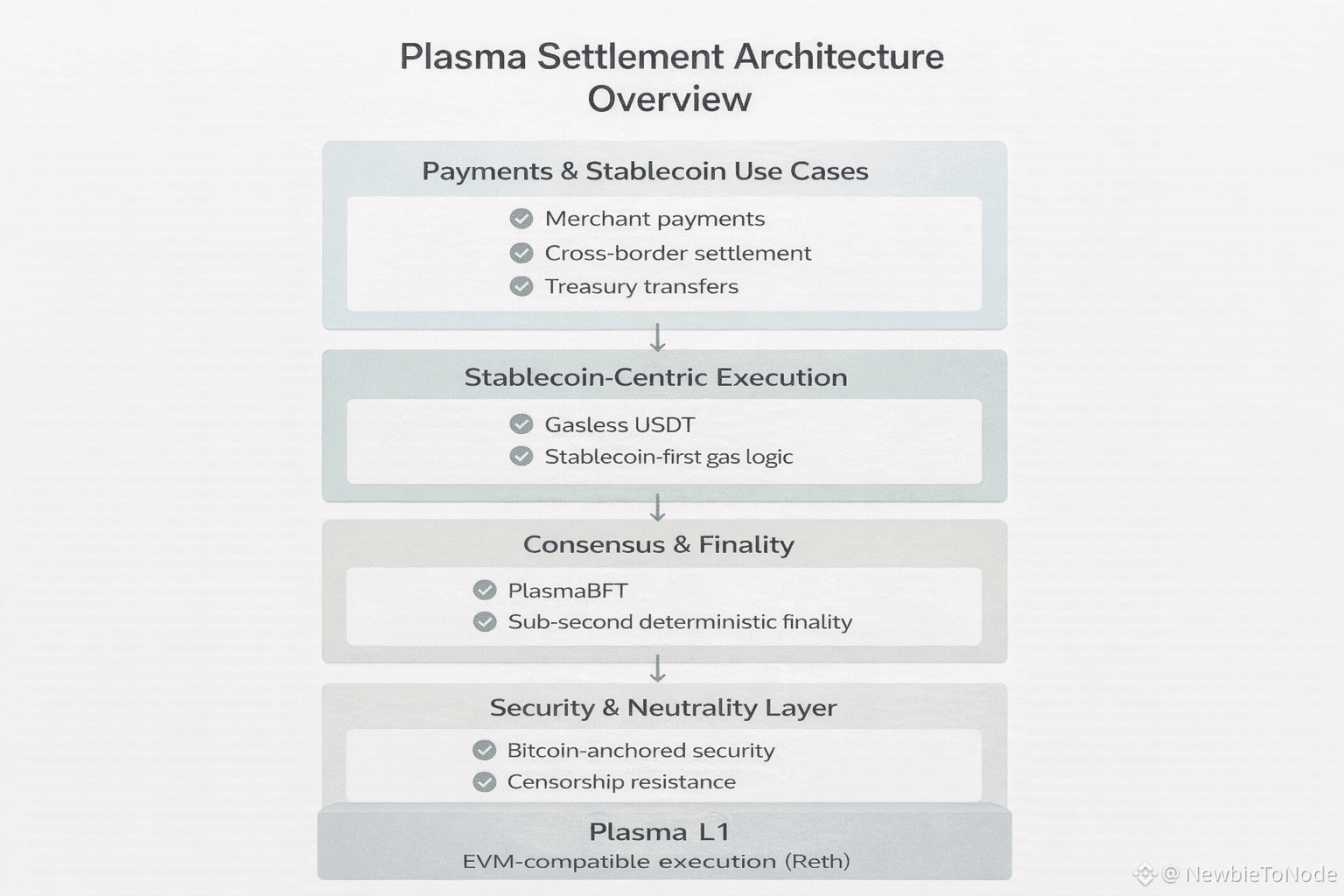
Plasma’s roadmap reflects an infrastructure-first mindset. Beyond its Layer-1 foundation, the project has outlined plans for payment functionality and an EVM-compatible Layer 2, Lightspeed, which would settle on the Plasma network.
This matters because regulated finance and large-scale payments do not exist in isolation. Interoperability with existing developer ecosystems increases the chances of real adoption while keeping settlement predictable and neutral.
Bitcoin-Anchored Security and Neutral Settlement
Plasma also introduces Bitcoin-anchored security to strengthen neutrality and censorship resistance. For payment and settlement infrastructure, neutrality is not a philosophical preference; it is a requirement. Users need confidence that transactions will not be selectively blocked or reordered based on geography, counterparties, or transaction size.
By anchoring security to Bitcoin, Plasma aims to increase trust at the base layer while still operating as an independent settlement network optimized for stablecoins. This combination is particularly relevant for institutions and high-adoption regions where stablecoins function as everyday financial tools rather than speculative assets.
A Different Direction for Layer-1 Design
Plasma represents a shift in how Layer-1 blockchains are designed. Instead of optimizing for maximum flexibility, it optimizes for a specific function: stablecoin settlement at scale. As stablecoins continue to expand into mainstream finance, this specialization may become increasingly valuable.
Whether Plasma becomes a dominant settlement layer will depend on execution and adoption, but its design reflects an important idea. In a market where stablecoins are becoming core financial infrastructure, blockchains built specifically around their needs may have an advantage over general purpose networks.


