I want you to think about all the photos, videos, and files we save online every single day. Usually, we trust a big company to keep them safe on one of their giant computers. But what happens if that computer breaks or someone turns it off? This is where Walrus comes in to change the game.
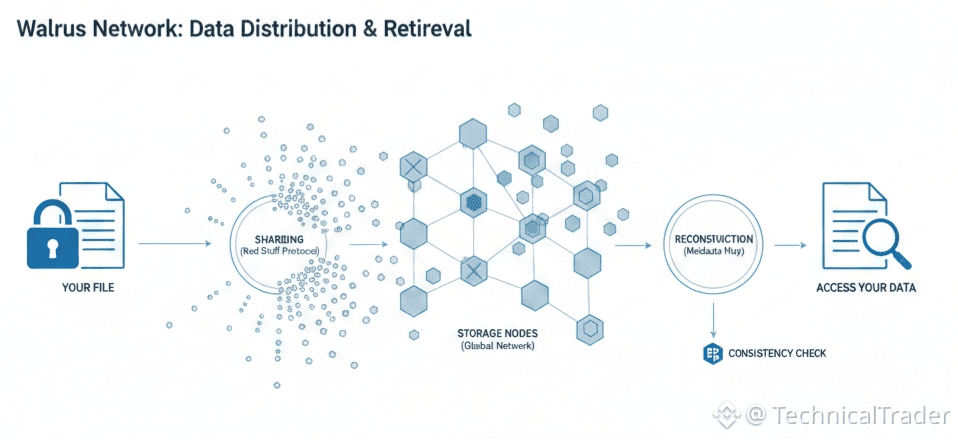
When we talk about Walrus, we are talking about a system that doesn't just put your file in one basket. Instead, it breaks your data into tiny pieces called slivers. Imagine taking a letter, cutting it into tiny scraps, and giving those scraps to a hundred different people across the world.
Even if a few of those people lose their scraps, we can still read the letter. This is the heart of how Walrus works. It uses a special "Red Stuff" protocol to make sure your information is always available, no matter what happens to individual computers in the network.
Let Us Look at How We Get Our Files Back
Now, you might ask, how do we actually get those pieces back when we want to see our file? I like to think of this as a very organized check-in process. When you want to read a blob of data, you first go out and collect the map, which we call metadata. This map tells us exactly what the pieces should look like.
Once we have that map, we start asking the nodes in the network to send us their slivers. We don't even need all of them! Because of the way Walrus encodes the data, we only need a specific number of honest responses to put the whole puzzle back together.
If the pieces we get match the map perfectly, the system gives you your file. If something is wrong, the system catches it immediately. It is a very secure way to make sure that what you download is exactly what you uploaded, with no mistakes or changes allowed.
The Amazing Way Walrus Can Actually Heal Itself
One of my favorite parts about this whole setup is that the Walrus network is basically self-healing. Sometimes, a storage node might be offline when a file is first uploaded, meaning it missed out on its piece of the data. In a normal system, that node would just stay empty and useless.
But in Walrus, that node can actually talk to its neighbors to catch up. It asks a few other nodes for tiny bits of information and uses them to rebuild its own missing sliver. It is like a student missing a class and getting small notes from five different friends to recreate the entire lesson perfectly.
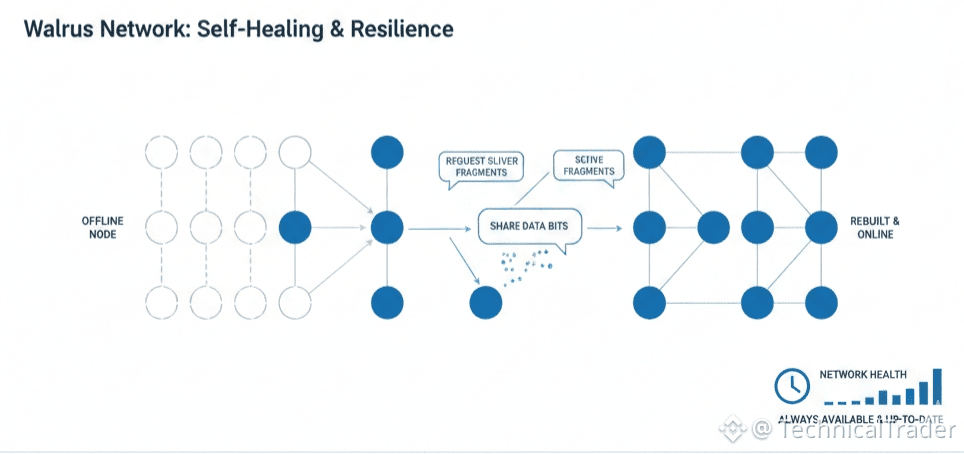
This means the network is always working in the background to stay healthy. We don't have to worry about the data fading away over time because the nodes are constantly helping each other stay up to date. It makes the whole system incredibly resilient and long lasting.
Keeping Things Fast and Affordable for Everyone
You might worry that moving all these pieces around would be slow or cost a lot of money. I have some good news for you on that front. The creators of Walrus and the Red Stuff protocol made sure it stays very efficient even as more people join the network.
The amount of work each computer has to do stays small because they only handle their specific little sliver. We have found that the cost to recover a file is almost the same as the cost to save it in the first place. This is a big deal because it means the system can grow really large without slowing down.
By keeping these costs low, we make sure that decentralized storage isn't just for experts or rich companies. We want everyone to have a way to store their data that is fast, cheap, and nearly impossible to destroy. It is all about making the technology work for us, rather than us working for the technology.
Why We Can Truly Trust the Consistency of Walrus
Trust is a big word when it comes to the internet. We need to know that if I send you a file through Walrus, you are seeing exactly what I sent. The Red Stuff protocol handles this through something called Read Consistency. This is a fancy way of saying the math never lies.
Before the system shows you a file, it re-encodes the pieces it found and checks them against a permanent record on the blockchain. If a writer tried to upload a "broken" file or if a node tried to trick us with fake data, the system would see the mismatch and stop right there.
This gives us a level of certainty that is hard to find elsewhere. Whether we are saving personal memories or important business records, we can rest easy knowing the Walrus network is using these smart protocols to keep everything honest and accurate for all of us.
what you think about this? don't forget to comment 💭
Follow for more content 🙂