

One of the clearest lines between speculative software and real financial infrastructure is how each one treats failure. Speculative systems tend to assume cooperation. Rational users. Stable incentives. Calm environments. Financial infrastructure cannot rely on any of that. It has to expect stress, misaligned incentives, regulatory pressure, and adversarial behavior as part of normal operation. Dusk is designed with those conditions in mind, and that perspective runs through every layer of the system.
On many blockchains, trust is still derived from visibility. The logic is straightforward. If everything is public, misconduct will be noticed and corrected. In practice, this breaks down quickly in financial contexts. Transparency produces noise as much as insight. It exposes sensitive positions and relationships. It accelerates reactive behavior during volatility. Most importantly, it does not stop failure. It simply records it. Dusk takes a different approach by focusing on correctness that can be enforced, not behavior that can merely be observed.
At the protocol level, this shows up as selective confidentiality paired with deterministic execution. Transactions and asset states are not broadcast to the world by default, but they remain provably correct under clearly defined conditions. This mirrors how mature financial systems actually work. Auditors and regulators do not watch every action in real time. They verify compliance when required. Dusk encodes this model directly into the protocol using cryptographic proofs rather than discretionary oversight.
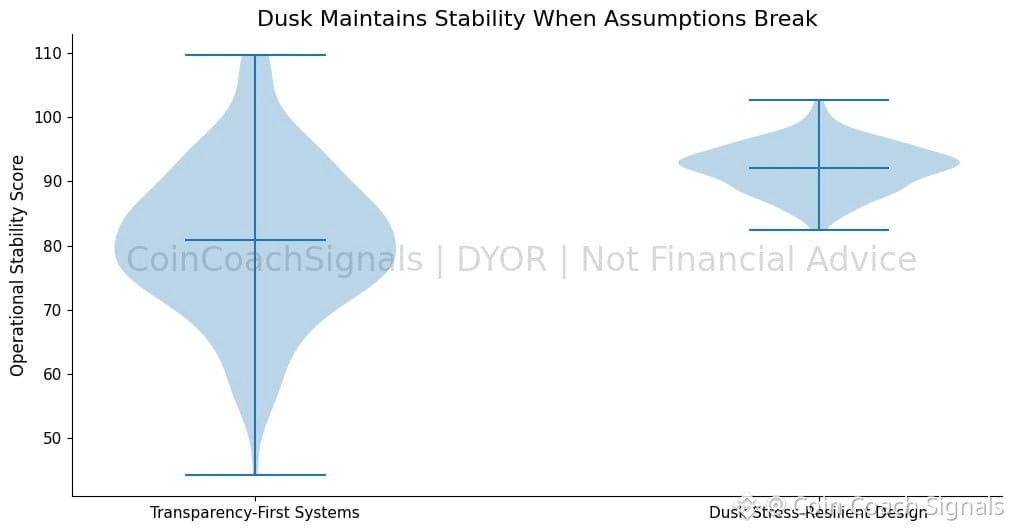
That separation between visibility and verification becomes especially important when markets are under stress. Public exposure during turbulence increases risk. Positions are mapped. Counterparties are inferred. Participants act defensively. Dusk limits this attack surface by keeping sensitive state private while enforcing rules automatically at execution time. Compliance checks are not suggestions. They are constraints. If conditions are not satisfied, actions simply do not occur. Prevention takes the place of post-event analysis.
This reflects a security model that assumes failure rather than perfection. Dusk does not depend on participants behaving optimally. It depends on code applying constraints consistently. Smart contracts operate on confidential state while remaining deterministic, so rules apply the same way regardless of who is interacting with the system or what the market looks like at the time. Trust is established through execution, not observation.
For developers, this creates a more deliberate design environment. Building on Dusk means making assumptions explicit. Who can interact. Under what conditions. What disclosures are required, and when. These parameters are encoded directly into contracts instead of being handled through offchain agreements or informal processes. Ambiguity is reduced at the protocol level, which matters because ambiguity is often where financial systems fail.
Tokenized assets make this especially clear. Real world assets onchain are not static objects. They move through market cycles, regulatory changes, and shifts in liquidity. Ownership may need to remain private. Transfer rules may change over time. Disclosure requirements can evolve. Dusk’s modular architecture generally allows these constraints to persist throughout an asset’s lifecycle without exposing sensitive information or weakening enforcement. Rules travel with the asset instead of being patched on later.
The ecosystem forming around Dusk reflects these priorities. Builders are not optimizing for short-term attention or rapid experimentation. They are working on issuance frameworks, regulated DeFi primitives, and settlement layers that assume scrutiny from the beginning. Audits are expected. Regulatory review is expected. Adversarial conditions are expected. As a result, systems are designed around clarity, correctness, and long-term reliability.
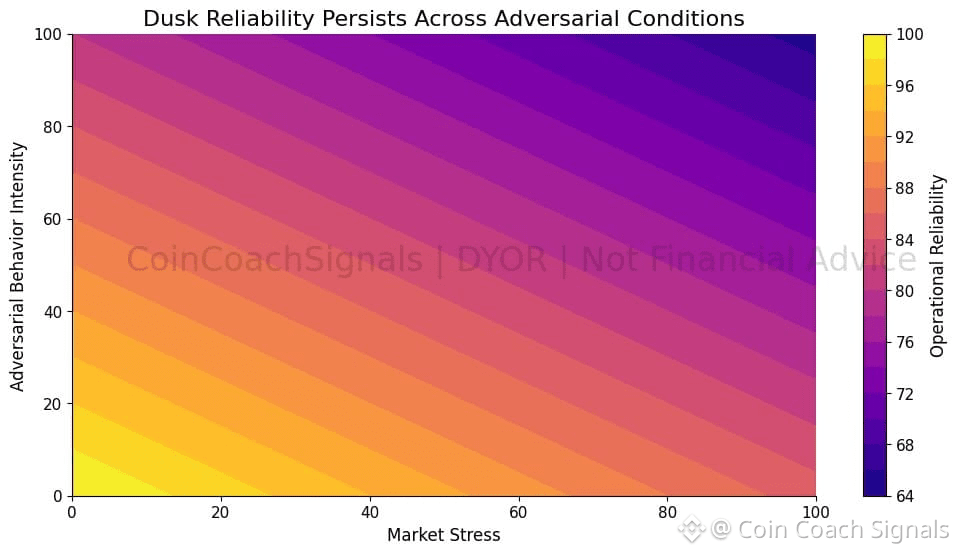
Dusk also takes a grounded view of decentralization under pressure. Decentralization is often described as the absence of rules. In reality, financial systems need rules to function. The real distinction is how those rules are enforced. Dusk replaces discretionary enforcement with protocol-level enforcement. Constraints are transparent, predictable, and applied automatically. That consistency strengthens decentralization instead of undermining it.
Censorship resistance looks different through this lens as well. It is not only about preventing the transactions from being blocked. It is about ensuring that rules cannot be selectively bypassed when stakes are high. By embedding constraints directly into execution, Dusk reduces the risk of arbitrary intervention. The system behaves the same way regardless of market conditions or participant identity. That predictability is essential for credibility.
Economic design supports this resilience. Short-term incentives often distort behavior in practice, during volatile periods, pushing participants toward risk rather than stability. Dusk is not built around the aggressive incentive schemes. Predictable economics matter more than the rapid growth. Builders and users can plan without the constantly adapting to shifting rules. That stability becomes especially valuable when confidence is fragile.
Usability plays a role here as well. Systems that require constant monitoring or complex operational decisions tend to break down under stress. Dusk pushes complexity into the protocol so participants do not have to manage it themselves. Clear rules enforced by code reduce cognitive load and operational risk, which is critical for real adoption.
As the broader crypto ecosystem matures, these qualities are becoming harder to ignore. Trustless systems are not judged by how open they appear in calm conditions, but by how reliably they function when conditions deteriorate. Censorship resistance is proven during contention, not equilibrium. Privacy and compliance are no longer opposing ideas. They are complementary requirements for infrastructure meant to handle real value.
What stands out most about Dusk is consistency. Its design repeatedly returns to the same assumptions. Stress will happen. Scrutiny is unavoidable. Failure is possible. Systems should be built to continue functioning anyway. That coherence is what allows infrastructure to remain credible long after attention fades.
Dusk is not trying to win short-term narratives. It is trying to build systems that remain dependable when attention disappears. Financial infrastructure that only works under ideal conditions is not infrastructure. It is a prototype. Dusk is building for permanence, where trust is not requested, but demonstrated through predictable, code-enforced behavior over time.
For educational purposes only. Not financial advice. Do your own research.
@Dusk #Dusk #dusk $DUSK
