

One of the longest-running misunderstandings in crypto is that privacy and accountability pull in opposite directions. Systems are often framed as having to choose. Either everything is visible and unsuitable for real finance, or everything is hidden and impossible to regulate. Dusk starts from a more grounded observation. In functioning financial systems, information is neither absent nor universal. It is shared with intent. Who sees what depends on context, role, and purpose. Dusk is trying to encode that reality directly into onchain infrastructure.
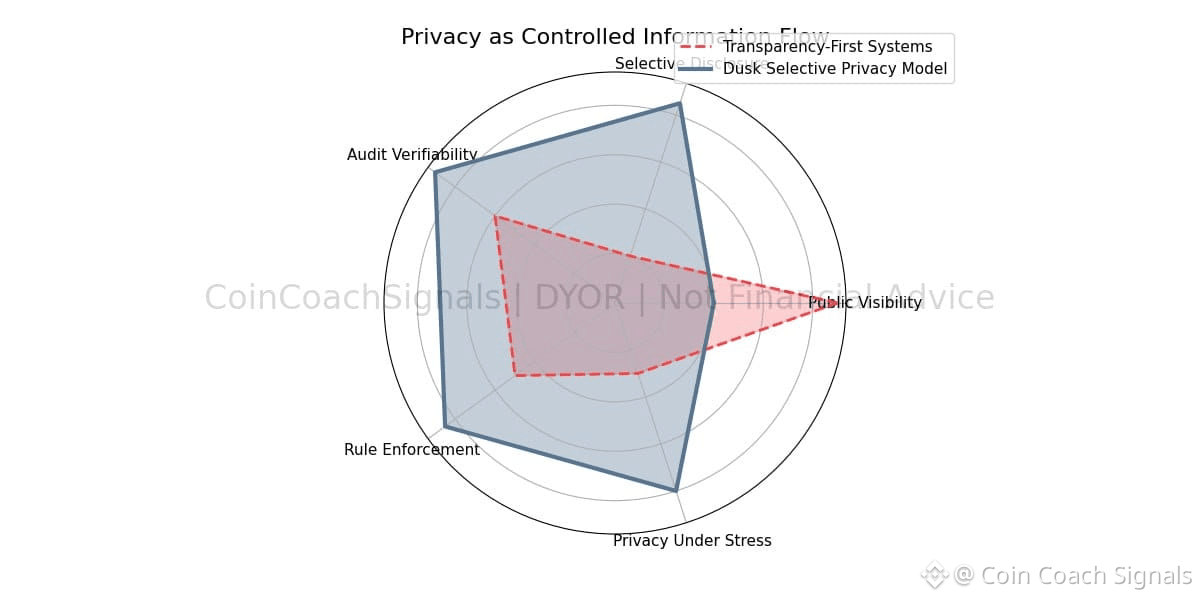
In real markets, participants do not operate with identical visibility. Traders do not see internal compliance processes. Counterparties do not have access to each other’s full exposure. Auditors do not publish raw data to the public. What matters is that rules are enforced and that verification is possible when it is required. Dusk reflects this structure by separating action, verification, and observation at the protocol level. These boundaries are not social conventions. They are enforced cryptographically.
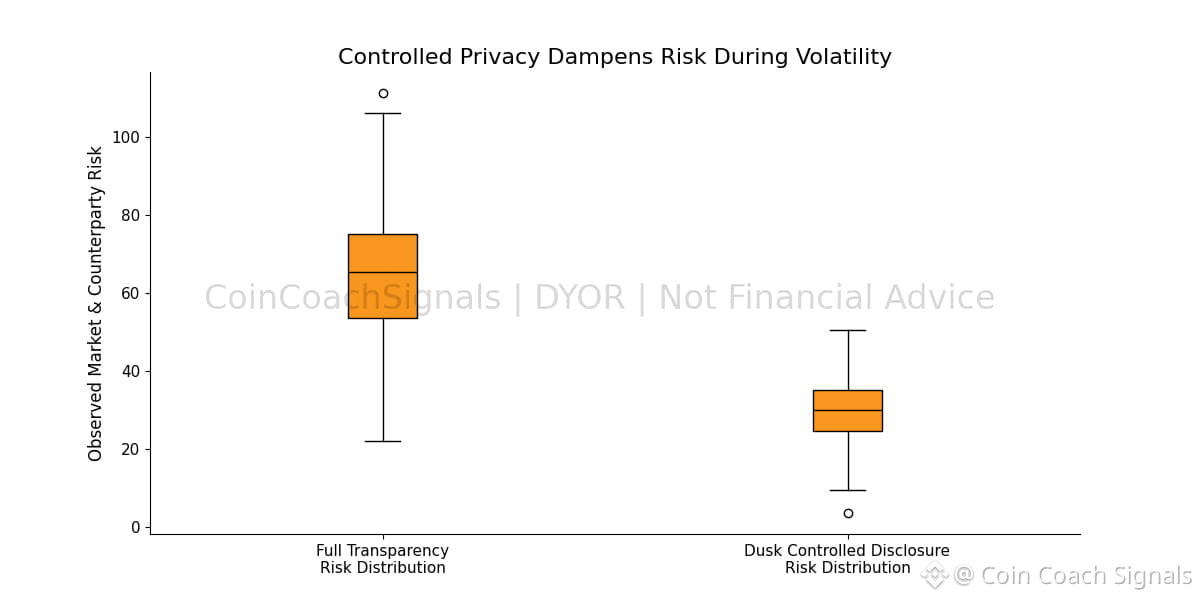
That distinction becomes increasingly important as onchain systems move beyond experimentation. When real assets and regulated activity enter the picture, full transparency stops being a virtue. Public exposure of ownership structures, transaction flows, and strategic positions creates risk rather than trust. It invites adversarial behavior and amplifies volatility. Dusk treats privacy as a stabilizing layer. By reducing unnecessary visibility, it lowers the incentive to exploit information while still preserving enforceability.
At the technical core of this approach is confidential execution with verifiable outcomes. Smart contracts on Dusk can process private state while still producing proofs that constraints were respected. Compliance conditions are enforced automatically, without revealing sensitive inputs. The system no longer depends on observers watching behavior. It depends on proofs confirming correctness. For financial infrastructure, this scales better and fails less often.
This design also shifts how trust is distributed. Instead of trusting intermediaries in practice, to manage disclosures responsibly, Dusk relies on explicit cryptographic guarantees. Permissions are defined. Verification paths are clear. Access is limited by code, not policy. This reduces discretionary control and aligns with a security model that assumes participants will act in their own interest, especially under pressure.
For developers, the implications are significant. Building on Dusk is not about maximizing openness or chaining everything together. It is about designing controlled interactions. Who can call a contract. Under what conditions. What information is revealed, and to whom. These decisions are encoded and enforced deterministically. There is little room for interpretation between intent and execution.
Tokenized assets make this especially concrete. Real world assets brought onchain are not passive objects. They come with obligations that persist. Ownership may need to stay confidential. Transfers may require eligibility checks. Disclosures may only occur under specific triggers. Dusk allows these requirements to live inside the asset itself. The asset carries its rules forward rather than relying on external enforcement.
This matters most when systems are under stress. During volatility or regulatory scrutiny, models built on discretionary controls tend to bend. Exceptions appear. Rules are reinterpreted. Confidence erodes. Dusk reduces this fragility by making enforcement automatic. When conditions change, execution does not. Predictable behavior under pressure becomes a form of resilience.
Decentralization in this context is not about removing structure. It is about removing arbitrariness. Dusk replaces discretionary enforcement with protocol-level enforcement. The logic of the rules is transparent, even if the underlying data is not. Participants may not see everything, but they can verify that the system behaves exactly as specified. That is a stronger guarantee than raw visibility.
Censorship resistance also benefits from this framing. It is not only about whether transactions can be blocked. It is about whether rules can be selectively bypassed. By embedding constraints directly into execution, Dusk reduces the surface for intervention. Transactions either satisfy the conditions or they do not. There is no subjective layer in between.
Economic design supports this stability. Systems driven by short-term incentives tend to behave erratically when incentive shift. Dusk emphasizes predictable economics that allow builders and users to plan over long horizons. For infrastructure meant to support real financial activity, predictability matters more than rapid expansion.
Usability follows naturally from this clarity. When rules are explicit and enforced by code, user experiences can be simpler. Participants do not have to rely on offchain assurances or interpret vague requirements. Complexity is handled by the protocol instead of being pushed onto users. That reduction in cognitive load is essential for adoption beyond technically sophisticated circles.
As the industry matures, the systems that endure will look less like ideological extremes and more like practical financial infrastructure. Not fully opaque. Not fully exposed. But structured, enforceable, and resilient. Dusk is building toward that middle ground with a level of discipline that is slower and harder, but also harder to displace.
What defines Dusk is not speed or spectacle. It is consistency. Privacy is selective. Enforcement is automatic. Verification is precise. The network stays focused on problems that grow more important as onchain finance intersects with real markets.
In a space still shaped by experimentation, Dusk is building for credibility. Infrastructure that continues to function when attention fades, incentives shift, and scrutiny increases. That path is rarely the fastest, but it is often the one that lasts.
For educational purposes only. Not financial advice. Do your own research.
@Dusk #Dusk #dusk $DUSK
