

One of the least discussed risks in blockchain systems is what happens after growth slows. Early phases are usually well supported. Nodes are active, incentives are strong, and data is widely replicated. Over time, participation normalizes. Attention moves elsewhere. Incentives change. This is when weak assumptions around data availability begin to surface. Walrus is designed around this long tail of system life rather than the launch phase.
As blockchain architectures modularize, the role of data becomes more exposed. Execution layers can be upgraded or replaced. Applications can evolve or disappear. Data, however, must remain accessible regardless of those changes. When historical data becomes unavailable, systems lose the ability to verify past state. Disputes become harder to resolve. Trust shifts from code to whoever still controls the remaining data. Walrus exists to prevent that shift.
Early blockchains solved availability by storing everything onchain. This guaranteed access, but at costs that did not scale. As usage expanded, data was pushed offchain to reduce overhead. In many designs, availability turned into an assumption rather than a guarantee. Data would exist somewhere, as long as it was convenient. Walrus challenges this approach by making availability explicit and enforceable.
The protocol allows large data blobs to be stored outside execution environments while anchoring their integrity cryptographically. This preserves verifiability without forcing base layers to absorb unsustainable storage costs. More importantly, it assigns responsibility. Data is not simply posted and forgotten. It is maintained through incentives aligned with continued availability over time.
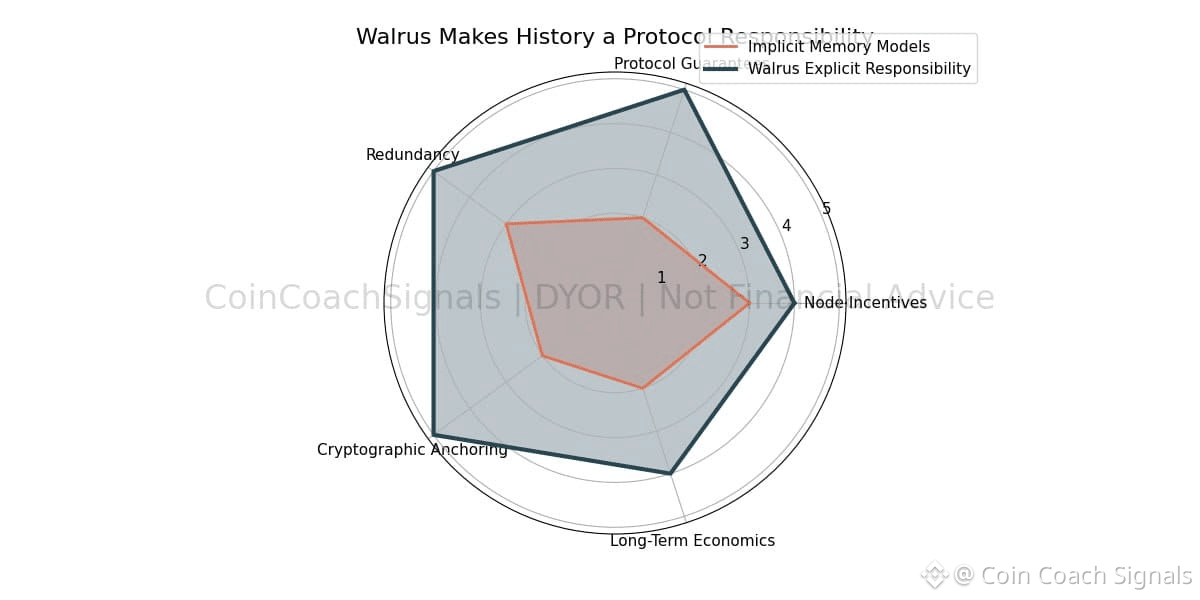
Time is the stress test that exposes fragile systems. Data availability is rarely challenged when networks are young and popular. It is challenged years later, when incentives weaken and participation thins out. Many systems fail quietly in this phase. They do not halt, but they lose reliability. Walrus is built for this delayed failure mode. Storage providers are incentivized to remain engaged long after initial activity has passed.
For rollups and Layer 2 systems, this reliability is not optional. Their security models depend on access to historical data for verification, dispute resolution, and state reconstruction. If that data is missing, execution correctness becomes unverifiable. Walrus provides a layer where these systems can assume continuity rather than building complex and fragile fallback mechanisms.
This approach reflects a security model that assumes failure rather than perfection. Participants will leave. Incentives will change. Attention will move on. Systems that rely on constant engagement eventually degrade. Walrus plans for entropy by making availability resilient to changing conditions instead of dependent on them.
Decentralization also takes on a deeper meaning here. A system with decentralized execution but fragile history is not fully decentralized. Control over the past concentrates in whoever still holds the data. Walrus strengthens decentralization by ensuring that long term access to data does not depend on a narrow set of actors or short lived incentives.
Economic predictability reinforces this resilience. Infrastructure meant to support long lived systems cannot rely on volatile or opaque pricing models. Builders need to reason about availability costs over extended periods. Walrus emphasizes clearer economic structures that support planning and stability rather than short term optimization.
Neutrality is another defining feature. Walrus does not compete with execution layers or applications. It does not influence how systems are designed or governed. It provides a service that many ecosystems can rely on simultaneously without ceding control. This neutrality reduces fragmentation and generally allows Walrus to integrate broadly across different stacks.
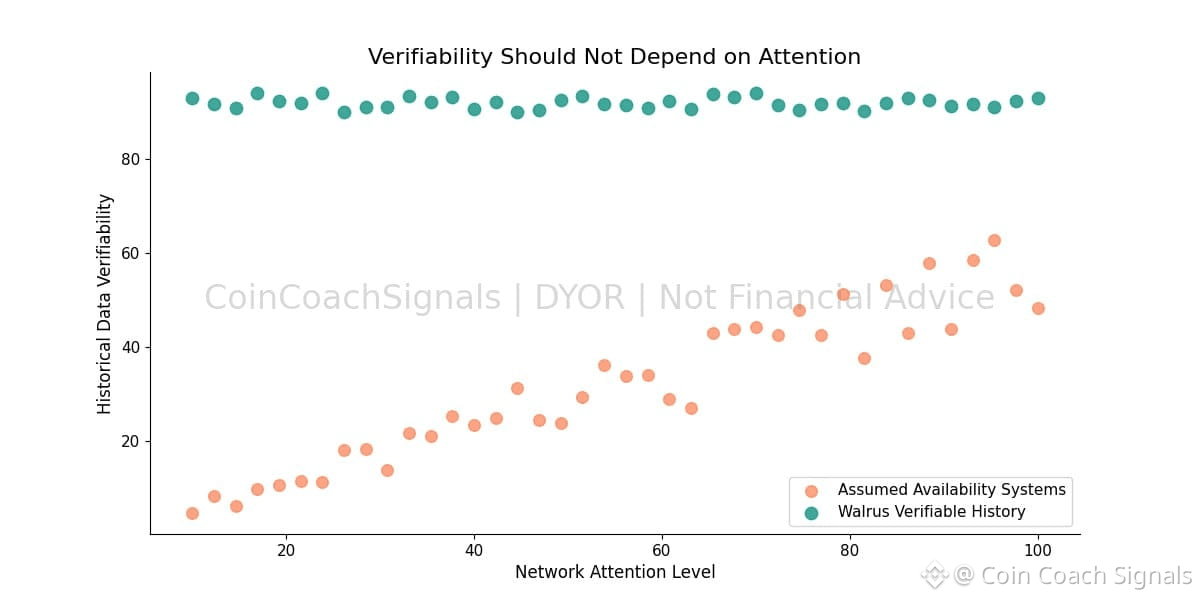
The ecosystem forming around Walrus reflects these priorities. Builders are not chasing visibility or rapid iteration. They are working on rollups, archival systems, and data intensive applications where failure cannot be undone easily. These teams value guarantees over features. For them, success is measured by absence. No missing history. No broken verification paths. No silent assumptions collapsing years later.
There is also a broader industry shift reinforcing Walrus’s relevance. As blockchain systems handle more real economic activity, tolerance for hidden fragility declines. Users may not articulate data availability as a concept, but they feel its absence immediately when systems fail to verify or reconstruct state. Mature infrastructure is defined by what continues to work when incentives weaken.
What ultimately defines Walrus is discipline. It does not expand beyond its core responsibility. It does not chase narratives or application trends. Each design decision reinforces the same objective. Preserve data. Make it verifiable. Make it sustainable over time. This clarity builds credibility slowly, but it builds it in a way that compounds.
In complex systems, reliability is often invisible. It appears as continuity. As history that remains intact. As assumptions that still hold years after deployment. Walrus is building for that invisible standard, ensuring that as blockchain systems scale and modularize, their memory remains trustworthy.
For educational purposes only. Not financial advice. Do your own research.
@Walrus 🦭/acc #Walrus #walrus $WAL

