
I first cared about this when I tried to map a “simple” private placement into something on-chain and realized the trade wasn’t the hard part the paperwork was. On a public ledger you either expose too much, or you hide so much that auditors can’t rely on it. That’s the quiet blocker for tokenized funds, private credit, even real estate: confidentiality and accountability usually fight each other.
It’s like running a bank vault with glass walls. Everyone can see the movement, which sounds fair, until you remember that regulated finance is made of client secrecy, limits, and permissions.
What Dusk is trying to do is make “proof” the unit of transparency, not raw data. The default state can be shielded: balances, transfers, and smart-contract state remain confidential, but actions can still be checked against public rules using zero-knowledge proofs. In plain terms: you can settle privately and still output a compact attestation that eligibility checks passed, limits were respected, and restricted addresses were avoided without broadcasting identities or positions.
Two implementation details matter more than the narrative. First, the chain supports dual transaction models (public and shielded flows), so a system can keep certain market signals open while protecting counterparty and position details. Second, the architecture separates settlement from execution: DuskDS handles consensus, data availability, and settlement, while DuskEVM offers an Ethereum-compatible execution layer so teams can use familiar tooling. Under the hood, Piecrust is described as a ZK-friendly VM, and its smart contracts compile to WebAssembly (WASM) bytecode a pragmatic choice if you care about portability and proof-friendly execution rather than legacy constraints.
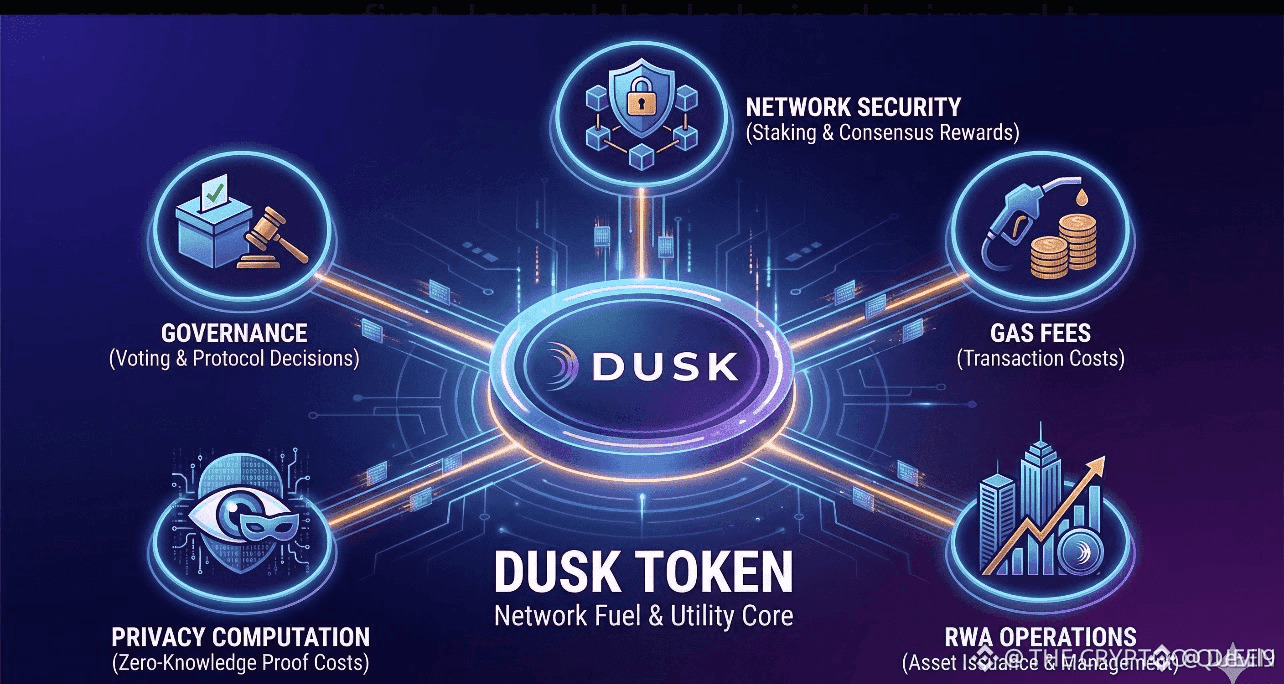
The DUSK token’s role is fairly neutral: it’s used for transaction fees (including gas on the EVM layer), it’s staked to secure the proof-of-stake consensus (Succinct Attestation), and it participates in governance over protocol parameters. No mystery there just economics attached to security and throughput.
Market context helps, but only a little. Tokenized RWA “distributed asset value” tracked on public rails sits around $21B, and one 2025 research estimate put tokenized real-world assets at roughly ~$33B. Those figures are small next to traditional markets, but big enough that “privacy vs audit” stops being theoretical and turns into procurement, legal review, and risk committees.
As a trader, I get why people obsess over short-term volatility. But infrastructure value shows up differently: in whether settlement finality is predictable, whether permissions are enforceable without manual exception handling, and whether audit trails exist without leaking the book. That’s not a candle chart story it’s an operational reliability story.
The risks are real. ZK systems are brittle if circuits or policy logic are wrong: a bad upgrade could accidentally freeze legitimate transfers for a regulated venue, or worse, accept an ineligible transfer while still producing a proof that looks valid against the wrong rule set. Even without a cryptographic failure, key management and selective disclosure can fail operationally; if an issuer can’t reliably reveal the right facts to an auditor on demand, “confidential” quickly becomes “unusable.”
Competition is also crowded other privacy-first chains, and a growing universe of permissioned systems that institutions already control. And the biggest uncertainty is social, not technical: I’m not sure when (or if) regulators will treat cryptographic proofs as sufficient oversight at scale across jurisdictions, without falling back to parallel paper trails.Still, the direction feels honest. If this works, it won’t be because privacy was bolted on, but because verification was redesigned. Adoption here won’t look loud. It’ll look like boring settlements that don’t leak, and audits that don’t need a back office full of exceptions.
