I used to think “scaling” was mostly about faster blocks and cheaper fees. Then I watched a perfectly normal settlement flow get stuck behind the cost of writing every tiny state update to the base chain. Nothing was “broken.” It was just… structurally expensive. And the more regulated or high-volume the use case, the more that friction shows up as delays, manual batching, and quiet centralization.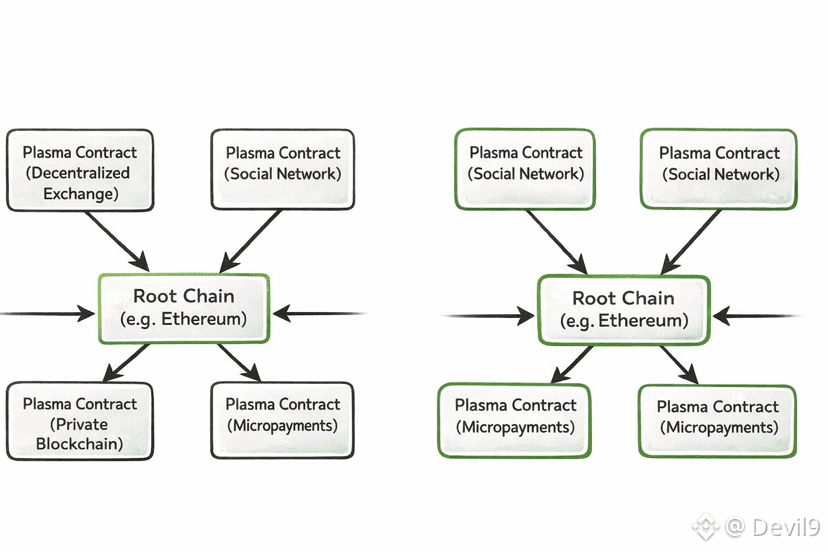
The simple problem is that a base chain is great at agreeing on final outcomes, but terrible at carrying all intermediate steps for everyone. Payments, exchange matching, fund share accounting these are repetitive updates. If you force every update onto the root chain, you’re paying the “global audit” cost even when nobody disputes anything.
It’s like insisting every cashier in a city must ring up each item over a speakerphone to city hall.The Plasma approach flips the workload. You run many “child” chains on top of a root chain, and the root doesn’t process every state transition. It just enforces correctness when someone proves fraud. That changes the default assumption from “verify everything always” to “commit small, challenge big.”Two implementation details from the original design are easy to miss, but they’re the whole trick.
First: state updates are compressed into tiny commitments one idea is a bitmap-UTXO structure where a spend can be represented as a single bit flip, so one signature can coalesce many participants’ ledger changes into one commitment.
Second: disputes need to be practical, so the design leans on a MapReduce-style framework to construct fraud proofs over nested chains—basically making “prove this step was invalid” scalable even when the chain is large and tree-structured.
A realistic failure-mode is also part of the story: data unavailability. If an operator withholds block data, users can’t verify exits. Plasma’s answer is the exit game prioritized withdrawals and challenge windows, so honest users can leave when the system stops being observable. It’s not pretty, but it’s survivable by design.
Where does XPL fit? In most modern implementations, you need a neutral coordination asset: staking/bonding for validators and operators, fees for network operations, and governance for parameters like exit periods and validator policy. That’s the boring role, and boring is usually correct for infrastructure.
Market context matters because the “why now” is mostly volume. Stablecoins alone sit at over $250B in supply by some industry tracking, and USDT is often cited around $187B in circulation. Even if you ignore narratives, those numbers imply relentless settlement demand and relentless cost pressure.Short-term trading will always be louder than plumbing. But this kind of design only pays off if it becomes routine: operators keep posting commitments, users rarely dispute, and exits remain a backstop rather than a daily event. The value is in persistent operation without constant root-chain babysitting.
Competition and uncertainty are real. Rollups have taken mindshare, and institutions often prefer simpler trust models. And honestly, I’m not sure how many mainstream users will tolerate exit games and challenge periods during stress, even if the math is sound.Still, I can’t unsee the core idea: move most computation off the root chain, keep the root as judge, and make failure containable. If that’s the direction, adoption won’t look dramatic. It’ll look like fewer stuck systems, fewer emergency migrations, and more weeks where nothing exciting happens because the infrastructure holds.